
Our Parenting Playbook Is Obsolete in the Age of AI
What raising Gen Z taught me – and with Generation AIR and Q on the horizon

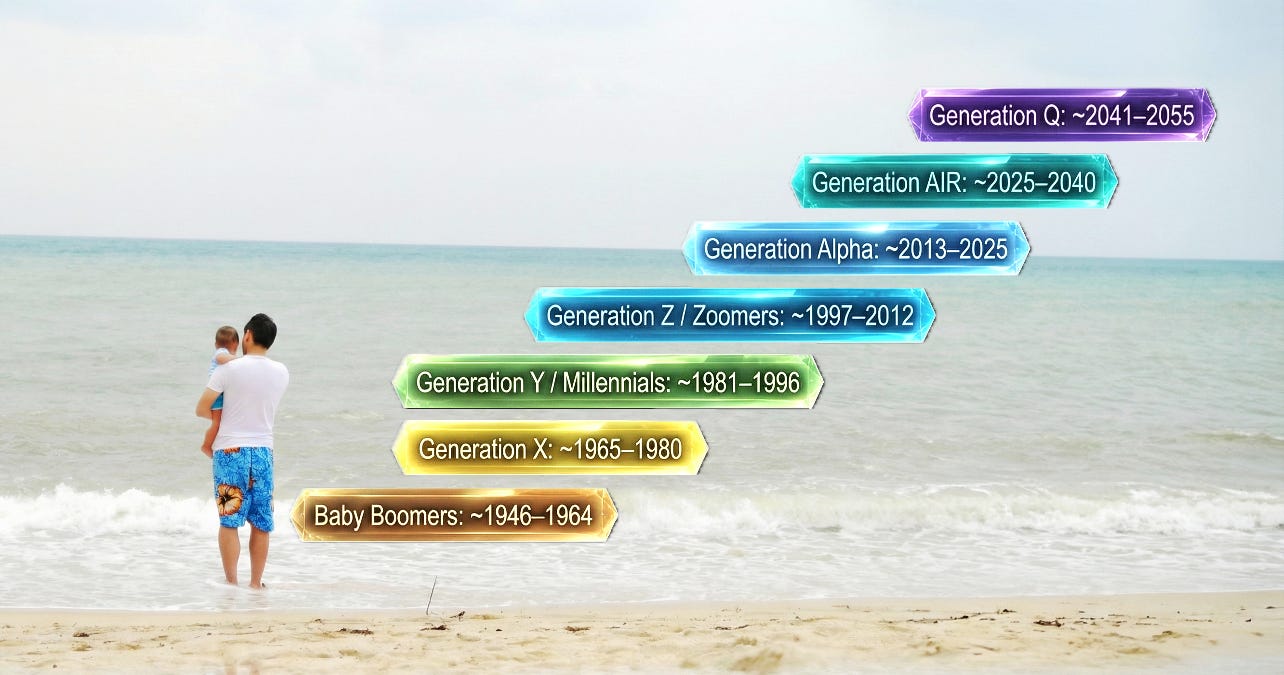
I’m a Gen X dad (born in the 70s) with two teenagers, which means I grew up rewinding cassette tapes and my two kids (born in the 00s) grew up rewinding YouTube videos.
In 2025, that gap hit me harder than ever as my son turned 18 at the end of last year. We spent late nights talking about university choices and future plans, and in May I watched him deliver his valedictorian speech at his high school. Observing him and his Gen Z peers (born in 00s and 10s) forced me to look beyond my own household. Their worldview has been shaped by technology disruptions (smartphones, social media, AI), natural disruptions (pandemics, climate change) and socio-economic disruptions (financial crises, political conflict, wars).
Understanding these generational differences is a survival skill for modern parenting. It changes how we communicate, how we interpret our children’s choices, and how we decide when to step in—or step back.

1. Ready to learn vs ready to teach
Like most parents, I started out believing “good parenting” meant opening as many doors as possible and pushing opportunities through them: extra classes, advice, internships, networks. It was all push.
After 19 years of experimentation (with ongoing debugging), I’ve realised how one‑sided that can be. If parenting were software, I am definitely still in early beta phase. Love may be unconditional; learning isn’t. For the first 16 years, I learned that there is no guaranteed download—no understanding—just because you are broadcasting wisdom on a strong signal.
Then, over the last few years, almost magically, something flipped.
In the middle of Grade 10, my son went from cruise control to full throttle. He began to initiate. He started asking questions, exploring options, thinking seriously about his future. He was no longer just being educated; he was educating himself. He was ready to learn.
By Grade 12, he had a better research stack than I did—search engines, AI copilots, and a willingness to DM/PM the right people on social media. My daughter, two years younger, started her own awakening earlier around Grade 9.
In How Will You Measure Your Life?, innovation theorist Clayton Christensen captures this with a simple but profound insight[1]1:
“Children learn when they’re ready to learn, not when we’re ready to teach. If we’re not with them as they encounter real challenges, we’re not there when they’re finally open to learning. Our job is to be present when life opens a learning window.”
Parenting stops being a broadcast model and becomes more like being on call: the job is to be around when life raises a ticket they care enough to open.
Even this is easier said than done, and at the same time you will also find yourself navigating through a minefield of classic traps along the way, most of which you would only notice in hindsight [1]:
· The helicopter trap: pouring in resources but starving them of experiences that build capability.
· The sequencing trap: “I’ll invest time when I’m less busy.” By the time we’re less busy, their values and priorities are already formed.
Timing and presence turn out to be the scarcest resources, not money or advice. They seem to be the core of effective parenting.
2. Prepare your child for the road, not the road for your child
“One generation plants the trees, and another enjoys the shade” or “前人栽树,后人乘凉” is a beautiful Chinese proverb. It sounds comforting. But in 2025, it can also be dangerous.
Gen X did plant trees. We built careers and companies in a relatively stable globalisation era. But we planted those trees for our climate. The climate has changed—economically, technologically, geopolitically.
If our children simply sit in the shade of what we built, they may be shielded from discomfort, but also from the practice they need to face their own storms. Our job is not to pave the road; it’s to prepare the driver. We don’t get to design the world they inherit; we only get to influence the operating system they bring into that world with.
We cannot teach them our solutions because their problems are structurally different. Christensen reminds us again that our job is not to script their paths but to be the safety net when the world teaches them hard lessons [1].
This also explains another familiar saying: “Wealth does not pass three generations / 富不过三代.” It often doesn’t if the second and third generations only inherit shade from the first, without learning how to plant, prune and replant in different soil. The problem is that shade feels comfortable—right up until the weather changes.
“Prepare your child for the road, not the road for your child. If they only inherit our shade, they won’t learn how to plant in a new climate.”
3. Worldview differences between the operating systems of Gen X and Gen Z
Psychologist Jean Twenge offers a simple way to think about the gap between generations. She argues that technology is the primary driver of generational change: older cohorts lived a “fast life” strategy (grow up fast, marry early, work early), while Gen Z runs a “slow life” strategy in a more complex, high‑stakes world. Seen that way, when Gen Z “quiet quits” or treats work–life balance as non‑negotiable, they’re not slacking; it’s a rational response to a harder game [2]2. Caitlin Fisher calls this “gaslighting”: tell a generation “work hard and anything is possible,” then blame them as entitled when the system breaks under them [3]3.
Generational researchers like Bobby Duffy adds another layer: our “formative years” (roughly age 0–15) are when the outside world quietly writes itself into our mental code. What happens in the society in those years—booms or busts, stability or crisis—shapes the operating system we carry into adulthood [4]4.
For parents, this means our kids’ reactions to work, risk and technology are often about the world they grew up in, not just their individual character. To see how this plays out in my son and me, it helps to look at our formative years and at two speeches we gave in the summer of 2025. I was addressing over 600 graduands at the 214th congregation of the Faculty of Medicine of the University of Hong Kong (available here). My son was delivering his valedictorian address to his cohort Class of 2025 at his high school [5]5 [6]6.

My formative years (70s and 80s): improvable systems
I grew up in analog Hong Kong. Systems did not feel perfect, but they felt improvable. ICAC [7]7 cleaned up corruption. Public housing expanded. Education opened up. Factory kids became office workers. Deng Xiaoping’s “Open Door” economic reforms and globalisation lifted growth. Hong Kong transformed into an international financial centre, and the Sino–British Joint Declaration set the stage for the handover. The message to my generation was simple: work hard, keep your nose clean, and things will generally improve. Systems were not perfect, but they were improvable.
My son’s formative years (10s and 20s): perpetual crises
My son arrived just as the global financial crisis was triggered by the collapse of Lehman Brothers, hardly the soundtrack you would choose for a memorable childhood. It was followed by equally turbulent noise: climate anxiety, deglobalisation, the Umbrella Movement, the 2019 social unrest, COVID, smartphone and AI disruptions. Don’t get me wrong, there were positive events in that period. But by and large, he came of age watching Millennials (generation before him) play by the rules—study hard, get the degree, grind in the job market—and still lose on things like jobs, housing and debt.
Four specific contrasts between the two speeches stand out. It was like watching two different versions of the same operating system.
What is growth to you?
Father: I talked about Felix—my inner alter ego, the voice that challenges and pushes me. I spoke about “manifestly important and nearly impossible” problems and failing forward. My underlying message: the answers are inside you if you’re prepared to wrestle with them.
Son: He described high school as training an AI bot. He compared growth to machine learning: feed in data, make mistakes, adjust the model.
The metaphors are telling. For me, growth is reflecting with an inner self. For my kids, growth is fine‑tuning a model with the outside world.
Definition of resilience
Father: Resilience means endurance and pivot. “Fail fast, fail big, fail forward.” It is about surviving large losses and rebuilding—classic antifragility.
Son: Resilience means adaptation. “Less about powering through and more about learning how to adapt.” It is about learning to bend with disruption (COVID, AI) instead of snapping.
View of AI
Father: AI is a tool. I challenged graduates to use AI for the obvious tasks and reserve their humanity for what AI cannot do: compassion, ethics, complex judgement.
Son: AI is a companion and a model. He joked about ChatGPT as his “new buddy” and used AI itself as the metaphor for human learning. For him, AI is not just a tool in the environment; it is part of the environment. He is near-AI-native.
Mindset
Father: The answers are inside you, if you have the grit to dig them out.
Son: The answers emerge from interaction—between self, peers, systems and algorithms.
These contrasts are not just differences in speechwriting; they are signs of a deeper rewiring in how each generation understands risk, time and growth. If technology could shift my son’s mental “operating system” this far from mine, it raises an obvious question: what happens to the children who grow up not just with phones in their pockets, but with AI woven into every corner of their childhood? What does the next great rewiring look like?
4. The next great rewiring, this time by AI & Robotics – Hello Generation AIR and Q
Social psychologist Jonathan Haidt calls 2010–2015 the “Great Rewiring” of childhood: the shift from play‑based to phone‑based childhood. Unstructured outdoor play was replaced by structured activities and always‑on screens, contributing to anxiety, sleep loss and social fragility in Gen Z [8]8.
But next great rewiring, even more powerful than phones and social media, is already underway: AI and robotics. Generation Alpha (born roughly from 2013 to the mid-2020s), the children coming after my kids, are already feeling its effects, but the cohort after them, Generation Beta (born from the mid-2020s onwards) will be thoroughly shaped by AI and robotics. If we were to choose a more directly descriptive name for Generation Beta, it could be called Generation AIR (Gen AIR): AI & Robotics natives, for roughly those born from 2020 to 2045. After Gen AIR lies Generation Q (Gen Q), who may grow up with quantum computing and bio‑digital hybrids as normal. At that point, our nostalgic arguments about radio vs television will sound very quaint.
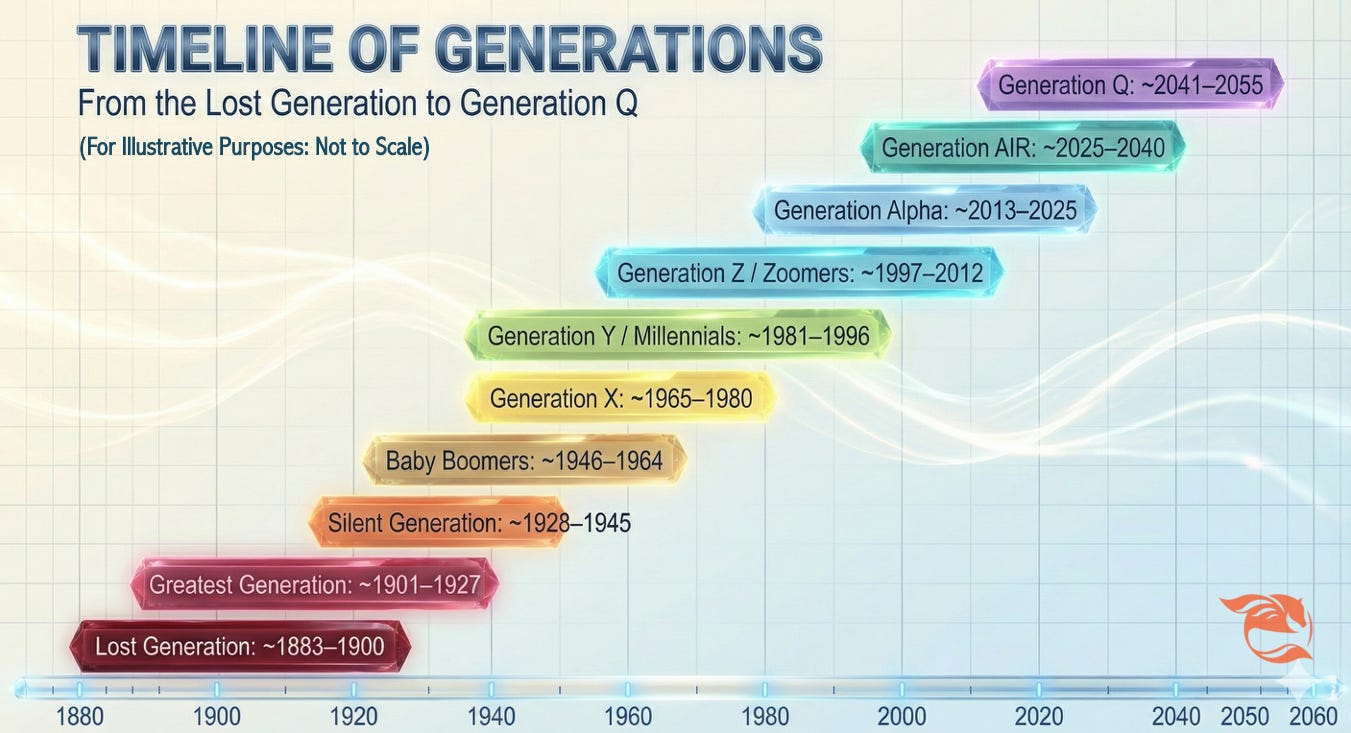
If Gen Z grew up with phones in their pockets, Gen AIR will grow up with AI in their bedrooms, classrooms, toys and all devices. Recent report in The Economist describes AI tutors that adapt perfectly to a child’s level, toys that talk back and remember their preferences, and AI companions that are always available, never sulk, never argue and always validate their feelings. That “perfect companion” creates new kinds of risk: echo chambers, “yes-bots” and cognitive offloading [9]9.
Echo chambers for children: the football‑obsessed child gets only football stories, examples and games. Imagine a childhood where the algorithm decides you’re “the football kid” at age six and never lets you forget it. Serendipity vanishes; so does tolerance for the unfamiliar. This is similar to the social‑media algorithm that feeds you content solely based on your preferences and exacerbates echo chambers and confirmation bias.
“Yes‑bots” as friends: a third of American teenagers (and likely the same in other developed countries) already say talking to an AI companion feels at least as satisfying as talking to a friend, and easier than talking to parents. For a teenager, a friend who never disagrees can be very tempting—and very misleading training for real relationships. My teenage self would have loved a chatbot that did my homework. My adult self is less sure.
Cognitive offloading / Cognitive delegation: students using AI tools show less brain activity and recall less of their own work, suggesting they are outsourcing not just tasks but thinking itself. A recent MIT study measured brain activity with EEG while three groups of people performed tasks using only their brains, a search engine, or an AI/LLM respectively. The results showed clear differences in neural engagement [10]10:
· Users relying solely on their brains had the richest, most distributed neural activity.
· Search engine users had reduced neural activity.
· LLM users had the lowest. Many users could not recall what they had written in their essays.
Simply put, when we lean on AI too heavily, our brains idle. Over time, this erodes learning capacity — a path straight to what I call “artificial ignorance.” For the trained professionals, “artificial ignorance” also means deskilling of their mastery.
If Gen Z is “anxious”, according to Haidt, Generation AIR risks being completely hollowed-out, raised with “perfect partners” who never demand compromise, patience or negotiation, yet quietly encourage subconscious cognitive offloading.
5. A bridging toolkit: Jobs to Be Done
Standing here as a Gen X parent with Gen Z kids, watching Gen AIR on the horizon, I find myself reaching back to Clayton Christensen for help. His “Jobs to Be Done” framework suggests we stop asking “Why is my kid using this?” and start asking “What job are they hiring this for?”[1]
When my child is glued to a screen, that device is doing a job:
· Functional: entertain me, teach me, help me finish homework faster.
· Social: keep me in the group chat, let me belong.
· Emotional: make me feel competent, comfort me, numb my anxiety.
In my childhood, the job “help me feel competent and independent” was served by roaming the neighbourhood, taking buses alone, finding part‑time work. In my son’s childhood, the same job might be served by mastering a game, building an online project or creating content.
The human need or the job is the same; the hired solution looks different. Instead of fighting the tool (screen, phone, social media, AI, etc.), we can ask what job it’s doing, check if it’s doing that job well, and offer alternative ways to meet the same need in the physical world.
“Don’t fight the tool. Ask what job your child is hiring it to do—and whether it’s actually doing that job well.”
Gen X and Gen Z are in a unique position because they are the bridge. Gen X remembers life before digital, mobile phone and the internet; Gen Z remembers life before AI, Robots and Drones. Together, they bridge analog, digital and now AI‑native childhoods.
My kids’ generation (Gen Z) will parent, teach and manage Gen AIR and Q. They have to figure out how to raise humans in a world where AI and quantum computing can do almost everything better, faster and cheaper—hopefully except be human.
6. An experimental prescription for the Human OS
When I read Jonathan Haidt’s three simple guidelines in Anxious Generation, I recognize some of my own mistakes. I’ve pinned these guidelines to my own mental dashboard [8]:
Treat the phone as an experience blocker, not just a distraction. It can block critical “sensitive periods” for learning social skills. Our job isn’t just to confiscate or shame the child; it’s to reopen those periods: family dinners, walks, shared projects, awkward but real conversations.
Scaffold real‑world risk. Encourage the kinds of risk we grew up with—travel, hard projects, unfamiliar groups—so they can rebuild some of the antifragility that unsupervised play once provided.
Fight the algorithm, not the kid. Our children are up against billion‑dollar recommendation engines. They don’t need another enemy; they need an ally who understands the game.
Which brings me back to our two speeches.
In my HKU talk, I ended with a health‑life prescription such as: “May you detect the first cancer cell of ego and heal them daily with kindness and humility.[5]”
In my son’s valedictorian speech, he told his classmates that in the long run, their lives would be measured not by grades but by “the relationships we’ve built, the kindness we’ve shown, and the lives we’ve touched.[6]”
Different worldviews but the same GPS coordinate: kindness. Perhaps this is our Human Operating System (Human OS).
Everything else is upgradable or replaceable: devices, platforms, languages, job skills. The Human OS—kindness, resilience, curiosity, courage, deep relationships—is the only software that has remained backward‑compatible through every generation.
“Our parenting playbook is obsolete. Our Human OS (kindness, resilience, real connection) isn’t.”
We don’t get to captain our children’s ships anymore; they have better navigation tech than we do. But we can be lighthouses—steady, visible, honest about the rocks and the storms.
That, at least, is the faith this Gen X dad is choosing to have. A century ago, people feared that the diffusion of colour TV would make society shallow and destroy the Human OS. The same fears appeared with computers, the internet, social media and smartphones. AI and, later, quantum technologies will stress it in new ways, but if history is any guide, the core code of the Human OS will adapt and survive. And if my kids are reading this: yes, I still reserve the right to complain about your screen time, lovingly so.
Wish you an awesome 2026!
Notes: I have used Perplexity to perform final edits and Gemini 3/Nano Bananas for the last illustration.
Footnote references:
C. M. Christensen, J. Allworth, and K. Dillon, How Will You Measure Your Life? New York, NY, USA: HarperCollins, 2012, ch. 8, “The Schools of Experience.”
J. M. Twenge, Generations: The Real Differences Between Gen Z, Millennials, Gen X, Boomers, and Silents—and What They Mean for America’s Future. New York, NY, USA: Atria Books, 2023, ch. 1.
C. Fisher, The Gaslighting of the Millennial Generation. New York, NY, USA: Skyhorse Publishing, 2019.
B. Duffy, The Generation Myth: Why When You’re Born Matters Less Than You Think. London, U.K.: Atlantic Books, 2021.
“The World Awaits The Difference Only You Can Make”, Speech by the Guest of Honor, 214th Congregation of the Faculty of Medicine of the University of Hong Kong, July 12, 2025. [Online]. Available: https://medium.com/@jason-chiu/the-world-awaits-the-difference-only-you-can-make-3e02ad9b6e9b .
The Valedictorian Address, the Class of 2025, the Canadian International School of Hong Kong, May 30, 2025. Available upon request.
ICAC - Independent Commission Against Corruption (ICAC), a statutory agency that investigates, prevents, and educates against corruption in Hong Kong.
J. Haidt, The Anxious Generation: How the Great Rewiring of Childhood Is Causing an Epidemic of Mental Illness. New York, NY, USA: Penguin Press, 2024.
“How AI reshapes childhood,” The Economist, pp. 71-73, Dec. 6-12, 2025.
Wu T, et al. The cognitive impact of LLM use: EEG evidence. MIT Cognitive Science Research Paper. 2024.
What an inspiring article! It definitely touches on a lot of common challenges and questions that we parents are all facing these days.