
The Non-obvious Moat
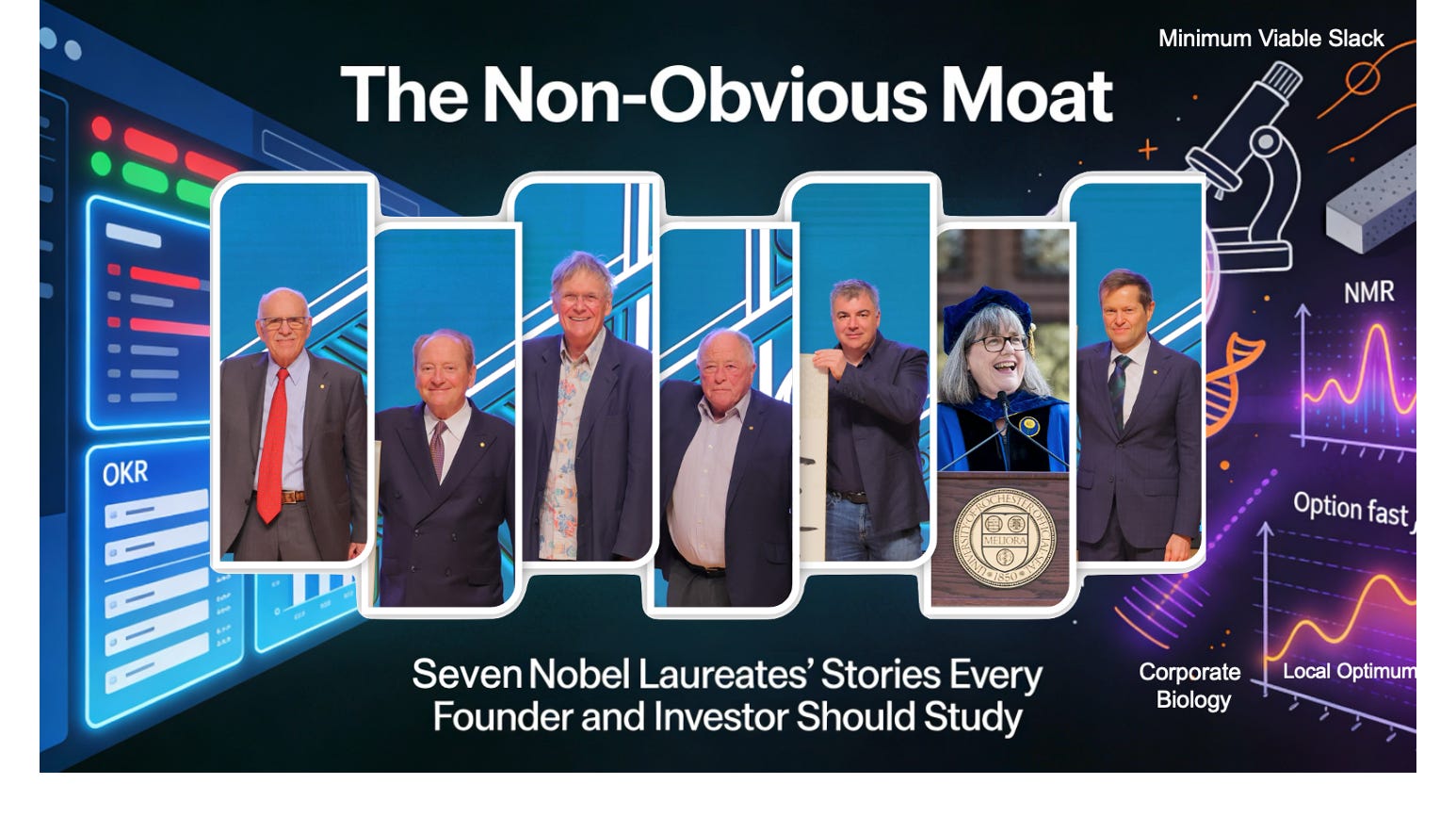
Seven Nobel Laureates Every Founder and Investor Should Study

TL;DR:
Nobel laureates systematically protect “wasted” work—and it becomes their moat
Corporate biology requires slack as safety: portfolio of slack habits, misfit talent
Startup biology can leverage minimum viable slack (MVS) to avoid locking in a hill: 5% time, piggybacked bets, cheap options, architecture for optionality
Founders can design slack systems and deliberately cultivate misfit talent.
1. When “moving the needle” is not enough
By startup standards, I should have rejected what I heard at the Nobel Heroes Forum. Much of what the laureates shared sounded counter‑intuitive, and even dangerous, for entrepreneurs.
I’ve spent decades as a founder and angel investor learning to run one operating system: kill what doesn’t move the needle, fail fast, and give every day an OKR (Objectives and Key Results)[1]1. Elon Musk is the caricature of this mindset of high cadence, public deadlines, visible intolerance for drift. And founders like Jeff Bezos and Jack Ma have built empires on ruthless execution toward a clear vision. That approach works until it quietly blinds you to a different kind of power.
On January 12, 2026, I sat in the Grand Hall of the University of Hong Kong as six Nobel laureates walked on stage with University of Hong Kong (HKU) President Xiang Zhang and Provost Richard Wong for The Nobel Heroes Forum[2]2. They weren’t there to raise a round or launch a product. They came to talk about decades of work that, for long stretches, looked like a waste of time—wrong paths, “useless” experiments, and methods nobody believed in.

One physicist, Konstantin Novoselov, told a packed room of over 600 students, academics, and founders that if your daily experience of science feels like nothing but struggle and failure, you are probably in the wrong profession; you must enjoy the process, not just the result. Another, Ferenc Krausz, described spending ten years chasing a seemingly crazy idea—watching electrons on attosecond timescales—with no inkling that the same tools would later open a path to ultra‑early cancer detection in human blood. A third, Kurt Wüthrich, calmly recounted how he realized in mid‑career that his field had spent years “completely on the wrong way” and decided to rebuild the entire programme from scratch.
Listening to them, I realized their lives were a controlled experiment in a claim most founders pay lip service to but rarely design around: the biggest long‑term returns often come from work that looks wasted on short time horizons—failed experiments, “useless” projects, non‑obvious applications, and arguably misfit people. Science has institutionalized this truth. Most startups haven’t.
I used to think this kind of “controlled experiment” with unknown outcomes was a luxury that neither startups nor even large corporates could afford. Now I have to admit it demands a complete rethink. As deep tech in AI, robotics, quantum computing, biotech, and space pulls startups closer to the scientific world, it feels like the right moment to examine the common ground between decacorn founders and Nobel‑level scientists. Their journeys rhyme more than we admit.
This essay is my attempt, as a founder and angel investor, to reverse‑engineer how stories from six Nobel laureates from the Nobel Heroes Forum and Donna Strickland operationalize “wasted” work, and how you might adapt their playbook meaningfully. These seven Nobel laureates whose careers, panel sharing and conversations with me shaped the ideas in this article. Think of it as a field guide to building failure and slack into your company so that what looks useless today becomes your moat tomorrow.
By a non‑obvious moat, I mean a competitive advantage built from work that looked “useless” or non‑core at the time (failed experiments, side projects, odd hires) that later becomes the hardest thing for competitors to copy.

2. Failure as route‑finding, not verdict
2.1 Ferenc Krausz – the physics of pivoting
When Ferenc Krausz[3]3 took the mic, he didn’t start with lasers. He started with questions.
Before you move any apparatus, he said, you have to decide what the right big question is. That question becomes your North Star for a very long journey. I was struck by how close this is to founding a startup: the best founders begin with a hard question or painpoint about the world. What problem are we really trying to solve here? And let that question, not the current tech stack, set the direction. It’s about falling in love with the question and the quest, not with any particular solution.
Along the journey, you’ll bump into all kinds of detours and side quests of anomalies, side effects, unexplained glitches. But every time you hit a fork you ask one thing: does solving this get us closer to the question? If not, walk away, however tempting it looks.
Krausz treats each failed attempt as a data point in a route‑finding algorithm. It tells you something about the landscape. As he put it, “A failure should never be understood as a failure in the conventional sense; it always offers a chance for rethinking and maybe taking a route which eventually will get us to our goal.”

In a Krausz‑style lab, the real failure is not a negative result; it’s failing to update the route. The sin isn’t that an experiment flops, it’s staying on a path that’s no longer promising just because it still produces papers, metrics, or comfort. In startup language: the true failure is the product‑market “almost fit” that keeps you stuck for years, fueled by founders’ confirmation bias and delusional thinking.
If you’ve ever kept a product alive because it was doing “okay” while quietly suffocating your ability to search for something better, you’ve already experienced the dark side of incremental success.
2.2 Kurt Wüthrich – when the whole field is wrong
Kurt Wüthrich[4]4 has the kind of story you usually only hear in retirement speeches.
In 1968, at Bell Labs, he took blood from his own arm to study his hemoglobin using NMR (Nuclear Magnetic Resonance, later known as MRI, Magnetic Resonance Imaging). The early results were exciting; he quickly became “quite famous” in structural biology.
Then, after six promising years, the field stalled. Wüthrich stopped to write a book surveying his own field and he realized something horrifying.
“We were completely on the wrong way.” Not slightly off. Completely wrong.

Instead, Wüthrich and his team went back to first principles. They hired mathematical physicists and rebuilt the entire method stack. By 1984, they had the approach that finally enabled the structures he’d dreamed of in 1968.
The founder parallel is brutal: sometimes the entire category you’re in is wrong. An industry can spend a decade marching confidently in the wrong direction. You could argue we are living through that dynamic now in AI: in the race toward AGI, the ecosystem is committing trillions of dollars and multi‑year roadmaps for ever more talent and compute at scaling LLMs with “more of the same.” But Yann LeCun and others are pushing different frontiers—embodiment, grounding, richer world models. If they are right, then today’s LLM arms race will look, in hindsight, like Wüthrich’s first NMR programme: an impressive but ultimately wrong way that had to be abandoned so the field could reconfigure around a deeper paradigm.
2.3 Konstantin Novoselov – the joy of daily failure
Konstantin Novoselov[5]5, the co‑discoverer of graphene, manages to be both more optimistic and more ruthless about failure than most founders.
He agrees that failure is everywhere in science, but he rejects the myth of heroic suffering. If you feel like you’re only struggling and failing, he told the HKU audience, you might simply be in the wrong profession. You have to enjoy solving the small daily problems (analytical puzzles, soldering, design hacks) as much as you enjoy the final breakthrough. “If you feel that you are struggling then it’s something wrong with what you are doing… you need to enjoy the process as much as the result.”

Contrast it with Jensen Huang’s “I wish upon you ample pain and suffering.[6]6” Huang is talking about character building and resilience in his Stanford’s speech: you cannot build a company like NVIDIA without long stretches of pain to develop real grit. Novoselov is talking about fit: if your work is only pain, with no genuine curiosity or play, you are probably on the wrong problem or in the wrong craft.
For deep‑tech founders, the synthesis is subtle but powerful. Expect hardship and treat it as training, not injustice—but insist that you still like the game you’re playing. The moment the work becomes pure dread rather than demanding fun, you’re no longer “building resilience”; you’re just burning your optionality and going blind to better routes.
2.4 How to fail well: productive pain, not burnout
In other words: adopt Huang’s tolerance for pain, Novoselov’s insistence on joy, and Krausz’s/Wüthrich’s habit of constantly asking whether you’re still on the right route. The mindset for deep‑tech founders and investors looks like this:
Expect long, painful stretches and treat them as training, not injustice.
Insist on intrinsic enjoyment of the craft as no amount of “grit” rhetoric will save you from daily dread.
Distinguish good suffering from bad suffering. Good suffering is effort, risk, and uncertainty in service of a question you care about (e.g. Krausz chasing attoseconds). Bad suffering is grinding on the wrong problem, with the wrong people, for the wrong reasons, because you’re scared to pivot.
Design organizations that can absorb pain without burning people out, and build a culture that treats setbacks as route‑finding—not personal failure—while leaving room for Novoselov‑style playfulness in the lab.
2.5 How work in the darkest hour became your greatest moat
Perhaps the clearest large‑scale example of “failure as route‑finding” is AI itself.
In the 1960s, Marvin Minsky and others predicted rapid progress toward human‑level AI[7]7. That optimism crashed into reality. By the mid 1980s, after overpromises and under‑delivery, funding dried up. MIT Technology Review and others ran covers effectively declaring that AI had failed and that there was no evidence it would ever fulfil its grand promises[8]8.

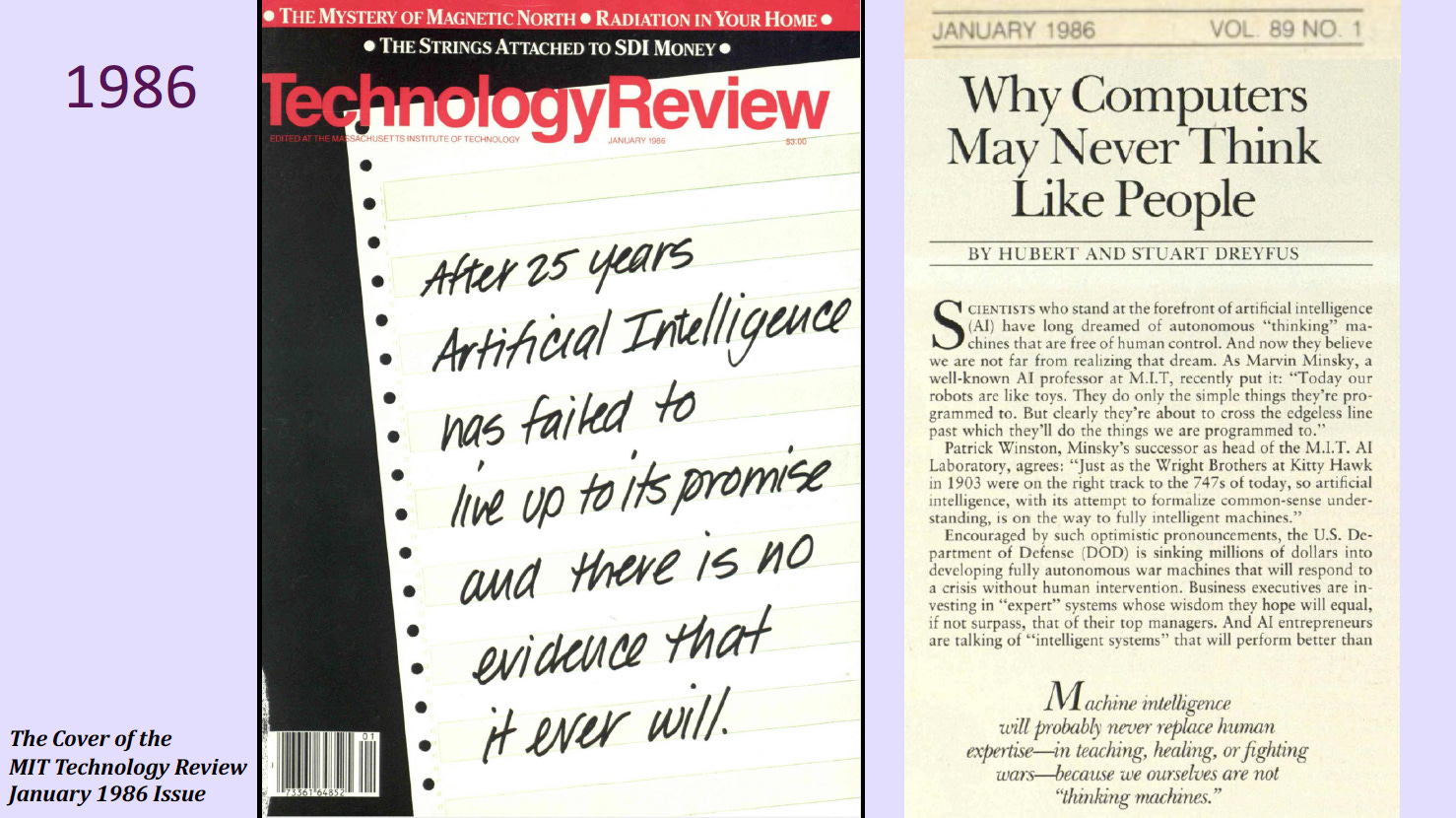
This was the AI winter. Symbolic AI and expert systems had hit a wall. I still remember my University of Waterloo days (90s) in electrical and computer engineering, trying to do a final‑year project on voice enhancement with early neural nets and expert systems. Backpropagation had just arrived and chewed through enormous compute just to train a few neural network layers; with the tools we had, real breakthroughs felt almost impossible.
Yet, a small group—Hinton, Bengio, LeCun and others—kept going anyway. Their “useless” work on backpropagation, deep learning architectures, and representations became the foundation of everything we call modern AI: transformers, generative models, foundation models, and the current wave of embodied systems and rich world models that learn by acting in 3D environments [9]9. The stone the builders rejected really did become the cornerstone.
From a startup perspective, AI winter is what happens when institutions mis‑price optionality. The field nearly died just as its critical building blocks were being formed. Imagine an investor board forcing Hinton to shut down “because it doesn’t move the needle this year.”
You see the same pattern in startups. During SARS in 2003 and aftermath of dotcom bubble burst, Jack Ma used a near‑death moment to build and launch Taobao, which later beat eBay China and became Alibaba’s crown jewel. Around the same time, Amazon looked finished after a 90% stock drawdown, but Bezos chose to “run scared” while doubling down on infrastructure and customer value; the internal tooling platform that kept Amazon alive under pressure became the seed of AWS, the largest cloud service provider in the world.
Jack Ma’s philosophy encapsulated the ethos of building your best product in the darkest days: “Today is hard, tomorrow will be worse, but the day after tomorrow will be sunshine. However, most people give up or die tomorrow evening, and could not see the sunshine. 今天很残酷,明天更残酷,但后天会很美好。然而,大多数人会在明天晚上放弃,因此无法看到后天的阳光 。[10]10”
2.6 Decision-making in bets like poker players: decision quality, not outcome quality
When you zoom out, Krausz, Wüthrich, Novoselov, and Hinton were all making decisions under radical uncertainty. They never had all the facts; they were, in Annie Duke’s language, thinking in bets rather than playing a solved game like chess[11]11.
In poker, you can make a brilliant decision and still lose because the river card goes the wrong way, or make a terrible decision and get lucky. Duke calls our habit of judging decisions purely by outcomes “resulting,” and it is deadly for non‑obvious moats.
If you treat every failed experiment as proof it was a bad idea, you will systemically under‑invest in exactly the volatile, long‑horizon bets that gave us deep learning, attosecond physics, or graphene. A healthier stance is to separate decision quality from outcome quality: given what we knew, was this a good bet—small downside, meaningful information gain, large possible upside—even if it failed this round?
Krausz and Wüthrich run their labs this way. Hinton spent the AI winter doing this inside departments that had already “resulted” on neural nets. If you want non‑obvious moats in a startup, you need the same discipline: treat each project as a probabilistic bet in an uncertain landscape, not as a guaranteed move on a solved chessboard.
3. Complex systems need slack - the case for “useless” work
If failure is navigation, “useless” work is fuel.
Founders are taught to avoid “waste” like poison. The investor deck demands a clear business case for every initiative. MBA logic says every project must hurdle an ROI threshold. Yet the most important work in science—and, frankly, in technology—almost never passes that test at the moment it is done.
3.1 Where scientists and deep‑tech founders land
Donald Stokes captured this tension with a simple 2×2 matrix[12]12. One axis is “quest for understanding,” the other is “considerations of use.” Bohr sits in pure curiosity, Edison in pure application, Pasteur in use‑inspired basic research, and the lower‑left is pure tinkering. Many Nobel‑level scientists care deeply about fundamental questions and often start in Bohr’s quadrant, where there is little or no thought of application. Deep‑tech founders and CTOs, by contrast, obsess with application and customers start in Edison’s quadrant.
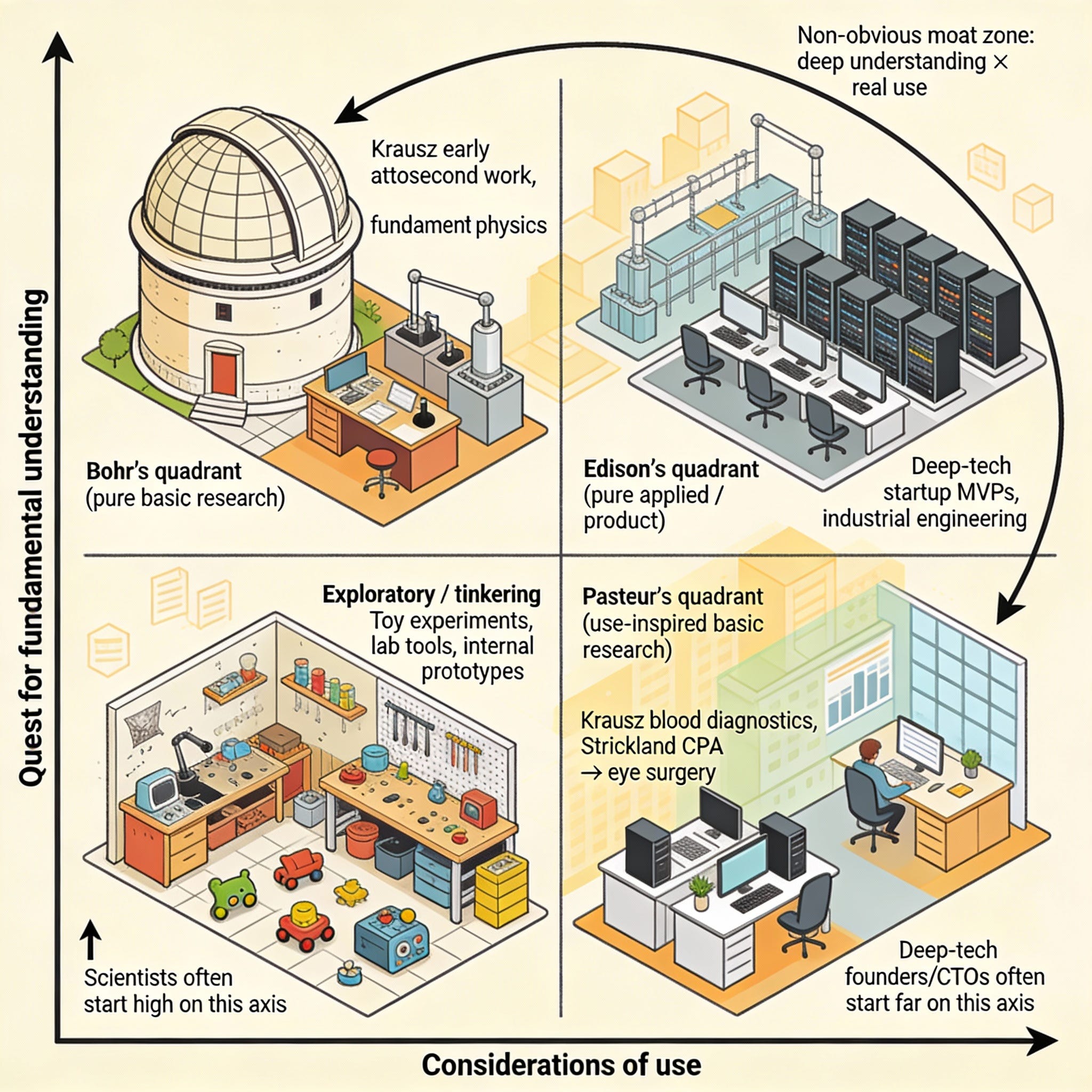
The most powerful work happens where these instincts intersect—Pasteur’s quadrant, where deep understanding unlocks important applications.
The founder move is to build a bridge between those quadrants: invite Bohr‑style questions into an Edison‑driven organization, and give your most scientific people enough slack to wander “upwards” while still anchored to real problems.
3.2 Attoseconds to blood diagnostics – connecting the dots that you can’t justify
In the early 1990s, Ferenc Krausz posed a question to himself and his group in Vienna: can we experimentally see the motion of electrons predicted by Schrödinger’s equation? Theory said electrons jiggle and oscillate on the attosecond scale (10 to the power -18 seconds). No instrument could see that. There was no product roadmap. No white paper promising a market. The question sat squarely in what Donald Stokes later called Bohr’s quadrant: pure curiosity‑driven science with no known application.
Krausz spent about a decade building the tools to answer that question. That work ultimately defined attosecond metrology. Then something unexpected happened.
Once they had the ability to capture attosecond oscillations, they realized the same technique could resolve the oscillations of visible and infrared light. Another decade of work later, they discovered that measuring those oscillations, when infrared light passes through a drop of human blood, reveals the blood’s molecular composition.
Today, Krausz’s teams in Munich, Budapest, and Hong Kong are using this to develop what might become the world’s first ultra‑early screening test for cancer, cardiovascular disease, COPD, and diabetes. The same “useless” question about electrons now sits at the core of a potential revolution in preventive medicine.
As Steve Jobs told Stanford graduates, “You can’t connect the dots looking forward; you can only connect them looking backwards. So you have to trust that the dots will somehow connect in your future.[13]13”
Krausz’s career is a living example. The quality of the dot—asking a deep, fertile question about the nature of electrons—mattered far more than any foresight about medical applications. He chose the right neighborhood to draw in, and the map revealed itself later.
Founders obsess over dot‑count (sprints, experiments, features). Nobelists obsess over dot‑quality (questions). The uncomfortable lesson: you can’t justify every dot upfront.
3.3 Scotch tape, “toys,” and solutions looking for problems
Novoselov’s most famous dot began as a toy.
He and Andre Geim started playing with Scotch tape and pencil graphite. Peel off a layer, stick it down, peel again. At first, it was simple curiosity: what happens if you keep going? Eventually they isolated a single atomic layer—graphene. Every one of those single layers had unique electronic and mechanical properties. That toy experiment opened an entire field of 2D materials and, eventually, a multi‑billion‑dollar industry.
At the forum, Novoselov told the students:
“I would definitely encourage people to do ‘useless’ research. There is enough people who would turn it useful.[14]14”
The basic research behind lasers was famously called “a solution looking for a problem” before they became ubiquitous in telecom, medicine, manufacturing, and consumer devices[15]15. In tech industry and startups, we’ve built a religion around “customer obsession” and “jobs to be done.” I deeply believe in Clayton Christensen’s JTBD lens[16]16—but I also know, from both science and deep tech, that there are categories of work whose only honest job at the time is “expand the frontier of what’s possible.”
3.4 Biological and financial systems – “slack” is safety
In the second panel, Louis Ignarro explained why a simple gas molecule, nitric oxide (NO), won a Nobel Prize[17]17.

NO is produced by our bodies to dilate blood vessels, reduce inflammation, and protect us from coronary artery disease. It also regulates sexual function in both men and women. It’s one molecule doing many jobs—but only in the right place at the right time. You don’t want full‑body vasodilation all day, nor continuous arousal while you’re eating lunch.
Biology solves this by layering tight local control on top of systemic capacity. The machinery to produce NO is always there, but it’s gated by context: cell type, signals, local feedback. The global system keeps slack—the ability to respond quickly—without wasting resources on constant maximum output.
Tim Hunt[18]18 added another lens: your nose.

Every seven years or so, almost all the cells in your nose have been replaced. Cell division and apoptosis are constantly renewing the tissue. Yet, from the outside, your nose looks the same size. There’s no explosion of mass, no gradual shrinkage. Underneath visible stability is a storm of “wasteful” activity: cells that divide then die, signals that over‑correct, micro‑errors that get edited away.
If nature ran purely on Lean Startup doctrine—no redundancy, no excess capacity, no non‑shipping work—you would not survive adolescence.
Robert C. Merton gave the financial version[19]19.

Markets work because they aggregate information no single actor has. Prices are not just numbers; they are weighted summaries of many people’s beliefs, resources, and confidence. Those with better information and higher conviction put more money behind their views, so the price reflects a biased but often more accurate collective intelligence.
But sometimes a crisis hits. Merton defines a true crisis as the moment when something terrible happens and nobody knows why. Suddenly the rules of the game seem changed. In those periods, rational actors withdraw: you don’t trade in a game whose rules you no longer understand. Liquidity evaporates.
That’s where government comes in—not because it is smarter, but because it has power. It can take positions when nobody else can, provide guarantees, and create temporary rules to stabilize things.
Underneath this is a simple principle: any system that pretends it can model the future perfectly will be brittle. Merton insists that real systems need reserves—capital buffers, slack, diversification—to remain robust under unknown unknowns.
As founders, we often run our companies closer to the “perfect model” fantasy than to biology or finance. We feel guilty about cash sitting idle, engineers not at 100% utilization, roadmap capacity not fully allocated. We optimize away slack to hit efficiency metrics. Then we’re shocked when a crisis hits (a pandemic or a regulatory shift) and we have no reserves.
The shared lesson from biology and finance is blunt: any system that pretends it can model the future perfectly will be brittle. Real systems keep reserves—redundant capacity, buffers, slack—so they can survive unknown unknowns. Complex systems don’t see slack as waste; they see it as safety.
3.5 Corporate biology: how companies store slack as potential energy
Big companies that stay innovative for decades have, consciously or not, copied biology and financial markets. Since the 1950s, 3M has had a 15% rule: employees are encouraged to spend up to 15% of their time on projects of their own choosing, outside formal assignments[20]20. Management doesn’t just tolerate this; they celebrate it. That “wasted” time produced, among other things, the Post‑it Note: a side experiment using a failed low‑tack adhesive[21]21.
Google popularized 20% time (“Innovation Time Off”), where engineers could work one day a week on personal projects. Insiders credit this with spawning Gmail, AdSense, and Google Earth; one VP estimated that over half of new Google products originated as 20% projects[22]22.
Over time, Google shifted from fully diffuse slack to more structured programmes like Area 120, an internal incubator giving teams concentrated blocks of time off normal duties to build new products[23]23. Research on slack time shows this broader trend: from scattered slack to focused, incubator‑style slack with clearer selection, to avoid a flood of marginal projects.
Then there’s X, Alphabet’s “moonshot factory,” which masters the art of encouraging slacks and filtering them. CEO Astro Teller has said bluntly that only about 2% of projects “graduate” after five or six years, yet those 2% consume nearly 44% of X’s total budget. X launches 100+ experiments yearly and tries to kill weak ideas as fast as possible. They publicly celebrate shutting down projects early and added a Foundry stage devoted to turning promising science experiments into businesses[24]24.
This is portfolio‑level slack and its slack filtering process is designed so that killing 98% of work is success, not failure.

As a founder, you might think, “We’re not Google; we can’t afford that.” You’re right: you can’t copy their percentages. You need a visible habit and a culture that celebrates good experiments, processes that make prototypes easy to start, and a storytelling loop that revisits how “useless” work became breakthroughs.
3.6 Startup biology: minimum viable slack (MVS)
At this point, a reasonable founder might object: All of this is fine for Nobel labs and trillion‑dollar companies, but I am running on 12 - 18 months of runway. I can’t afford slack.
The constraint is real. Early‑stage startups are resource‑starved. Copying Google or 3M would be suicide. The trap is assuming that the only alternatives are “full moonshot factory” or “zero slack.” Lean done badly optimizes for local certainty: every hour must tie to this quarter’s KPIs, or it is “waste.” But in deep tech, your biggest risks are model error (wrong question, wrong architecture, wrong market) and option loss (shutting down lines of inquiry that would have become your moat).
If you remove all slack, you may extend runway in the short term while silently increasing the probability that the company dies for structural reasons—wrong problem, wrong design space, wrong platform. So the question isn’t “Can we afford slack?” but “What is the minimum viable slack we need to avoid building the wrong thing really efficiently?”
Minimum Viable Slack (MVS) is the smallest deliberate buffer of time, talent, and architecture that keeps you from locking into the wrong hill while still feeding the one you’re climbing (building the wrong thing efficiently). In practice, that looks like:
Timeboxing and scope discipline. Reserve a tiny, explicit quota, say 5% of engineering time for exploration. Run 1 - 2 day spikes with a crisp question (“Can we get X latency with Y method?”), then decide: kill, park, or promote
Piggybacked exploration. Attach non‑obvious bets to work you’re already doing. While shipping a feature, prototype a strange data representation that might become differentiating.
“Cheap options, expensive convictions.” Make it cheap to try many small, reversible experiments—and very expensive to commit headcount or multi‑quarter budget. This is Annie Duke’s thinking‑in‑bets applied to your roadmap with numerous, tiny bets.
Optionality through architecture. Even if you can’t fund parallel moonshots, you can build modular interfaces, clean data boundaries, and richer instrumentation so you don’t lock yourself out of future directions.
Externalizing some of the “lab.” Use open source, academia, and your ecosystem as part of your slack. Partner with a lab on one narrow, high‑leverage question; expose APIs so external developers can explore weird use cases beyond your bandwidth.
Cultural moves that cost almost nothing. A “We Were Wrong” slide in every all‑hands, one‑page field notes after killed initiatives, a standing agenda item for “one non‑obvious bet we’re willing to fund this quarter and why”, and one intentional misfit hire or advisor whose job is to challenge your assumptions.
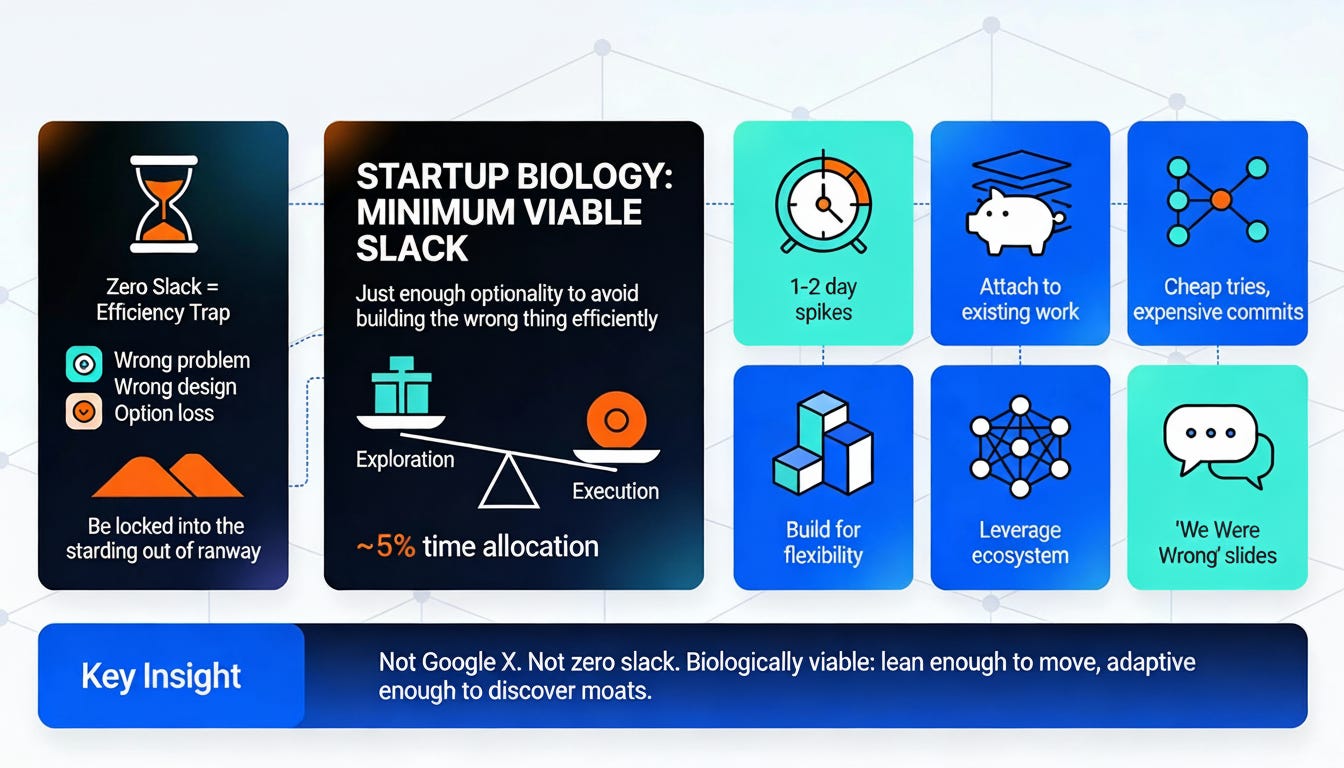
You’re building a biologically plausible organism: lean enough to move, but with just enough redundancy and slack to adapt, heal, and stumble into non‑obvious moats.
Try this week: Protect one tiny piece of slack.
Block one afternoon for a 1–2 day spike with a crisp question.
Attach one weird prototype to a feature you are already shipping.
Add a “We Were Wrong” slide to your next all‑hands.
4. Useless inputs: humanities, art, and misfit talent
One of the most striking things about the Nobel Heroes Forum was how un‑narrow these scientists were.
Ferenc Krausz talked about creativity in science and art as fundamentally similar; Konstantin Novoselov talked about Chinese calligraphy and painting; Kurt Wüthrich talked about artists painting molecules before computers could draw them, and patients listening to Mozart during MRI scans. They are “useless inputs” that quietly shape how these people see problems.
4.1 Calligraphy, the Medici effect, and impossible planning
Novoselov has spent years practising Chinese calligraphy and ink painting. He described a deep parallel: you cannot plan a masterpiece. You can only set up the conditions, practise the strokes, and be ready. Some days the brush does what your mind sees; most days it doesn’t.
Science operates the same way. You cannot schedule a discovery for next quarter. You can only arrange conditions and increase the probability.
In a similar vein, Jobs later credited a calligraphy class at Reed College with shaping the Macintosh: “I learned about serif and sans‑serif typefaces, about varying the amount of space between different letter combinations, about what makes great typography great… ten years later, when we were designing the first Macintosh computer, it all came back to me…”
One pre-condition that may increase the chance of serendipitous discoveries – the Medici effect, a term coined by Frans Johansson, refers to breakthroughs that happen at intersections of disciplines and cultures[ ]25. Renaissance Florence combined artists, merchants, engineers, and philosophers in dense proximity; today, Novoselov’s institute in Singapore deliberately mixes mathematicians, computer scientists, biologists, chemists, and physicists—and he said he would happily add arts and literature if he could.
From a founder’s hiring dashboard, a calligrapher‑physicist looks inefficient. From an innovation‑portfolio view, he is a walking crossover engine.
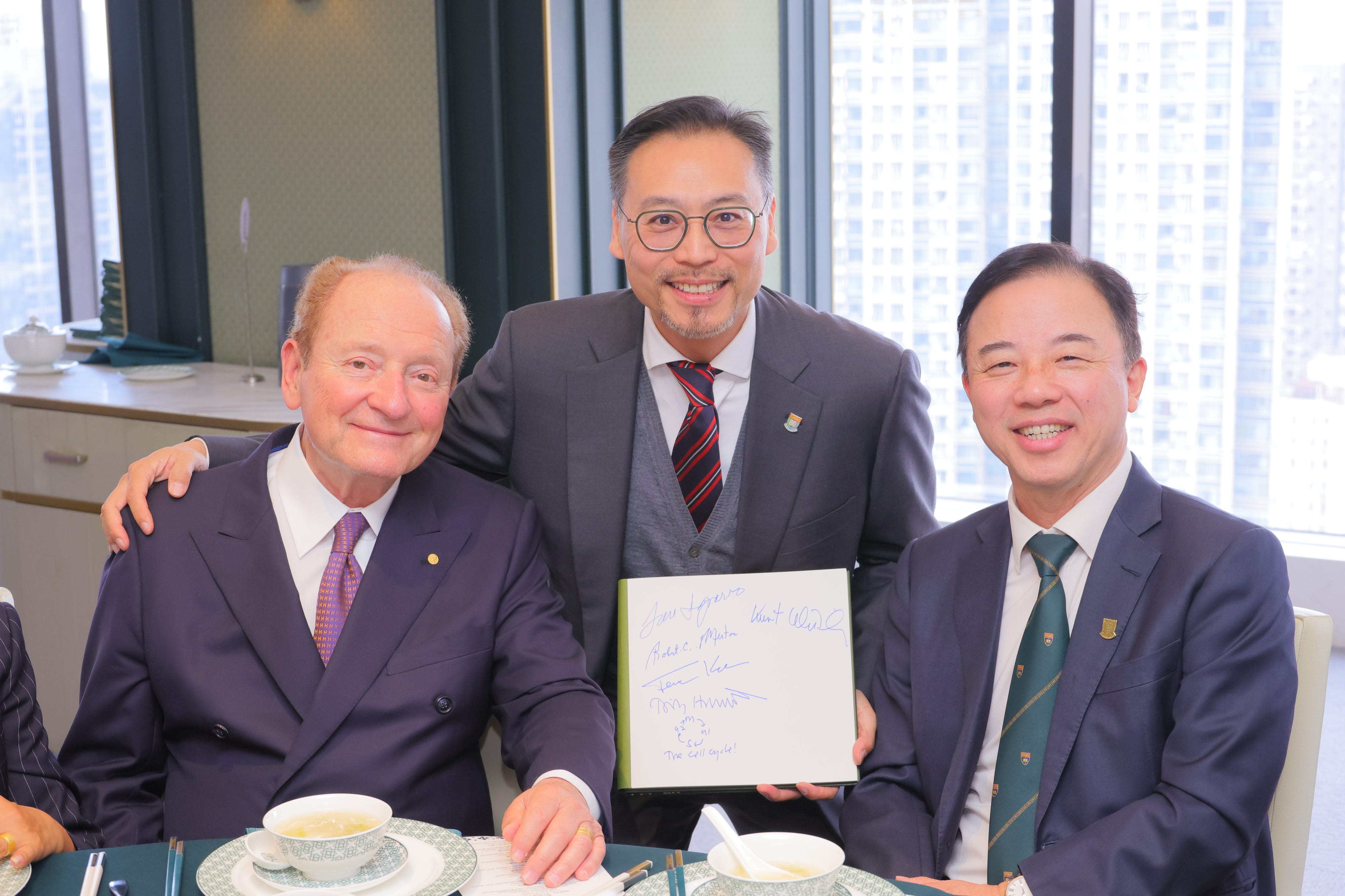
At the Forum, HKU Vice‑Chancellor Zhang Xiang closed the loop in his own way, presenting each laureate with a carefully chosen Chinese phrase from classical literature as a personalized gift (see figure). Each phrase appeared to capture how their ‘useless’ work and misfit paths became world‑changing; I’ve unpacked the phrases and their meanings in the footnote references[26]26.

4.2 Wüthrich’s painters and MRI Mozart
Before graphical software existed, Wüthrich’s lab had no way to visualise the molecules they were studying from NMR data. They did the obvious thing: they hired artists. The painters turned streams of numbers into accurate, beautiful images of proteins and nucleic acids.
Later, MRI—partly rooted in NMR—made it into hospitals. It is loud, claustrophobic, and frightening. To make it tolerable, hospitals discovered that giving patients headphones and letting them listen to Mozart or Louis Armstrong dramatically improved the experience. Wüthrich sees this as another art‑science loop: physics enabled imaging; music made it humane[27]27.
In my Li Shu Pui Symposium Lecture “The Doctor Will See You Now… With AI,” I argued that the real bottleneck in AI medicine is not whether a model can read an X‑ray, but whether patients, clinicians, and regulators can trust it enough to let it into the consultation room. I framed the challenge as building Artificial Integrity: turning black‑box AI into glass‑box AI that is explainable and governed with integrity so it amplifies human values instead of merely automating tasks[28]28.
These details matter for founders building products in healthcare, AI, robotics, or fintech. You can build technically brilliant systems that are unusable or untrusted if you treat design, narrative, and emotion as “non‑core.” Humanities and arts are the R&D department for meaning.
4.3 Donna Strickland – the mispriced PhD
Then there is Donna Strickland, the third woman ever to win the Nobel Prize in Physics[29]29. She did the work that won her the prize—chirped pulse amplification (CPA)—as a PhD student at the University of Rochester in the 1980s. That work, her first scientific paper, made it possible to generate ultra‑short, ultra‑intense laser pulses safely and underpins laser eye surgery and precision micromachining.
When I met Donna Strickland at an alumni dinner in Hong Kong in early 2023, she came across as a disarmingly humble intellect, more like a favourite homeroom professor than a Nobel laureate, fully present in conversation and quietly, genuinely engaged.

Benjamin Jones has shown that, as knowledge accumulates, major scientific contributions tend to happen later, not earlier, in researchers’ lives. In his “Age and Great Invention” and “Burden of Knowledge” work, he documents a simple structural shift: it now takes more years of training just to reach the frontier, which pushes breakthrough work into mid‑career, shrinks the window for originality, and forces people into narrower specializations and larger teams[30,31]3031.
Against that backdrop, Strickland’s early, quiet contribution at the PhD stage looks like a statistical outlier, exactly the kind of mispriced talent we systematically overlook. By Jones’ logic, the burden of knowledge should have pushed a contribution of that depth later in life and deeper into team science; instead, it arrived early, quietly, and from someone the system was not primed to pattern‑match as a future Nobelist.
For decades, her contribution sat in the literature, widely used but not widely celebrated; physics went 55 years between second woman winner Maria Goeppert Mayer’s Nobel[32]32 and Strickland’s. She spent most of her career as a professor at Waterloo, teaching and running a lab, with relatively little public fanfare and no Wikipedia page until 2018. In other words: Strickland’s PhD work looked like “just” a student project, and she looked like a “normal” mid‑career academic; only later did the system admit that this “non‑core person” had done work that quietly rewired both basic science and industrial practice.
If you are a founder or investor, ask yourself how many Donna Stricklands walk past your pattern‑matching filters each year. The junior engineer whose side project is quietly solving a deep infrastructure bottleneck. The female founder outside Silicon Valley whose PhD work you don’t fully understand. The misfit candidate whose CV doesn’t match your mental picture of “high‑growth CEO” or “10x engineer.” If you’re honest, the answer is more than zero—and Jones would argue that, as the burden of knowledge rises, it will take more of these mispriced, high‑depth individuals working in teams to move the frontier at all, which means systematically overlooking them is an increasingly expensive mistake.
Try this month: bet on one mispriced person.
Identify one junior or “non‑obvious” person whose side project hints at deeper capability.
Give them a small, bounded‑downside project with real autonomy.
5. Designing non‑obvious moats in startups
So what do you do with all this if you run a startup or a tech team?
Nobel lives make for wonderful conference inspiration, but founders live under cashflow, runway, and customer pressure. You can’t replicate these practice with a 12‑person seed‑stage company. You can, however, design a smaller, leaner version of their systems.
5.1 Portfolio design — build small options
At the level of projects, you are essentially running a portfolio of bets under radical uncertainty. You don’t know in advance which lines of work are “Bohr’s quadrant” curiosities and which will turn into Pasteur‑style moats. Your job is to size and structure those bets so that you can afford to be wrong many times and still be very right once.
Flickr followed a similar arc. It emerged from a massively multiplayer online game project, Game Neverending, where photo‑sharing was a side feature. The game went nowhere. The “useless” feature—put in to make the game more fun—became the main product, and eventually a pioneering photo community that set norms for web‑scale image sharing[33]33.
From a startup perspective, these stories show what it looks like to protect a handful of small, bounded‑downside, high‑upside options in your portfolio:
You carve out a few projects that don’t obviously move this quarter’s KPIs but touch deep questions in your problem space.
You accept that most will die, but you size them so their death is survivable and their success can change the company.
I’ve lived both sides of this. During the period 2009–2011 at Cherrypicks, we built iButterfly, an AR + location app that let people “catch” digital butterflies in the real world and redeem them for rewards. Smartphones were young, GPS was flaky, the B2B business model was murky. After a few years, despite millions of downloads from Italy and Turkey to Japan and Indonesia, I killed it as a distraction from our “core” work[34]34.
On the spreadsheet, that looked rational. In hindsight, iButterfly was a non‑obvious moat in embryo: a working prototype of the same AR, geolocation, and game‑loop mechanics that later made Pokémon GO a global phenomenon. We would have given iButterfly a second life if we had changed the business model to B2C and engaged with branded characters. I had confused “doesn’t move the needle this year” with “never will,” and treated a live world‑scale experiment as waste instead of a strategic lab.
A few years later, I made the opposite call. In 2013 I carved out a small “SEAL Team Alpha” at Cherrypicks to explore indoor positioning with sound, Bluetooth, and Wi‑Fi fingerprints. Through reorganizations and even an acquisition, their platform rarely contributed more than 5% of revenue, but we kept advancing the core competence. In late 2024, it snapped into place: those indoor‑positioning technologies unlocked a 100× performance gain in AI 3D world‑model (Deep World Model), and ten years of “non‑core” slack became the strongest moat in our AI work[35]35.
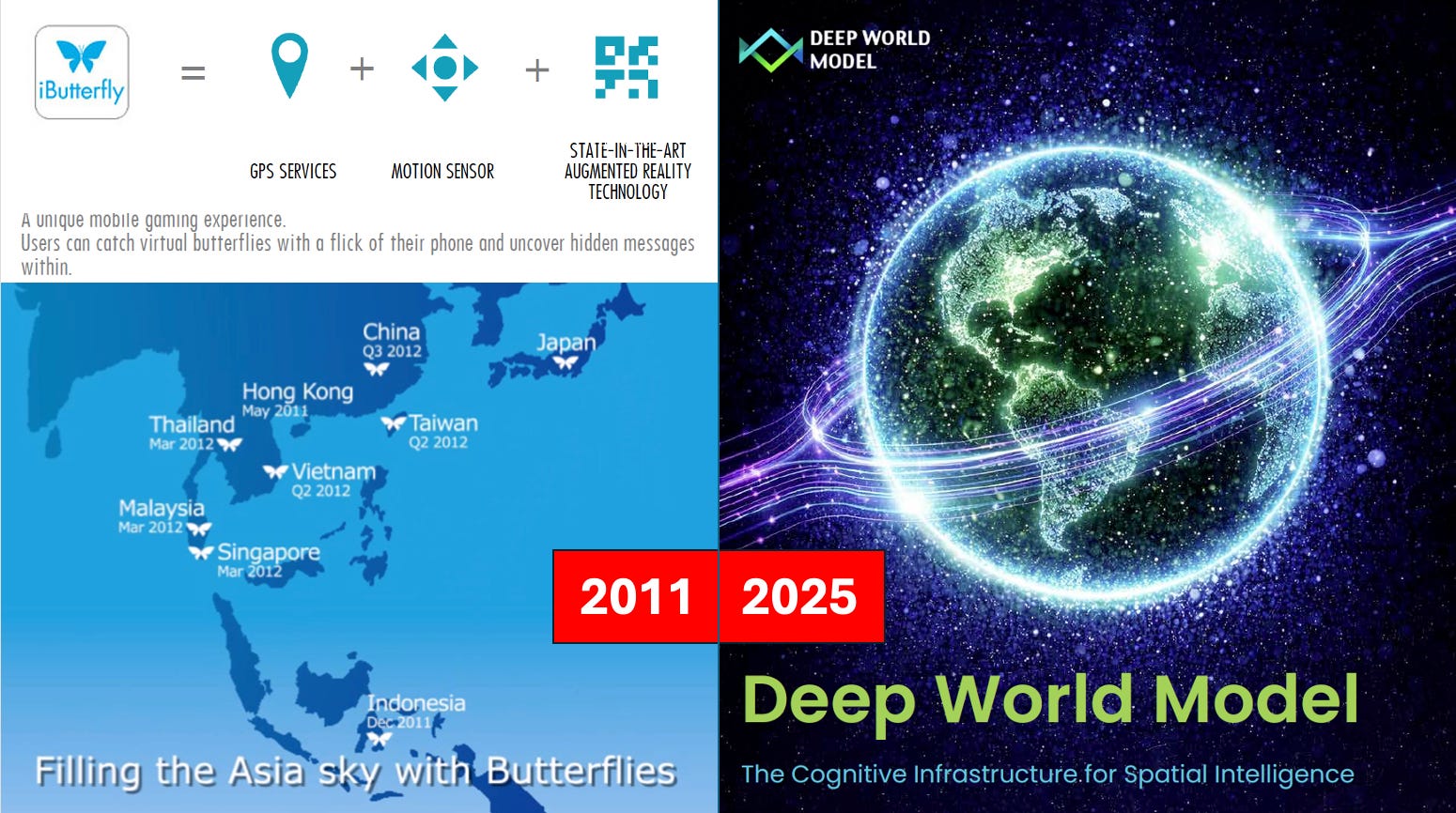
iButterfly is the option I killed too early; Deep World Model is the option I protected long enough to become a moat.
5.2 Slack as a habit
Slack is a habit at system level. MVS is what that habit looks like at startup scale: visible but small allocations of time and budget that you protect even when the runway clock is loud. You can also see mature versions of this in corporate biology at 3M, Google, and X, Alphabet’s ‘moonshot factory.’
Design a slack system, don’t bolt on one‑off hacks. Start with:
Time: a visible 5% exploration quota.
Budget: a small, protected pool for experiments that don’t need full business case.
Architecture: modular APIs, clean data boundaries, rich instrumentation.
Portfolio: 1–3 option bets that are allowed to look “useless” for a while.
5.3 Cultural norms — normalize being on the wrong way
Behind the portfolio and the systems sits culture. Wüthrich only realized his field was “completely on the wrong way” because he stepped back to write a book and was willing to admit it publicly. Krausz infects his lab with an attitude that treats setbacks as chances to rethink the whole route. Novoselov insists that if it all feels like struggle, something is misaligned.
GitHub has long encouraged hack weeks, side projects, and shipping tiny experiments behind feature flags. Many of its core ideas—like social coding patterns around pull requests—emerged more from community practice and internal tinkering than from top‑down product roadmaps.
Bring that into your company with cheap moves:
A regular “We Were Wrong” slide in every all‑hands, where leaders share one assumption they’ve updated and what changed.
One‑page field notes for killed initiatives, capturing what you learned and where the next team might pick up the thread.
A standing roadmap agenda item: “One non‑obvious bet we’re willing to fund this quarter and why.”
The goal is to make “we are on the wrong way” a promoted behavior, not a career‑ending confession.
5.4 Talent and intersection design
The last lever is who you let into the building and what worlds they connect.
Nintendo has spent decades living off “lateral thinking with withered technology” (Gunpei Yokoi’s phrase): combining old, cheap components with surprising design to create things like the Game Boy and Wii[36]36. From a spreadsheet view, hiring toy designers and eccentric engineers to work with yesterday’s chips looked inefficient. In reality, those “misfit” teams built some of the most enduring franchises in entertainment.
Anthropic is a more recent, AI‑native version of misfit talent as moat. It has oriented itself around safety research on frontier models—RLHF, Constitutional AI, red‑teaming, agentic misalignment studies—that many companies would treat as pure cost or compliance overhead[37]37. That “useless” work is, in fact, a stock of methods, evaluations, and habits that becomes a competitive advantage when models get powerful and risky. Safety researchers and contrarians—the people whose job is to say “this may fail in ways you haven’t imagined”—are Anthropic’s version of Wüthrich’s painters and the MRI Mozart headphones.
In your own teams, the simplest move is to consciously hire at least one Medici‑type per core group: someone with a serious side domain (art, philosophy, anthropology, hardware hacking) and explicit license to connect dots across domains. Then, ask a Strickland question in hiring and investment committees: Which candidate here looks least like our pattern but could plausibly be the one doing the work we’ll regret missing in 20 years?
To build a talent and culture edge, do three simple things:
One misfit hire or advisor whose explicit job is to question assumptions.
A recurring “We Were Wrong” slide and short debriefs after killed projects.
A simple rule: promote people who run good experiments, not just those who ship features.
6. Build your own lab for the non‑obvious moat, not local optimum
At the Nobel Heroes Forum, President Xiang Zhang said that Hong Kong wants to be a scientific bridge between China and the world; that science should be a common language across political divides; and that discovery often starts with work that looks useless, only to become essential decades later. He could have been talking about startups.
The point of this essay is not to make you feel guilty about execution. It is to suggest that execution without designed slack is a local optimum. You can build a very efficient machine that perfectly exploits your current opportunity, only to discover that you’ve optimized yourself away from the future.
The Nobel laureates on stage at HKU did not get there by grinding harder within the accepted playbook. They got there by:
Asking questions with no immediate use.
Persisting through years of apparent failure.
Embracing misfit interests and misfit people.
Operating in systems—labs, meetings, mentoring cultures—that institutionalized “wasted” work as a feature, not a bug.
AWS did not emerge from a perfectly efficient retail IT budget; it came from a willingness to treat infrastructure work as more than cost. SpaceX did not build reusability by trying to avoid failed launches at all costs; it treated those setbacks as tuition. Anthropic is betting that the “useless” work of safety will turn out to be the only thing that matters when the models get weird.
If you’re a founder, you will never have their time horizons or funding security. But you can still decide, today, to run your company a bit more like a lab:
Protect small pockets of work that don’t yet have a business case—your internal tool that might be a Slack, your “boring” infra that might be an AWS.
Design slack into your system before a crisis forces it on you—whether that slack looks like a 5% exploration block, a tiny Area‑120‑style incubator, or one person whose job is to be your internal Anthropic.
Hire and mentor at least one person who looks useless to your current roadmap but deeply interesting to your future, the kind of mispriced Strickland or Nintendo designer you’ll later realize was holding the keys.
In the end, you don’t need a Nobel‑sized lab. You need a founder‑sized version of Minimum Viable Slack: a small, deliberate buffer of time, talent, and architecture that keeps you from building the wrong thing really efficiently.
To wrap up, I have one question and one call for action to leave you with:
Question: if Hinton had optimized for performance KPIs in 1985[ ]38, it’s hard to imagine we’d have GPT-4 in 2023. What are you killing today that the world will need in five years, 20 years? Whatever your answer is, that would probably be the “wasted work” you most need to protect.
Call for action: this week, protect one ‘wasted’ hour. Next month, hire one misfit. Next quarter, fund one non-obvious bet. In several years, that might be your moat.
Slack wisely, and may today’s “useless” work become your future non-obvious moats.
Footnote References:
J. Doerr, Measure What Matters: How Google, Bono, and the Gates Foundation Rock the World with OKRs. New York, NY, USA: Portfolio, 2018.
The Nobel Heroes Forum, University of Hong Kong, Hong Kong, China, Jan. 12, 2026. [Online]. Available: HKU Co-hosts “The Nobel Heroes Forum: Shaping Science and Future” Convene World-Leading Minds to Forge Next Era of Discovery” https://www.hku.hk/press/press-releases/detail/28877.html
“Ferenc Krausz – Facts,” The Nobel Foundation, Stockholm, Sweden. [Online]. Available: https://www.nobelprize.org/prizes/physics/2023/krausz/facts/
“Kurt Wüthrich – Facts,” The Nobel Foundation, Stockholm, Sweden. [Online]. Available: https://www.nobelprize.org/prizes/chemistry/2002/wuthrich/facts/
“Konstantin Novoselov – Facts,” The Nobel Foundation, Stockholm, Sweden. [Online]. Available: https://www.nobelprize.org/prizes/physics/2010/novoselov/facts/
J. Huang, Commencement Address, Stanford Univ., Stanford, CA, USA, Jun. 2023.
M. Minsky, “Matter, mind, and models,” in Proc. IFIP Congr., 1965, pp. 45–49.
H. Dreyfus and S. Dreyfus, “Why computers may never think like people,” MIT Technology Review, vol. 89, no. 1, pp. 42–61, Jan. 1986.
I. Goodfellow, Y. Bengio, and A. Courville, Deep Learning. Cambridge, MA, USA: MIT Press, 2016.
“Jack Ma on hardship and the ‘day after tomorrow’,” Alibaba Group internal speech, Hangzhou, China, 2003. (in Chinese)
A. Duke, Thinking in Bets: Making Smarter Decisions When You Don’t Have All the Facts. New York, NY, USA: Portfolio, 2018.
D. E. Stokes, Pasteur’s Quadrant: Basic Science and Technological Innovation. Washington, DC, USA: Brookings Inst. Press, 1997.
S. Jobs, “You’ve got to find what you love,” Commencement Address, Stanford Univ., Stanford, CA, USA, Jun. 12, 2005.
K. S. Novoselov, Remarks at the Nobel Heroes Forum, Univ. of Hong Kong, Hong Kong, China, Jan. 12, 2026.
J. Hecht, Beam: The Race to Make the Laser. New York, NY, USA: Oxford Univ. Press, 2005.
C. M. Christensen, T. Hall, K. Dillon, and D. S. Duncan, Competing Against Luck: The Story of Innovation and Customer Choice. New York, NY, USA: HarperBusiness, 2016.
“Louis J. Ignarro – Facts,” The Nobel Foundation, Stockholm, Sweden. [Online]. Available: https://www.nobelprize.org/prizes/medicine/1998/ignarro/facts/
“Tim Hunt – Facts,” The Nobel Foundation, Stockholm, Sweden. [Online]. Available: https://www.nobelprize.org/prizes/medicine/2001/hunt/facts/
“Robert C. Merton – Facts,” The Nobel Foundation, Stockholm, Sweden. [Online]. Available: https://www.nobelprize.org/prizes/economic-sciences/1997/merton/facts/
E. von Hippel, Democratizing Innovation. Cambridge, MA, USA: MIT Press, 2005.
“The story of Post-it® Notes,” 3M Company, St. Paul, MN, USA. [Online]. Available: https://www.post-it.com
L. Bock, Work Rules!: Insights from Inside Google That Will Transform How You Live and Lead. New York, NY, USA: Twelve, 2015.
“Introducing Area 120,” Google Inc., Mountain View, CA, USA, 2016. [Online]. Available: https://area120.google.com
A. Teller, “The unexpected benefit of celebrating failure,” TED Talk, Vancouver, BC, Canada, 2016.
F. Johansson, The Medici Effect: What Elephants and Epidemics Can Teach Us About Innovation. Boston, MA, USA: Harvard Business School Press, 2004.
See “Meaning of the Chinese phrases for each of the Nobelist at the Nobel Heroes Forum” after the end of the footnote references below.
M. A. Tramo, “Music and the brain,” in The Cognitive Neurosciences, M. S. Gazzaniga, Ed. Cambridge, MA, USA: MIT Press, 2000, pp. 999–1013.
J. Chiu, “The Doctor Will See You Now… With AI,” Li Shu Pui Symposium Lecture, Hong Kong Sanatorium & Hospital, Hong Kong, China, 2025. [Online]. Available: https://medium.com/@jason-chiu/the-doctor-will-see-you-now-with-ai-9a686e0ec1a1
“Donna Strickland – Facts,” The Nobel Foundation, Stockholm, Sweden. [Online]. Available: https://www.nobelprize.org/prizes/physics/2018/strickland/facts/
B. F. Jones, “Age and great invention,” Rev. Econ. Stat., vol. 92, no. 1, pp. 1–14, 2010.
B. F. Jones, “The burden of knowledge and the ‘death of the Renaissance man’: Is innovation getting harder?” Rev. Econ. Stud., vol. 76, no. 1, pp. 283–317, 2009.
“The Nobel Prize in Physics 1963,” The Nobel Foundation, Stockholm, Sweden. [Online]. Available: https://www.nobelprize.org/prizes/physics/1963/summary
J. Livingston, Ed., Founders at Work: Stories of Startups’ Early Days. Berkeley, CA, USA: Apress, 2007.
iButterfly captured the World Summit Award, Abu Dhabi, 2012. [Online]. Available: https://wsa-global.org/winner/ibutterfly/
Deep World Model: The Cognitive Infrastructure for Spatial Intelligence Whitepaper. [Online]. Available: https://collectiv.co/deep-world-model-whitepaper
B. J. Harris, Console Wars: Sega, Nintendo, and the Battle That Defined a Generation. New York, NY, USA: HarperCollins, 2014.
Y. Bai et al., “Constitutional AI: Harmlessness from AI feedback,” arXiv:2212.08073, 2022.
G. E. Hinton, D. E. Rumelhart, and R. J. Williams, “Learning representations by back‑propagating errors,” Nature, vol. 323, pp. 533–536, Oct. 1986.
Meaning of the Chinese phrases for each of the Nobelist at the Nobel Heroes Forum:
Ferenc Krausz:「極深研幾」 means “probe what is extremely deep and investigate the subtlest beginnings,” from Neo‑Confucian language about pursuing principles to their limits while catching the earliest traces of change. It fits a career that pushes physics into the attosecond regime, then uses those tools to read ultra‑fine infrared fingerprints in blood. A seemingly abstract question about electron motion becomes ultra‑early disease detection from a single drop.
Kurt Wüthrich:「識微知著」 means “perceive the subtle and understand the significant,” praising those who infer large consequences from tiny early signs. Wüthrich reads faint NMR shifts to reconstruct 3D protein structures and noticed small conceptual inconsistencies that meant his whole field was “on the wrong way.” The phrase captures both his technical craft—extracting structure from micro‑signals—and his strategic decision to rebuild an entire discipline.
Konstantin Novoselov:「大道至簡」 means “the Great Way is supremely simple,” a Daoist idea that the deepest truths are simple beneath surface complexity. Graphene—a single atomic layer in a hexagonal lattice—is exactly that kind of radical simplicity, and his Scotch‑tape method for isolating it is almost childlike in its elegance. Novoselov’s work shows how minimal rules and simple tools can unlock an entire universe of 2D materials.
Louis Ignarro:「感而遂通」 means “be stimulated and thus become unobstructedly open,” where a small cue triggers smooth flow and understanding. Nitric oxide is precisely such a stimulus molecule: tiny pulses relax arteries and restore healthy circulation. Ignarro’s work turned scattered pharmacological observations into a coherent signaling story, making cardiovascular biology “open up” in one stroke.
Robert C. Merton:「數興理協」 means “when numbers flourish, principles fall into harmony,” linking quantitative methods (數) with underlying order (理) and systemic coordination (協). Merton used continuous‑time mathematics to value contingent claims, revealing shared structure across seemingly different financial contracts. The phrase reflects a career devoted to using math to reveal, organize, and stabilize the logic of complex markets.
Tim Hunt:「格物探原」 means “investigate things and probe their origins,” from the Great Learning ideal of studying concrete phenomena to reach underlying principles. Hunt began with humble sea‑urchin eggs and a disappearing protein band, tracing them back to cyclins and CDKs as universal cell‑cycle regulators. The phrase honors an experimentalist who followed small anomalies all the way to the roots of how cells grow and cancers begin.