
The Unidentical Twins and the Flywheel Gambit
How China is engineering the AI-Robotics economy the West wasn't ready for

I. Unidentical Twins in AI
The distance between U.S. and Chinese AI is widening, but not for the reason most people think. It’s not because one side is “winning” and the other is “losing.” It’s because their AI aspirations are being raised in different environments, trained on different problems, and optimized for fundamentally different competitive realities.
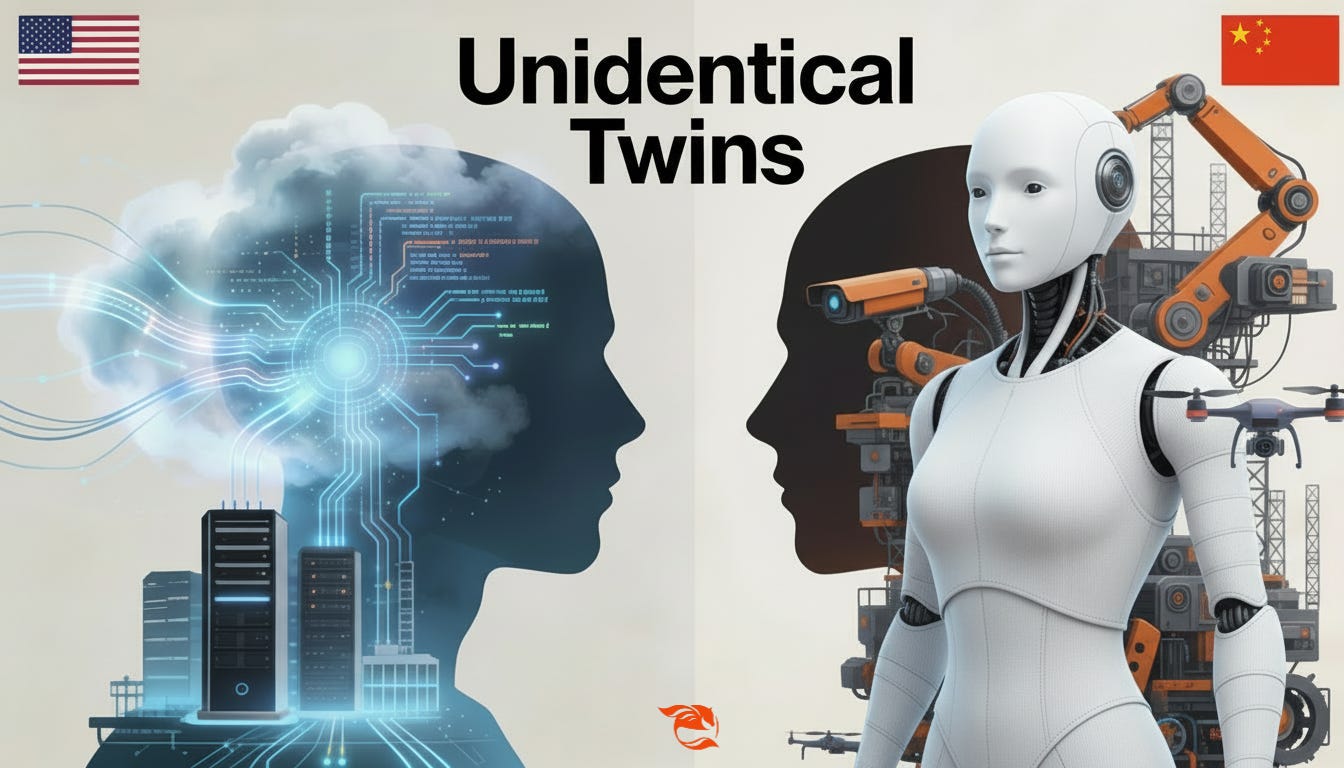
On one side, the U.S. is building a deep infrastructure moat around pure intelligence. Its stack runs from advanced chip design to hyperscale cloud computing, from decades of enterprise software to capital-intensive foundation models powered by vast data centers. The US controls about 75% of global AI supercomputer capacity with 850,000 H100-equivalents compared to China’s 110,000. US computational performance is 9x China’s and 17x the EU’s.[1]1
Companies like OpenAI, Anthropic, Google, Meta, Microsoft, Nvidia, AMD, Broadcom and Oracle have collectively invested well over US$1 trillion into frontier model research, training, and the infrastructure that supports it. The strategic bet is explicit: whoever builds the most capable generative models and reasoning systems will capture disproportionate value toward Artificial General Intelligence (AGI).
On the other side, China’s structural advantages lie somewhere very different: in striving for efficiency in model training and fine-tuning, as well as in the hardware-centric manufacturing and control of the physical infrastructure that intelligent systems depend on.
China produces roughly 75% of global lithium-ion batteries and close to 90% of neodymium magnets, and it dominates power electronics and embedded compute used in EVs, industrial equipment, and robots [2,3]23. It’s the critical foundation of every electric vehicle, industrial robot, drone, and autonomous system that will run on AI.
China also deploys more than half of the world’s new industrial robots each year, while companies like DJI, Unitree, and UBTech push drones and humanoids toward mass-market viability.
A different “Sputnik moment”
The DeepSeek r1 launch in January 2025 was, in many ways, a “Sputnik moment” for the West, exposing that the AI gap between the U.S. and China is far narrower than many had assumed. It showed that China can now produce frontier-class open-weight models at a fraction of U.S. training costs, catching many observers by surprise.
But more importantly and somewhat different this time around, it crystallized two diverging expectations of what AI is for, and where the real value will be captured over time. U.S. and China are the unidentical twins in the global AI and robotics ecosystem.
In the U.S., the twin is surrounded by researchers and compute. It learns to read, write, code, summarize, argue, and plan. Its world is tokens, parameters, and benchmarks. Its job is to think as powerfully and flexibly as possible, for as many people as possible, through a browser window or an API call.
In China, while always optimizing for cost efficiency, the twin grows up on factory floors and in city streets. It learns to grasp, carry, weld, navigate, and monitor. Its world is torque, voltage, sensor noise, and unit price. Its job is to act reliably in the messiness of the physical world—in hospitals, warehouses, eldercare facilities, and logistics corridors.
They are diverging because the problems they’re being prioritized and trained to solve are fundamentally different. The datasets are different. The optimization targets are different. The time scales and failure modes are different. And yet, both kinds of intelligence are essential.
Such divergence somewhat echoes patterns identified by Kai-Fu Lee in AI Superpowers (2018), though I believe the relationship is increasingly complementary rather than zero-sum, and extends Chris Miller’s semiconductor analysis in Chip War (2022) into the AI domain [4,5]45. The crucial point is that the U.S. and China are not simply competing on the same track with the same objective function. They are specializing.
Make no mistake: the twins’ strategies are not static. The U.S. will inevitably invest more heavily in robotics, bring manufacturing back onshore, and build resilient supply chains for critical components. China will continue to pour capital into semiconductor design, large-language models and closed-source frontier systems for their own ecosystem platforms (especially for Tencent and Alibaba), while simultaneously pushing open-source/open-weight alternatives into the commons.
In other words, beneath their divergence lies a quiet convergence on the common denominators of foundational ingredients and overlapping terrains. This offers yet another compelling reason for collaboration and mutual learning.
Finally, one more interesting tale of the superpowers worth highlighting is Dan Wang’s new lens of the twins in Breakneck: China’s Quest to Engineering the Future (2025): China is an engineering state, building big at breakneck speed, in contrast to the U.S.’s lawyerly society, blocking everything it can, good and bad. Each superpower offers a vision of how the other can be better [6]6.

A better set of questions to ask
Viewed through this “unidentical twins” lens, the usual “Who is ahead?” question looks less helpful. Rather, a better set of questions emerges:
What happens as model capabilities continue to advance toward agentic AI, robotics, embodied intelligence, and ultimately AGI?
In that world, who captures the value: the owner of the smartest model, or the owner of the robots, vehicles, factories, and infrastructure where that intelligence is deployed?
The DeepSeek moment offers some critical clues to the questions above and helps reveal the emerging flywheel that China is starting to assemble in AI and robotics.
II. China’s Speed and Impact
(Tsinghua Agent Hospital and Wenge Enterprise Workflow)
In less than a year, a relatively unknown team at DeepSeek produced a model that briefly topped global benchmarks and shook Western markets. With improved mixture-of-experts architectures, aggressive distillation, and ruthless efficiency, r1 was released it under an open-weight license.
DeepSeek rewrote the rules of the game by asking “who can move fastest, run most cost efficiently, and turn intelligence into an ingredient that anyone can use?” DeepSeek is just one example of how fast AI is being deployed, scaled, and repurposed inside real Chinese institutions.
On the consumer side, we see domestic models powering everything from super-apps to education platforms. On the enterprise side, companies like Manycore have created the world’s largest spatial design platform, and Unitree Robotics humanoid robots G1 and R1 are mastering combat-grade dynamic movement at record speed [7]7.
Other AI-native and robotic-native startups such as Zhipu, MiniMax, Moonshot, BrainCo, DEEP Robotics, EngineAI and UBTech, alongside hardware giants and EV makers, are all underpinning the rapid innovation. To really see the character of this wave, though, it helps to look at a couple of lesser-known but equally revealing cases in hospitals and enterprises, where the approach is pragmatic and unapologetically impact-oriented.
Healthcare offers one of the clearest windows into this speed
In May 2024, Tsinghua University’s Institute for AI Industry Research (AIR) and Beijing Tsinghua Changgung Hospital launched Agent Hospital: a fully simulated hospital where AI agents act as doctors, nurses, patients, and administrators [8]8. Within this digital twin, thousands of simulated cases run across different departments: internal medicine, surgery, pediatrics, emergency, and more. Agents learn triage, diagnosis, treatment workflows, and care coordination in a safe, synthetic environment, long before touching real patients.
Beijing Tsinghua Changgung Hospital is a separate, real-world teaching hospital. This integration is for assistance and decision support, not for replacing human doctors entirely. By 2024, the system had been stress-tested at scale. Forty-two AI “doctors” were operating across 21 medical departments.
On the patient side, researchers generated 50,000–100,000 synthetic patient agents mirroring real demographic, geographic, and disease patterns. Within weeks, the system had completed 10,000 virtual patient cases (roughly equivalent to two years of human clinical workload) while achieving 93% diagnostic accuracy on MedQA respiratory datasets, with strong performance across other specialties [8].
Tsinghua borrowed from autonomous driving framework and defined four levels of human–AI collaboration:
Level 0 – Simulation only: agents operate entirely in a virtual hospital (current status).
Level 1 – Shadow mode: agents run alongside clinicians, reading the same charts and proposing diagnoses and treatment plans, but only for human reference.
Level 2 – Suggestion mode: agents propose decisions; clinicians approve, override, or modify them.
Level 3 – Limited autonomy: agents handle routine, low-risk cases autonomously and escalate edge cases or ambiguous situations to human doctors.
The first real-world pilot at Tsinghua Changgung Hospital begins in 2025. By the time an AI agent sees its first real patient, it will have “seen” far more synthetic cases across more specialties than any human doctor will over an entire career. Vice Provost and Senior Vice-Chancellor of Tsinghua Medicine Wong Tien Yin noted that the AI Agent Hospital is designed to transcend the traditional “Hospital + AI” model [9]9.
AI agent functions are embedded at the foundational design level, driven by clinical service needs. This approach will assist doctors in making precise decisions, improve healthcare efficiency and patient satisfaction, lower hospital operating costs, and help address the shortage of primary care physicians. In the long term, the hospital plans to operate as a physical AI-enabled hospital, promoting a revolutionary transformation of healthcare models. It will also serve as a key platform for medical education at Tsinghua, nurturing a new generation of "AI-collaborative physicians."
If Agent Hospital is the visible frontier in healthcare, the real economic impact is unfolding quietly inside thousands of enterprises wrestling with a different reality: AI hype versus AI impact.
Implementing AI in the enterprise workflow is the real test for AI impact
MIT NANDA’s The GenAI Divide: State of AI in Business 2025 report found that while roughly 90% of companies claim to “use AI,” 67% remain stuck in pilot mode, and only 6% have successfully embedded AI into workflows with measurable business impact [10]10. The gap between AI adoption and AI impact is not primarily a technology problem. It is an implementation problem.
Wang Lei, founder of Zhongke WengAI (Wenge), a Beijing-based spin-off from the Institute of Automation at the Chinese Academy of Sciences, has built a business around closing that gap. Wenge is what Chinese policy calls a “little giant”: a national specialized, sophisticated, differentiated, and innovative SME targeted for support under Beijing’s strategy to cultivate high-growth, technology-driven companies.
Wang’s core insight is deceptively simple: Most companies don’t need breakthrough reasoning models. They need agents embedded in their existing workflows—procurement, supply chain, manufacturing execution, customer service—that incrementally improve how work actually gets done.
Wenge does have its own proprietary base models (Yayi Foundation Model), but that’s not where it competes. Instead, it offers pre-built agent toolkits with native industry-specific models trained on sector data, deep integrations into legacy systems via APIs, and out-of-the-box workflows tuned for government administration, manufacturing, retail, finance, logistics, media and more.
More than 1,000 enterprise and government clients have embedded Wenge agents into live operations. The workflow AI includes all-media intelligent topic selection and production for Xinhua News Agency, traditional Chinese medicine-assisted medication for the Academy of Traditional Chinese Medicine, the AI intelligent government service system in Zhongguancun, experts in the field of finance and taxation for Air China, financial and legal experts in Hong Kong, and investment research and credit analysis for small and medium-sized enterprises [11]11.
Wenge also illustrates how fast this can go global. In 2025, it formed a strategic alliance with Cherrypicks, a major Asia-Pacific application developer headquartered in Hong Kong, to package its agent stack for overseas markets where the same workflow agents now handling Chinese documents and procedures are being localized and exported as a turnkey AI layer for enterprises in the global markets [12]12.
Both Tsinghua Agent Hospital and Wenge Enterprise Workflow speak to China’s speed and pragmatism at scale: start from workflows and bottlenecks; iterate in production across hundreds of clients; and export the playbook. Some of these experiments will fail. Many will struggle with shaky economics. But in classic China fashion, the system is betting that running enough experiments fast enough in models, hospitals, workflows, factories, and cities will surface the configurations that matter.
III. DeepSeek r1 as the Opening Gambit of Commoditizing Intelligence
If open-source and open-weight models keep improving at their current trajectory, China’s AI industry may trigger a fundamental shift in where competitive advantage sits in the entire AI and robotics stack. The DeepSeek moment is the opening gambit of that shift.
Today, the most intelligent models remain closed: OpenAI’s GPT-5, o3, Gemini 2.5 Pro, Claude 4.1 Opus, and Grok 4. The open-weight models (OpenAI’s GPT-OSS 120B, Qwen 3, DeepSeek v3.2, etc.) trail closely in aggregate intelligence performance. While top performers remain predominantly U.S. models, Chinese models are emerging rapidly.
After years of trailing the US in model quality prior to 2023, Chinese models have surpassed US counterparts in global downloads and model adoption. For example, among open-weight/open-source models, Qwen 3 edges out Meta’s Llama 4 in user preference and global downloads. The reason goes far beyond mere performance: it lies in accessibility and adoption-friendliness for developers and builders in terms of training stacks (OpenRLHF and verl), Apache-2.0/MIT license, model sizes and shapes.
On the video generation front, Tencent’s Hunyuan Video (13B), an open-sourced transformer-based diffusion model, outperformed Runway Gen‑3 and Luma 1.6. The momentum continues to accelerate, setting the stage for China’s open-sourcing strategy [1].
Value migration
When DeepSeek r1 launched in January 2025, the surprise was not only on closing the performance gap, but also for its superb economics in characteristically Chinese style. When DeepSeek-level reasoning can be purchased for on the order of US$0.50 per million tokens, and comparable open-weight alternatives proliferate, foundation models start to drift toward commodity status.
The business logic that sustained premium positioning of ”we have the best model, pay accordingly” inevitably erodes. Competition is forced to move to adjacent layers of the value chain. This dynamic follows Harvard Professor Clayton Christensen’s theory of value migration in The Innovator’s Dilemma (1997), where disruptive innovation commoditizes incumbent technology and shifts value to adjacent layers of the stack [13]13.
We have seen similar movie before. When HTML became an open web standard and browsers commoditized, value shifted to web services, search, and advertising. When Android and iOS created stable smartphone platforms, value moved from operating systems to apps, services, and chipsets.
When cloud computing standardized infrastructure, value migrated to SaaS and data. The same dynamic is now unfolding in AI. As foundation models commoditize, the locus of competitive advantage shifts decisively to embodied implementation—robots, drones, agentic devices, and smart sensors deployed at scale.
If intelligence becomes effectively “free”, available via open-weight models and cheap APIs at negligible marginal cost, then the center of gravity shifts to the layers that are not easily copied: hardware, data, and deployment ecosystems in the real world. This is where China holds structural advantage.
China’s open-source strategy makes sense in this light. Rather than fighting an uphill battle for absolute dominance in frontier model research, where Western capital and talent remain heavily concentrated, China is more than willing to commoditize that layer by opening model weights, training frameworks, and tooling into the commons. In exchange, they aim to dominate the layer that will generate trillions of dollars of economic value: intelligent systems that act reliably and cost-effectively in the real world.
Commoditized intelligence lever
For embodied AI companies, commoditized models are a gift. Roboticists, drone manufacturers, and autonomous system teams no longer need to build or fine-tune proprietary large language models. They can plug in whichever open model is “good enough” and focus entirely on the other hard problems: building robust world models for physical understanding, designing mechanical and electrical systems, achieving real-time control under noise and uncertainty, and adapting to unstructured environments.
When open-source/open-weight models such as Qwen 3 perform “good enough” for most real-world tasks and come in all shapes and sizes with developer-friendly attributes, competition shifts. The bottleneck is no longer building and training the smartest model. It is building the cheapest, safest, most reliable systems that embed that intelligence in machines, workflows, and infrastructure.
Billion-user ecosystem players such as Tencent, Alibaba and ByteDance will continue to pour capital into large-language models and closed-source frontier systems for ecosystem competitive advantage, while simultaneously push for open-source/open-weight as a value migration lever to drive the competition to a layer that China has most advantages - energy, hardware and deployment systems. And that leads directly to the next question: in a world where intelligence commoditizes, who owns the energy, hardware, and deployment systems that turn intelligence into reality.
IV. China Is Racing to Where the Ball Is Going: Energy and Embodied AI
While American AI discourse remains fixated on who has the best model in the race toward AGI, China has quietly positioned itself to dominate a deeper, more material layer: the hardware and systems that turn electricity into physical action.
The trinity for producing everything
As Packy McCormick argues in his “Electric Slide” analysis, everything we produce ultimately rests on three pillars: energy, intelligence, and action [14]14. Energy is the ability to generate and distribute power for the insatiable demand of compute. Intelligence is the suite of models, algorithms, and agents that make decisions.
Action is the translation of those decisions into real-world effects: robots moving, drones flying, vehicles routing, machines operating. This trinity of ingredients will truly unleash the full power of AI while intelligence alone without energy and action is impotent thinking.
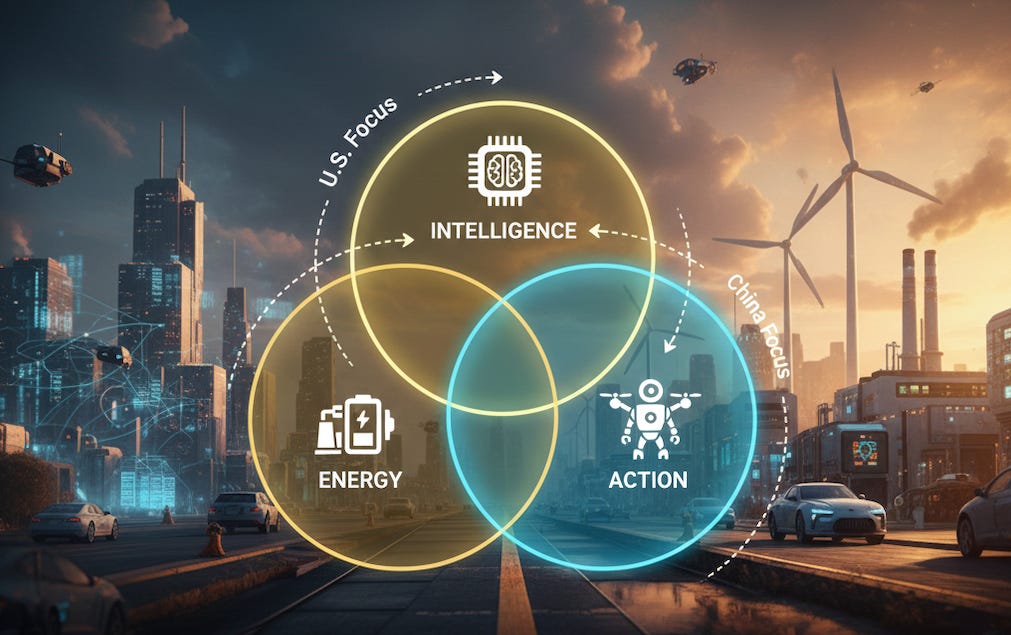
The U.S. seems to be making an implicit bet: win decisively on intelligence first, then catch up on energy infrastructure and embodied systems later. China is running the opposite play: build overwhelming strength in batteries, motors, power electronics, and manufacturing capacity, and then plug increasingly capable intelligence into that base.
In terms of peak electricity demand, China and the U.S. set the records of 1,450 GW and 759 GW respectively. China does not only serve more demand, it is also building a larger overhang of available power. China now generates roughly 2.5 times as much electricity as the U.S.. It operates the world’s largest renewable energy system and manufactures the majority of global lithium-ion batteries and a dominant share of neodymium magnets for electric motors.
China is rapidly closing the gap in power electronics and now produces a large portion of the world’s power conversion systems. While still catching up in leading-edge chip manufacturing, China is accelerating its dominance in edge processors and embedded AI chips—exactly the components that go into robots, drones, vehicles, and industrial equipment. Crucially, companies like BYD, DJI, and Huawei don’t merely supply parts; they integrate the entire stack into finished product [15]15.
Simply put, each superpower faces its own critical bottleneck: for China, it is semiconductors; for America, it is electricity.
Controlling the cost curves of the electro-industrial stack
This integration powers almost everything that moves, powers, or computes, from EVs to robots and drones to data centers. China’s dominance of the electric stack is not just about supply-chain self-sufficiency. It increasingly controls the cost curves for the entire embodied-AI ecosystem.
The dynamic works like this:
Motors get cheaper.
Batteries get cheaper.
Power conversion hardware gets cheaper.
Edge compute gets cheaper (even if the very highest-end chips remain constrained).
When all of those components get cheaper at the same time, robots get cheaper. When robots get cheaper, deployment accelerates. As deployment accelerates, data generation increases. As data increases, AI models improve. As models improve, more complex tasks become automatable. This is the virtuous cycle China has been orchestrating.
For embodied AI to move from niche applications to transformative, economy-wide impact, unit economics must cross a threshold. A US$150,000 humanoid can only justify itself in wealthy countries and narrow use cases. A US$6,000 humanoid, roughly where Unitree has driven some models, down from around US$16,000 in a single year, can scale to eldercare facilities, warehouses, and factories around the world. That kind of price compression is driven almost entirely by electro-industrial cost curves that China increasingly controls.
Another critical foundation of the electro-industrial stack is the dominance of steel and rare earth production. In 2024, China produced over 50% of global steel and 70% of global rare earth elements, while processing nearly 90% of the world’s rare earths [16, 17]1617.
Investors like Ryan McEntush at a16z have argued that the electro-industrial in batteries, motors, power electronics, and compute will “move the world,” unleashing a productivity boom and a new industrial renaissance [18]18. If that’s true, then China, with its world leadership in manufacturing everything from EVs to drones to electric bikes to robots, is heading directly to where the ball is going.
In industrial robotics, China has already become the global center of gravity. According to the International Federation of Robotics, roughly 4.28 million industrial robots were operating in factories worldwide in 2023, an all-time high and a 10% year-on-year increase.
Annual installations have held above half a million units for three consecutive years. Around 70% of all new industrial robots in 2023 were installed in Asia, reflecting both manufacturing concentration and the rapid shift from labor-intensive production to highly automated, AI-enabled factories [19]19.
A decade ago, most industrial robots in China were imported. Today, Chinese manufacturers provide close to or more than half of all robots installed in China, with domestic market share rising to roughly 47–57% in 2023–24. China has also overtaken Japan to become the largest producer of industrial robots globally. With a domestic installed base approaching 2 million robots by 2024, China’s factories have become the main training grounds for the next generation of embodied AI [20]20.
Compared with industrial robots, humanoid and service robots are still early in their growth curve. Global installed volumes remain small, but capital and expectations are large.
Morgan Stanley estimates that the global humanoid robot market could reach US$4.7–5 trillion in annual revenue by 2050, with a cumulative installed base of more than 1 billion humanoids worldwide. Their analysis starts from a roughly US$60 trillion “embodied AI” total addressable. Indeed, China could end up the “embodied AI” factory for Western brands in addition to being self-sufficient domestically [20].
For now, however, the humanoid market remains capital-intensive and experimental. Before humanoid robots can take off, they still need AI world models and physical AI capabilities for spatial reasoning, and comprehensive safety measures beyond just economic viability.
Undeniably though, these elements of commoditized intelligence, energy scale, manufacturing dominance, and deployment speed form the core competence of China’s advantages. The question for Western competitors, then, is no longer simply, “Can we compete in AI?” It is, more precisely:
Can we compete in the manufacturing, supply chains, energy systems, and cost optimization that turn intelligent systems into deployable reality?
V. The Emerging AI–Robotics Flywheel
Codename for a long game - MIC2025
China’s capabilities in energy, hardware, and manufacturing didn’t materialize overnight. They are the product of decades of industrial policy and investment from “Made in China 2025,” (MIC2025) infrastructure build-outs, and long-run bets on high-speed rail, new-energy vehicles, and biomedicine.
The national strategy “Made in China 2025,” launched in 2015, explicitly aimed to shift the country from low-cost manufacturing to a high-tech, high-value-added industrial powerhouse. Ten strategic sectors were identified, with high-end numerical control machinery and robotics prominent among them, alongside next-generation IT, advanced rail, new energy vehicles, and biomedicine [21]21.
Despite trade headwinds and export controls, multiple independent analyses suggest that around 80–86% of the more than 260 specific Made in China 2025 targets have been achieved by 2024–25 [22]22. In robotics, the policy translated into domestic content requirements, R&D subsidies, local action plans (especially in provinces like Jiangsu and Guangdong), and the build-out of innovation platforms, standards, and testbeds.
The rise of dense regional ecosystems—sometimes described as “six dragons” in places like Hangzhou—reflects the combination of local government support, entrepreneurial drive, and dense supplier networks.
In August 2025, The State Council of China released “AI-Plus Plan”, a national strategy to deeply integrate artificial intelligence across six key sectors (science, industry, consumption, quality of life, governance, global cooperation) by 2030, aiming for an “intelligent economy” and “intelligent civilization” by 2035.
The focus was placed on practical deployment, “new quality productive forces,” robust infrastructure (data/compute), and fostering an open-source AI ecosystem to drive economic growth and national competitiveness, distinct from purely frontier research.
In short, in 10 years, China aims at AI capabilities fully integrated across the entire economy with complete AI penetration across all sectors [23]23.
This “long game” mindset driven by the State allows incremental gains in talent, supply chains, and capital to compound into an ecosystem that now moves at speed and scale few other economies can match.
All of these capabilities are starting to behave like a self-reinforcing AI–robotics flywheel. This flywheel spins through three interconnected layers: industrial production, societal adoption, and intelligent infrastructure.

Layer 1: Industrial foundation
The first layer of the flywheel is the industrial foundation: a manufacturing base and near self-sufficient robotics supply chain that provides an unmatched proving ground.
China now has one of the world’s largest installed bases of industrial robots, and it continues to deploy more than half of all new industrial robots globally each year. Each robot on each production line is not just replacing human labor; it is generating terabytes of real-world sensor data (gripper pressures, motion paths, error recoveries, task adaptations) that can be fed back into machine-learning models to improve the next generation of robots.
That creates a data virtuous cycle: more robots in factories produce more real-world training data; better models produce more capable robots that can handle more complex tasks; more capable robots justify further adoption. The factory floor has essentially become the training ground for embodied AI in the physical world.
Simultaneously, every critical component (actuator, torque sensor, gear reducer, vision system, control board, even custom microcontroller) is available domestically, often within dense localized ecosystem clusters like Shenzhen’s Huaqiangbei or Beijing’s Zhongguancun. A new robot design in such a localized ecosystem can go from concept to prototype in weeks, not months, with cost-efficient iterations happening at a pace that is difficult to match elsewhere.
The economic barrier to experimentation is low, iteration cycles are tight, and price–performance improves quickly. A “wolf-pack” dynamic with dozens or hundreds of small competitors all pushing to outperform each other drives down costs while simultaneously ratcheting up capabilities.
Layer 2: Societal adoption
The second layer of the flywheel is societal adoption, driven by demographics, urbanization, healthcare and policy.
Widespread cultural optimism toward technology adoption
Cultural optimism toward technology adoption is widespread in China, with citizens readily embracing innovations that promise to improve everyday life. After all, this confidence is rooted in tangible everyday experience: over the past decade, citizens witnessed the transformative leap from cash-based transactions directly to mobile payments, skipping the intermediary card-based phase entirely.
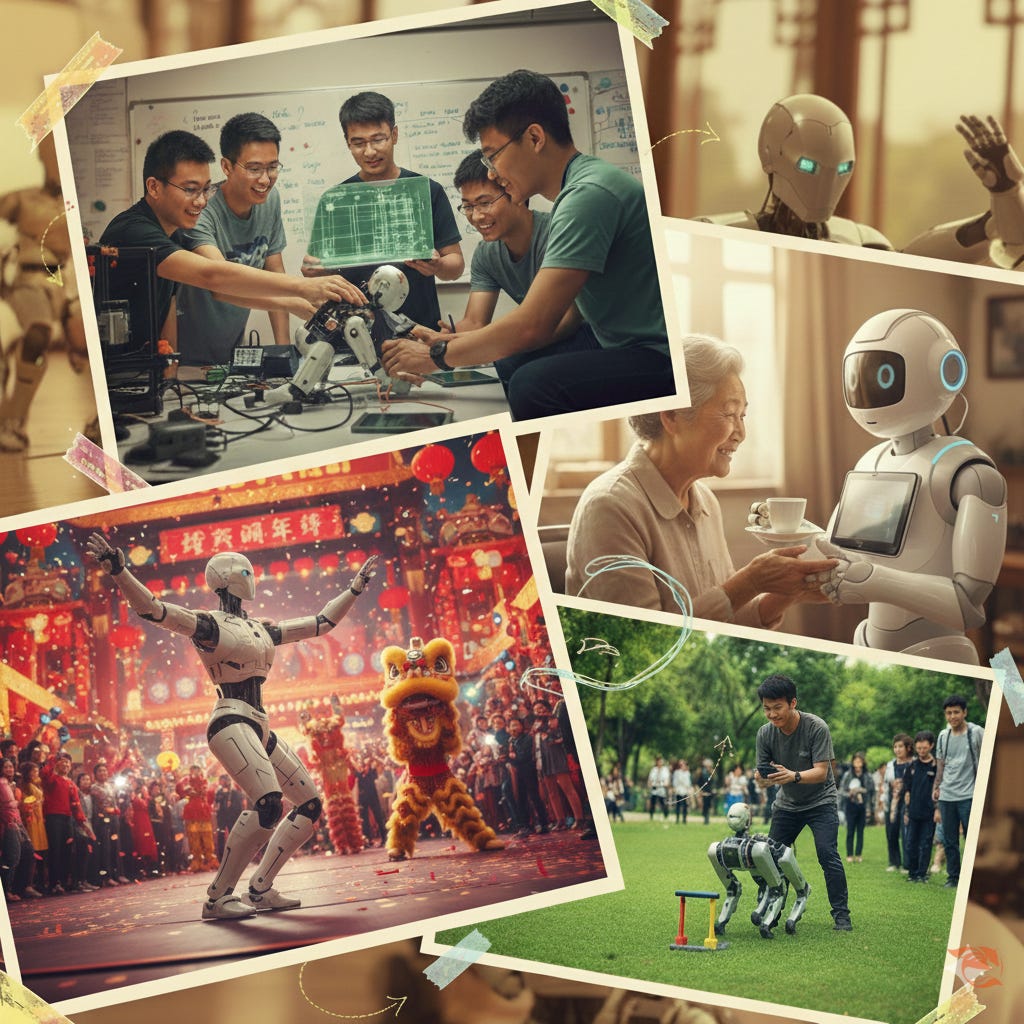
Today, that optimism is manifesting visibly. Robots serve meals in restaurants, perform as dancers in pop concerts, and take center stage during New Year celebrations.
Preparing for the tsunami of labour shortage and silver economy
China’s demographic and labor trends create a structural pull for robotics. More than 310 million people are now over 60 (compared to the U.S. population of about 340 million), and the working-age population is shrinking.
Young people increasingly avoid low-wage, physically demanding, or hazardous jobs even at higher pay. This produces acute shortages in exactly the roles robots can fill: eldercare staff, warehouse workers, cleaners, and basic service roles. Unlike many Western countries where labor regulations, unionization, and social anxiety can slow automation, China’s state-driven policy environment and relatively enthusiastic attitude toward new technology make large-scale experiments politically and socially feasible.
The Economist estimated that, by 2050, 487 million people will be over the age of 60, about 35% of China’s population, up from 21% today. This calls for digital healthcare to support the wave of chronic diseases brought by the rapidly ageing population [24]24.
Central and local governments are actively seeding adoption. A three-year elderly-care robotics pilot program is underway. Notable pilot examples include Beijing’s smart elderly care station robot and Shanghai Changning District’s elderly care robot companion. Cities like and Shenzhen offer subsidies of up to 30% of the purchase price for approved eldercare robots.
The Ministry of Civil Affairs has issued directives encouraging deployments in hospitals, nursing homes, and community care centers across dozens of cities. Each deployment produces data and experience that loops back into product design and policy, tightening the link between need, experimentation, and refinement [25, 26]2526.
Telemedicine took off during the covid-19 pandemic out of necessity. While significant traction was achieved by digital health apps such as JD.com’s JD Health App (serving over 500,000 consultations a day) or Ant Group’s AQ app (served 140 million patients with 1 million doctors on the platform), the typical users of telemedicine apps are young urban resident who already have access to the best access to China’s public health services. Hence, it is far from the original goal of offering healthcare access to faraway experts for the rural population [24].
In November, 2025, the Central Government released a plan calling for “full coverage” of AI-powered diagnosis and treatment tools at grassroots health centers by 2030. The notion here is to allow local doctors to use AI models to access the latest advice and help build patients’ trust in the technology while only complex cases would go to large clinics and hospitals [23].
Layer 3: Intelligent infrastructure
The third layer of the flywheel is intelligent infrastructure, where state coordination is most visible, especially in smart cities, autonomous driving (autonomous EVs and robotaxis), and the low-altitude economy (drones and air taxis).
Not just intelligent things
China has designated hundreds of cities as candidates for smart-city development, with billions of dollars flowing into intelligent infrastructure: sensors, cameras, roadside units, and computational layers used to construct unified digital twins of entire urban areas.
In policy documents, this is often described as “vehicle–road–cloud integration”: vehicles, roads, and cloud systems all talking to each other in real time [27]27. It is the whole symbiotic integration of vehicles, physical road infrastructure and backend cloud infrastructure that requires to be intelligent and connected.
Pilot cities like Shenzhen, Shanghai, Beijing, Wuhan, and Guangzhou are running thousands of autonomous vehicle-miles per day on real streets, under coordinated traffic control and data-collection regimes.
Don’t just fly, soar
Parallel to ground-based systems, China has identified the low-altitude (LAE) economy as a strategic emerging industry. The LAE comprises of consumer drones (0-120m), industrial drones (up to 300m), cargo drones (50-300m) an eVTOLs/passenger aircraft (300-600m on fixed, pre-approved routes).
The Civil Aviation Administration projects this market could reach 1.5 trillion yuan (about US$210 billion) by 2025 and 3.5 trillion yuan by 2035 [28, 29]2829.
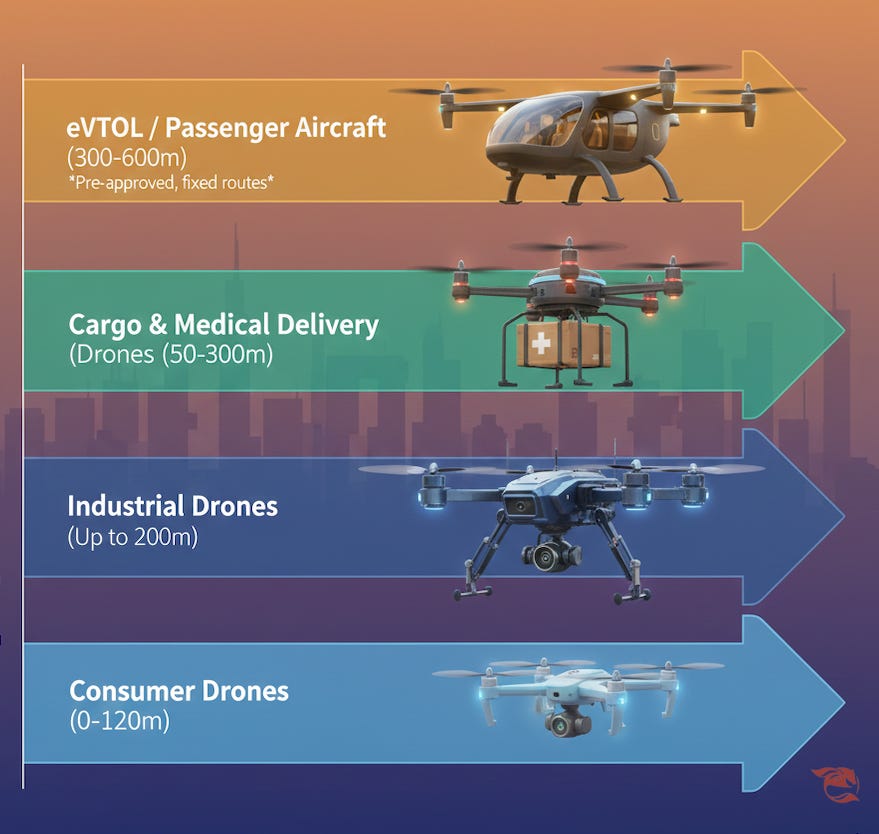
To enable that, regulators have opened dedicated air corridors, simplified certification for cargo flights, and built take-off/landing sites, maintenance centers, and localized air-traffic management systems across more than 30 provincial regions. Companies like Ant Work (medical drones), DJI (commercial and agricultural drones), JD Logistics, Meituan, and SF Express already operate thousands of drone routes, completing hundreds of thousands of commercial deliveries in major Chinese cities such as Shenzhen where drone landing pads are installed in office buildings and shopping malls for aerial deliveries.
In addition, medical delivery corridors into rural areas are established to dramatically cut down the accessibility and timeliness of healthcare [30]30. All of this creates a unique ecosystem where billions of autonomous vehicle-kilometers—on the ground and in the air—are logged annually. In fact, a robotaxi revolution is gathering pace where the cost of China’s robotaxi is one-third of the cost of Waymo’s in America [31]31.
Put these three layers together and you get a self-amplifying loop:
1. More embodied AI systems (robots, drones, autonomous vehicles) are deployed.
2. More use cases, data, user feedback, operational insights, and fail-forward lessons are generated.
3. Better algorithms, training datasets, and control policies emerge.
4. Robots become more capable and cheaper to build.
5. New applications and solutions emerge.
6. Loop back to step 1.
And the flywheel spins faster.
Morgan Stanley estimates that humanoid robots alone could see cost declines of more than 50% over the next 5–10 years as volumes increase and AI improves, mirroring the cost trajectories seen in electric vehicles and solar photovoltaics before them [18]. If that happens, the economics of deploying embodied AI at massive scale begin to look not only plausible but inevitable.
The 158-km clue
Not only is China striving to build intelligent infrastructure, it is also transforming the way infrastructure is being built and maintained. In October 2024, China had completed the world’s first fully unmanned paving construction along a 157.79 km stretch of the Beijing-Hong Kong-Macao Expressway.
The use of fleets of autonomous pavers, robotic rollers and drones, all operated remotely with no worker on the road represents a powerful leap in AI-driven road construction and maintenance in the future. This approach reduced human risk and improved safety, quality, speed and scale of infrastructure delivery [32]32.
What makes China’s AI–robotics flywheel distinctive is simultaneity and scale. Industrial robots are already deeply embedded in production; humanoid and service robots are moving out of labs and into early commercialization; autonomous vehicles and drones are being tested and, in some cases, used in real operations across dozens of cities.
China is running all three layers together, across hundreds of cities and thousands of factories, at once. No other country is running this experiment at comparable scale across all three dimensions.
VI. Entrepreneurial Culture, Deep Talent Pool and Permissive Policy As Turbochargers
The flywheel is not just a product of top-down planning. It is also turbo-charged by entrepreneurial culture in the private sector and lubricated by policy at the state, provincial, and city government levels.
The iteration culture
Chinese entrepreneurs in robotics and embodied AI are willing to show unfinished, imperfect products in public. At trade shows and expos, it is common to see humanoids that stumble, service robots that occasionally misroute themselves, and drones that are still rough around the edges.
Instead of hiding these flaws until everything is polished, founders invite feedback, iterate fast, and treat the field as a living lab. This cultural permission to fail fast, learn cheaply, and fix quickly shortens the path from idea to viable product.
Consumer-facing humanoids and service robots from firms like Unitree (sub-US$6,000 humanoids), UBTech (relatively affordable home companions), EngineAI Robotics (ready for mass production by 2026) and other startups are already in the hands of early adopters and researchers.
They are not perfect, but they are out there—walking, falling, learning. The same is true in cleaning, inspection, delivery, and security robotics. As early adopters deploy these systems in small but meaningful ways, they generate usage patterns, performance reports, and failure logs that feed directly into product roadmaps.
While American robots remain mostly in labs, Chinese firms are field-testing theirs across stadiums, factories and martial arts arenas in an industrial revolution fueled by scale, speed and system. South China Morning Post reported a stark contrast between tech giant Tesla and a shoestring Chinese robotics startup in the Greater Bay Area region.
Tesla’s Optimus recently “set a personal record” by jogging a few steps but fell backwards while trying to hand over a water bottle. Meanwhile, in less than two years, EngineAI Robotics, led by CEO Zhao Tongyang, created the T800 – a robot that delivers roundhouse kicks with the peak torque of a small car, human-like dexterity, and a solid-state battery for extended operation, will be ready for mass production by 2026 [33]33.

U.S.-China talent pool inversion
The entrepreneurial culture is reinforced by the deep talent pool of armies of engineering graduates. Beijing, Hangzhou, Shenzhen, and other hubs now host dense networks of founders, engineers, and applied researchers. Each year, China now produces on the order of 1.5 million engineering bachelor’s graduates, compared with about 140,000 bachelor’s graduates in the United States, an order-of-magnitude difference in the size of the technical talent pool.
Beyond sheer volume, universities and research institutes are adapting by allowing a working product, rather than a traditional thesis, to serve as a PhD defense, explicitly rewarding translation of ideas into real-world systems. Harbin Institute of Technology (HIT), one of China’s “Seven Sons of National Defense,” is part of a broader national pilot program led by China’s Ministry of Education and other agencies to let several top engineering universities in strategically important fields (semiconductors, quantum, etc.) experiment with product-based doctorates [34]34.
In addition, an interesting contrast emerges when examining the teams’ bench strength at DeepSeek and Meta’s Superintelligence Lab. A Stanford report analyzing 201 staff at DeepSeek found that 55% were trained and based entirely in China, with no U.S. affiliation.
Only 24% of DeepSeek authors had any U.S. affiliation, most for just one year [35]35. Meanwhile, half of the researchers reporting to Alexander Wang in Meta’s Superintelligence Lab received their undergraduate degrees in China [1].
On December 17, Tencent appointed Yao Shunyu, a 27-year-old fomer OpenAI reserach, as Chief AI Scientist, leading a new AI research structure for the billion-user Tencent/QQ/wechat ecosystem, and reporting directly to the President Martin Lau [36]36.
These cases signal China’s growing ability to train and retain its scientists locally and attract scientists from U.S., while the U.S. has become increasingly dependent on Chinese AI talent.
Many overseas-educated researchers and engineers are returning to mainland China and Hong Kong to join University research and start companies, drawn by this combination of opportunity, ecosystem support, access to supply chains and geopolitics. And three Chinese tech giants (Tencent, Alibaba and ByteDance) spent over RMB 100 billion on AI infrastructure in 2024 [36].
Policy is the third turbocharger. Numerous examples throughout this essay reflect a pattern of state-driven policy, permissive regulations and agile local government incentive schemes. At the highest level, China’s leadership has repeatedly emphasized the importance of AI.
In April 2025, Xi Jinping used a Politburo study session (20th collective study session) to push for an “orderly development” of AI, stressing both opportunity and risk. These high-profile signals matter. They tell ministries, provincial leaders, and SOE executives that AI is not optional; it is a strategic priority.
This is consistent with the only previous session focused on AI, the 9th collective study session held on November 2018, where Xi called for “healthy development of a new generation of AI. [37, 38]3738”
Entrepreneurship and the deep talent pool provide the catalysts. State-driven, long-term policies and permissive regulations provide the lubricant of agile rulemaking. Together, they keep the flywheel spinning.
VII. Going Global as the Fifth Great Invention
If this AI–robotics flywheel fully materializes inside China, it will not remain a domestic phenomenon. It will be exported—just as China has already exported high-speed rail, 5G infrastructure, smartphones, solar panels, and electric vehicles.
In each earlier wave, the pattern was similar: China combined domestic market scale, manufacturing cost advantage, and state-backed export strategies to capture large shares of emerging and developing markets. Robotics and embodied AI are poised to follow a similar trajectory, with potentially deeper implications.
The Global South, BRICS countries, Belt and Road partners, and other emerging markets represent a massive unmet demand for automation, infrastructure, and services. Many of these economies face their own versions of labor shortages, urbanization challenges, and infrastructure gaps. For them, Chinese robots, drones, and AI infrastructure can be an attractive package: lower cost, faster deployment, bundled financing and training, and often fewer political strings than Western alternatives.
China is already positioning robotics and embodied AI within its major geopolitical frameworks, especially the Shanghai Cooperation Organization (SCO) and the Belt and Road Initiative (BRI). At the 2025 SCO Summit in Tianjin, for example, China proposed a new “China–SCO Artificial Intelligence Cooperation Forum” and announced a plan to build an AI cooperation center for more than 20 SCO member nations [39]39. In parallel, Chinese companies are actively exploring BRI channels for robotics and AI exports.
In embodied AI, diversity of training data is crucial. A humanoid or service robot that learns only in Chinese factories and apartments will be useful, but one that has been trained through federated learning or structured data sharing on China’s factories, Thailand’s farmlands, India’s hospitals, and Brazil’s elderly homes will be far more robust.
China’s expanding networks of BRI and SCO partners give it a natural platform to pursue such a “global training set” in partnership with the Global South. This echoes earlier export plays in high-speed rail and telecoms but moves them up one layer, into the intelligence stack itself.
In August 2025, the State Council published an opinion paper describing AI as a “public good for humanity” [40]40. China has proposed setting up a new World AI Cooperation Organization and is working with the UN’s Pact for the Future and Global Digital Compact to build out processes for AI development and governance.
The private sector is already moving along this vector. Zhongke WengAI, for instance, is pursuing an explicit “going global” strategy. By investing in and partnering with firms like Cherrypicks, a major Asia-Pacific application developer and integrator headquartered in Hong Kong, it is building pathways to bring Chinese AI tooling into broader Asian, Middle East and Global South markets [12].
For many developing countries, the appeal is straightforward: lower cost than Western vendors, faster time to deployment, more flexibility in integrating with local systems, and a greater sense of sovereignty than being locked into proprietary Western SaaS and licensing regimes.
Just as important, China is not only exporting technology; it is exporting standards and governance frameworks. Initiatives like the “Shanghai Declaration” and other AI governance proposals are being pitched as reference points for countries that want AI development but are wary of being fully dependent on U.S. or EU rulemaking [41]41.
As The Economist’s latest feature article on “What China will dominate next” sharply pointed out that, in response to China’s rise, any knee-jerk protectionism in the name of security or safety from the West would be a mistake. It would be better for Western economies to reflect and rethink how innovation works at home [31].
For centuries, the world has remembered China for four great inventions: papermaking, printing, the compass, and gunpowder. Each fundamentally reshaped human civilization and spread far beyond China’s borders.
Today, as Chinese AI matures from generative models to embodied systems deployed at scale, could embodied AI (AI and Robotics) become China’s fifth great invention for the world? If history is any guide, this time the diffusion wouldn’t take centuries. It could unfold within a single decade.
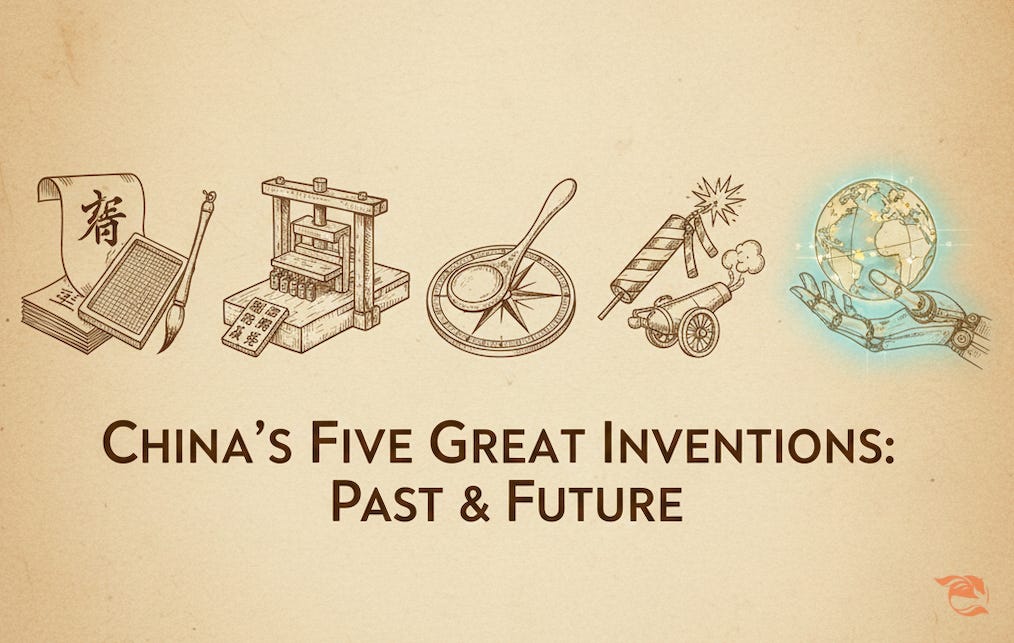
Notes: I wrote this article when I was invited to provide input on AI and Robotics for a new book about how companies need to change to win in China. I have used Perplexity to perform final edits and Gemini 3/Nano Bananas for illustrations.
Footnote references:
N. Benaich, State of AI Report 2025, pg 44-45, 135-138, 145-147, 172-174, 224-226, 239-240, 280-281, Air Street Capital, October 9, 2025
International Energy Agency (IEA), “Global EV Outlook 2024,” Paris, France, 2024. [Online]. Available: https://www.iea.org/reports/global-ev-outlook-2024
U.S. Geological Survey, “Mineral Commodity Summaries 2024,” Reston, VA, USA, 2024. [Online]. Available: https://www.usgs.gov/publications/mineral-commodity-summaries-2024
K.-F. Lee, AI Superpowers: China, Silicon Valley, and the New World Order. Boston, MA, USA: Houghton Mifflin Harcourt, 2018.
C. Miller, Chip War: The Fight for the World’s Most Critical Technology. New York, NY, USA: Scribner, 2022.
D. Wang, Breakneck: China’s Quest to Engineer the Future. New York, NY, USA: W.W. Norton & Company, 2025.
Unitree Robotics, “G1 and R1 Humanoid Robot Product Specifications,” Hangzhou, China, 2024. [Online]. Available: https://www.unitree.com
Junkai Li et al., “Agent Hospital: A Simulacrum of Hospital with Evolvable Medical Agents,” arXiv preprint arXiv:2405.02957, May 2024. [Online]. Available: https://arxiv.org/abs/2405.02957
Li Han, JP, “Tsinghua University holds Tsinghua AI Agent Hospital Inauguration and 2025 Tsinghua Medicine Townhall Meeting",” Beijing, China. Tsinghua Medicine, Tsinghua University, April 26, 2025. [Online]. Available: https://www.tsinghua.edu.cn/en/info/1245/14224.htm
MIT Sloan School of Management, NANDA. The GenAI Divide: State of AI in Business 2025. MIT Press; 2025.
Zhongke WengAI, “Company Overview and Product Portfolio,” Beijing, China, 2024. [Online]. Available: http://www.wengeai.com
“Zhongke Wenge strategically invests in Cherrypicks, a subsidiary of NetDragon (00777), to jointly promote the globalization of China’s AI technology,” iMedia, August 2025. [Online]. Available: https://min.news/en/tech/0124415b4372bf68758dac1e9d65b935.html
C. M. Christensen, The Innovator’s Dilemma: When New Technologies Cause Great Firms to Fail. Boston, MA, USA: Harvard Business School Press, 1997.

U.S. Energy Information Administration (EIA), “International Energy Statistics,” Washington, DC, USA, 2024. [Online]. Available: https://www.eia.gov/international/data/world
“2024 global crude steel production totals,” World Steel Association, January 24, 2025. [Online] Available: https://worldsteel.org/media/press-releases/2025/december-2024-crude-steel-production-and-2024-global-totals/
“Distribution of rare earths production worldwide as of 2024, by country,” U.S. Geological Survey 2024, November, 2024. [Online]. Available: https://www.statista.com/statistics/270277/mining-of-rare-earths-by-country/
R. McEntush, “The Electro-Industrial Stack,” a16z Podcast, Andreessen Horowitz, 2024. [Online]. Available: https://a16z.com/podcast/
International Federation of Robotics (IFR), “World Robotics 2024 - Industrial Robots,” Frankfurt, Germany, 2024. [Online]. Available: https://ifr.org/worldrobotics/
Morgan Stanley Research. Humanoids: A $5 Trillion Global Market. Global Insight, Morgan Stanley. April 2025.
State Council of the People’s Republic of China, “Made in China 2025,” Beijing, China, 2015. [Online]. Available: http://www.gov.cn/zhengce/content/2015-05/19/content_9784.htm
Z. Tong et al, “Made in China 2025: China meets most targets in manufacturing plan, proving US tariffs and sanctions ineffective,” South China Morning Post, April 30, 2024/ [Online]. Available: https://www.scmp.com/news/china/science/article/3260307/made-china-2025-china-meets-most-targets-manufacturing-plan-proving-us-tariffs-and-sanctions
“Explainer: China moves forward with its “AI Plus” initiative,” Xinhua News Agency, November 22, 2025. [Online]. Available: https://english.news.cn/20251122/d29059c2ba06428e8554a3b31589d4d3/c.html#:~:text=The%20%22AI%20Plus%22%20initiative%20aims,the%20industrial%20application%20of%20AI.%22
“Dr Chatbot will see you right now: China wants AI and telemedicine to bolster its health system,” Medical Innovation (2), page 34, The Economist, November 29, 2025
“Smart Healthy Elderly Care Pilot Demonstration MIIT 2024,” Ministry of Industry and Information Technology (MIIT), in partnership with the Ministry of Civil Affairs (MCA) and other agencies. 2024
W. Chen, “China turns to robots for elderly care with national plot programme,” South China Morning Post, June 9, 2025. [Online]. Available: https://www.scmp.com/tech/policy/article/3313739/china-turns-robots-elderly-care-national-pilot-programme
Ministry of Industry and Information Technology (MIIT), “Intelligent Connected Vehicle Road Test and Demonstration Application Management Regulations (Trial),” Beijing, China, 2024.
M. Chan, “IN FOCUS: What’s low-altitude economy, and is China struggling to make it fly?”, Channel News Asia. October 2025. [Online]. Available: https://www.channelnewsasia.com/east-asia/china-low-altitude-economy-air-taxi-drones-policy-regulations-5419456
Civil Aviation Administration of China (CAAC), “Development Plan for the Low-Altitude Economy (2024–2035),” Beijing, China, 2024.
“Drones deliver medical supplies to remote areas,” China Daily, Beijing, China, Oct. 2024. [Online]. Available: https://www.chinadaily.com.cn/
“What China will dominate next: The country’s high-speed innovation holds lessons for the world,” Leaders, page 9, The Economist, November 29, 2025
“China Just Resurfaced 158 km of Highway Using Only Robots and Drones,” Highways Industry, October 21, 2024. [Online]. Available: https://www.highwaysindustry.com/china-just-resurfaced-158-km-of-highway-using-only-robots-and-drones/
T. Zhang, “How China’s US$150,000 robotic start-up beat Tesla boss Elon Musk in 2 years,” South China Morning Post, November 24, 2025/ [Online]. Available: https://www.scmp.com/news/china/science/article/3336182/how-chinas-us150000-robotic-start-beat-tesla-boss-elon-musk-2-years?module=perpetual_scroll_0&pgtype=article
Ministry of Education of China, “Pilot Program for Product-Based PhD Degrees in Engineering,” Beijing, China, 2023.
A. Zegart et. al., “A Deep Peek into DeepSeek AI’s Talent and Implications for US Innovation,” Hoover Institution and The Stanford Institution for Human-Centered AI, April 21, 2025. [Online]. Available: https://www.hoover.org/sites/default/files/research/docs/Zegart_DeepSeekAI_Talent_FINAL_4-21.pdf
“Tencent Appoints Former OpenAI Researcher Its Chief AI Scientist”, Technology, Bloomberg News, December 17, 2025.
“At the 20th Collective Study Session of the CCP Central Committee Politburo, Xi Jinping Stresses: Persist in Being Self-Reliant, Be Strongly Oriented Toward Applications, and Push the Orderly Development of Artificial Intelligence 习近平在中共中央政治局第二十次集体学习时强调 坚持自立自强 突出应用导向 推动人工智能健康有序发展 (Translation),” Center for Security and Emerging Technology. [Online]. Available: https://cset.georgetown.edu/publication/xi-politburo-collective-study-ai-2025/
“Xi Jinping Calls for ‘Healthy Development’ of AI (Translation)”, New America. [Online]. Available: https://www.newamerica.org/cybersecurity-initiative/digichina/blog/xi-jinping-calls-for-healthy-development-of-ai-translation/
Shanghai Cooperation Organization, “Tianjin Summit Communiqué,” Tianjin, China, June 2025.
State Council of the People’s Republic of China, “Opinions on Promoting the Development and Governance of Artificial Intelligence,” Beijing, China, August 2025.
Shanghai Municipal People’s Government, “Shanghai Declaration on Global AI Governance,” Shanghai, China, 2024.