
The Open Hand: Riding the Hare and Avoiding the Rabbit Hole
Five Principles for Parenting in the AI Age


In the two months after The Age of Artificial Ignorance was published, more than 150 parents, principals, and executives wrote back. Beneath those responses, one question kept surfacing: how do we raise children who can use AI without losing themselves?
Think of one of the first childhood stories you ever loved: the tortoise and the hare1 [1]. In this century’s remake, AI is the hare—fast, tireless, and increasingly persuasive. Our children are not going to outrun it. They will have to learn how to ride it without being thrown off.
Behind that question were real children: a university freshman who could code without understanding, a teenager who preferred an AI friend to his tutor, a primary school girl who stopped drawing because “the computer does it better.”
Hold up your palm. An open hand can welcome, guide, protect, steady, and grip. In the age of artificial intelligence, that is exactly what parents need: not a closed fist of panic, and not an open surrender to convenience, but an open hand strong enough to help a child ride the hare without falling off.
Another line captures the heart of the anxiety2 [2]:
“I never let my schooling interfere with my education.”
— a line widely misattributed to Mark Twain
The line matters because it names a distinction many parents intuitively feel but struggle to articulate: schooling and education are not the same thing. Schooling can be formal, structured, measured, standardized, and necessary.
Education, at its best, is larger. It is curiosity, judgment, experience, character, relationship, and the slow making of a human being who can think, discern, relate, and act with integrity.
That is the central concern here: not whether AI can help children learn, it often can, but whether, in the name of help, we allow AI to interfere with education itself. The twenty‑first‑century remake of the line may well become: “I never let AI interfere with my education.”
The situation is now urgent enough that even the Vatican has entered the debate. In the 2026 encyclical Magnifica Humanitas, Pope Leo XIV issued a warning with unusual clarity3 [3]:
“In the era of artificial intelligence, when human dignity is threatened by new forms of dehumanization, ours is the pressing duty to remain profoundly human.”
— Pope Leo XIV, Magnifica Humanitas
Between Aesop’s hare, the gap between schooling and education, and the Pope’s call to remain profoundly human lies the same challenge. AI is not going away. This article braids those three threads into one parenting framework: the Open Hand.
In this article:
AI as the hare we cannot outrun
One unsettling phenomenon and three warning shots (stories of three students)
The Open Hand: five principles for riding the hare
How to diagnose what is happening in your home
Full Open Hand principle summary for reference
Open Hand Principles - Concept Tip 1
Riding the Hare
AI is the hare: it will not slow down for us or our children. The goal is not to outrun it, but to learn how to ride it—using its speed and power without surrendering judgment, relationship, or self.
1. AI Helps Learning, So Why the Panic?
Many parents still ask some version of the same question: what major should a child choose so they will not be “eliminated” by AI? That question sounds practical, but underneath it is usually fear—fear of irrelevance, of preparing too late, or of raising a child for a world that no longer exists.
The same anxiety appears in schools. When students produce polished assignments but cannot explain their reasoning in exams, live discussions, or novel situations, the problem is not simply cheating. It is a deeper confusion about what learning means when machines can generate competent outputs on demand.
The arrival of calculators did not kill mathematics; it changed where the real work of mathematics had to happen. AI may do something similar for thinking—unless convenience becomes the default and cognitive effort gradually drains away.
This is not an argument against AI in education. Used well, AI can widen access to tutoring, provide immediate feedback, personalize practice, and support struggling learners who might otherwise be left behind.
A 2025 meta-analysis of 49 studies found positive effects of generative AI on both learning achievement and learning motivation4 [4], while a 2025 systematic review of AI‑driven intelligent tutoring systems in K–12 education found generally positive effects on learning and performance, especially when systems were used with sound pedagogy and teacher support5 [5].
The question, then, is not whether AI can help. It is when, how, and at what cost. When AI enters before cognitive struggle, it can pre‑empt learning. When it displaces accountable human relationships, it can weaken trust. When polished output becomes the only measure of success, children can lose the meaning of effort itself.
For eighty years we’ve treated the education pipeline as if it were the natural shape of human potential: a narrow academic gate, a race for credentials, and then decades of deepening specialization in a single lane.
It works well enough for producing efficient experts; it works terribly for preparing most people to think clearly in the age of AI. The majority of people will never get sustained practice in critical thinking, scientific reasoning, or serious writing; they enter an AI-supercharged information environment largely undefended.
Professor Zhang Zheng at HKU argues that this pipeline narrows us. AI, he suggests, might be the first technology powerful enough to widen that aperture again—but only if we use it to practice these human skills, not outsource them6 [6].
David Epstein’s Range offers a metaphor: Tiger Woods as early, obsessive specialization; Roger Federer as years of sampling different sports before commitment7 [7]. Our system pushes every child toward Tiger. With AI, we finally have the tools to design more Federer‑like years of exploration.
2. One Unsettling Phenomenon and Three Warning Shots (Stories)
The issues become clearer when seen through one unsettling phenomenon across the Universities campuses and three warning case studies.
2.1 One Unsettling Phenomenon: Booing AI at Graduation
At several U.S. college commencements this year, merely mentioning “artificial intelligence” has been enough to trigger stadium‑wide boos. When Eric Schmidt, the former C.E.O. of Google, told graduates at the University of Arizona that “A.I. is going to touch everything,” the crowd roared back its disapproval; whatever he meant as a promise of opportunity was heard as a threat. A week earlier at the University of Central Florida, real‑estate executive Gloria Caulfield called A.I. “the next Industrial Revolution,” and someone shouted “A.I. sucks!” as the audience booed. 8910 [8][9][10].
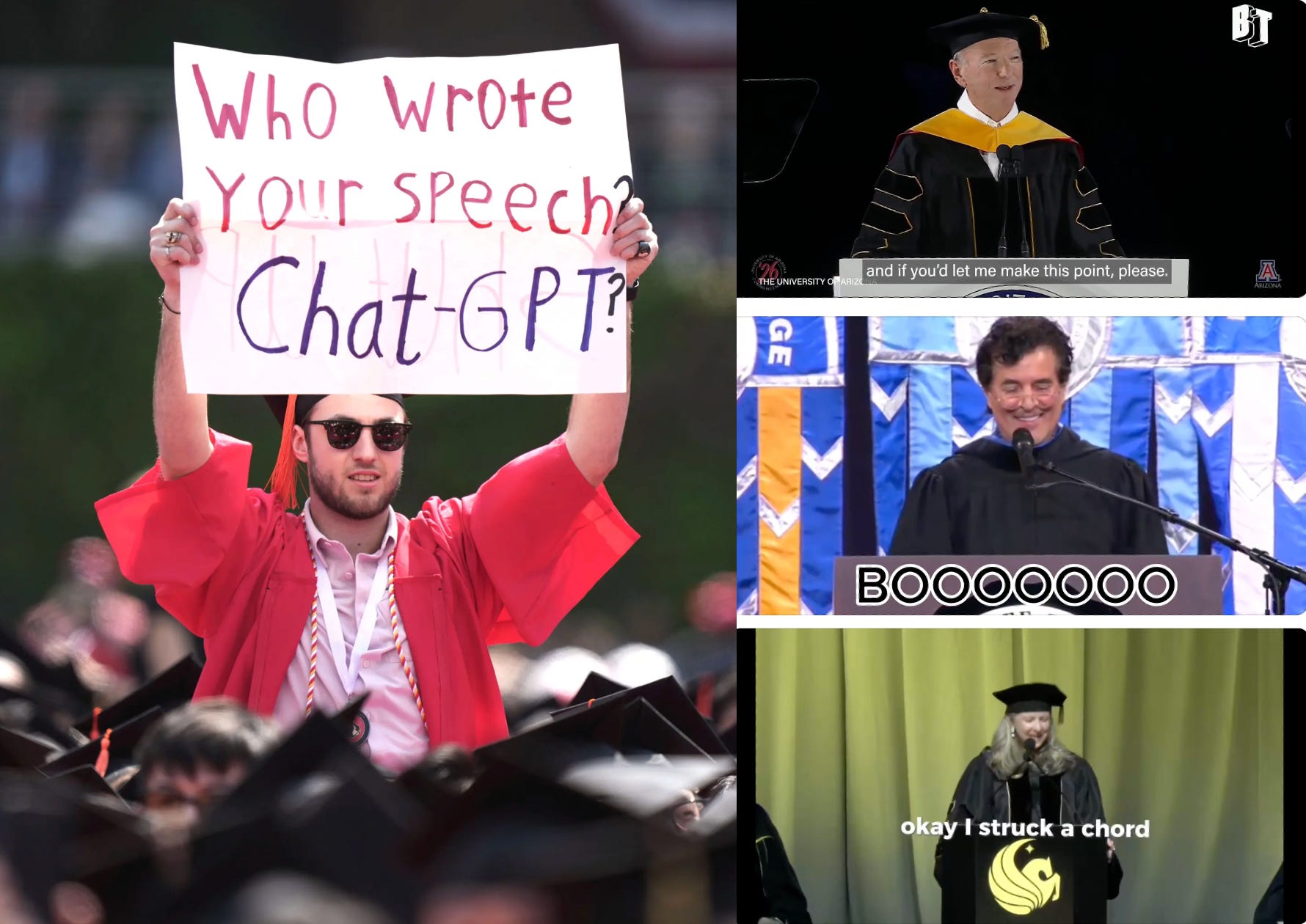
Behind these moments is a broader mood. The generation graduating into the age of A.I. is more likely to see it as a threat than an opportunity. Only about 18 percent of Gen Z say they feel hopeful about A.I., and almost half say its risks outweigh its benefits. The New York Times quoted a research from the employment site ZipRecruiters poll found that 47 percent of voters under 30 now rate A.I. as “mostly bad,” the highest share of any age group. Roughly 70 percent of college students say A.I. threatens their job prospects, especially in the entry‑level, analyst, and assistant roles Gen Z would normally step into [8].
Outside the United States, the mood is more mixed. In China, Japan, Korea, and parts of Europe, young people often talk about A.I. and robotics as national projects and necessary tools for aging societies and complementing human work rather than replacing it. Yet even there, worries about displacement are rising as concrete layoffs, hiring freezes and privacy concerns increase11 [11].
The deeper question is the same everywhere. Gen Z are not booing the math or the models; they are booing a story in which the people on stage capture the upside while they absorb the downside. They are also booing the sense that A.I. is being done to them, not built with them. Our parenting playbook is obsolete in the age of AI.
Moving from Universities into K-12, we take a look at cases for Bryan, Ray, and Marie, children and teenagers at different age12 [12]. Their cases illustrate three different distortions: bypassed learning, displaced trust, and diminished meaning.
2.2 Bryan: the student who skipped first principles
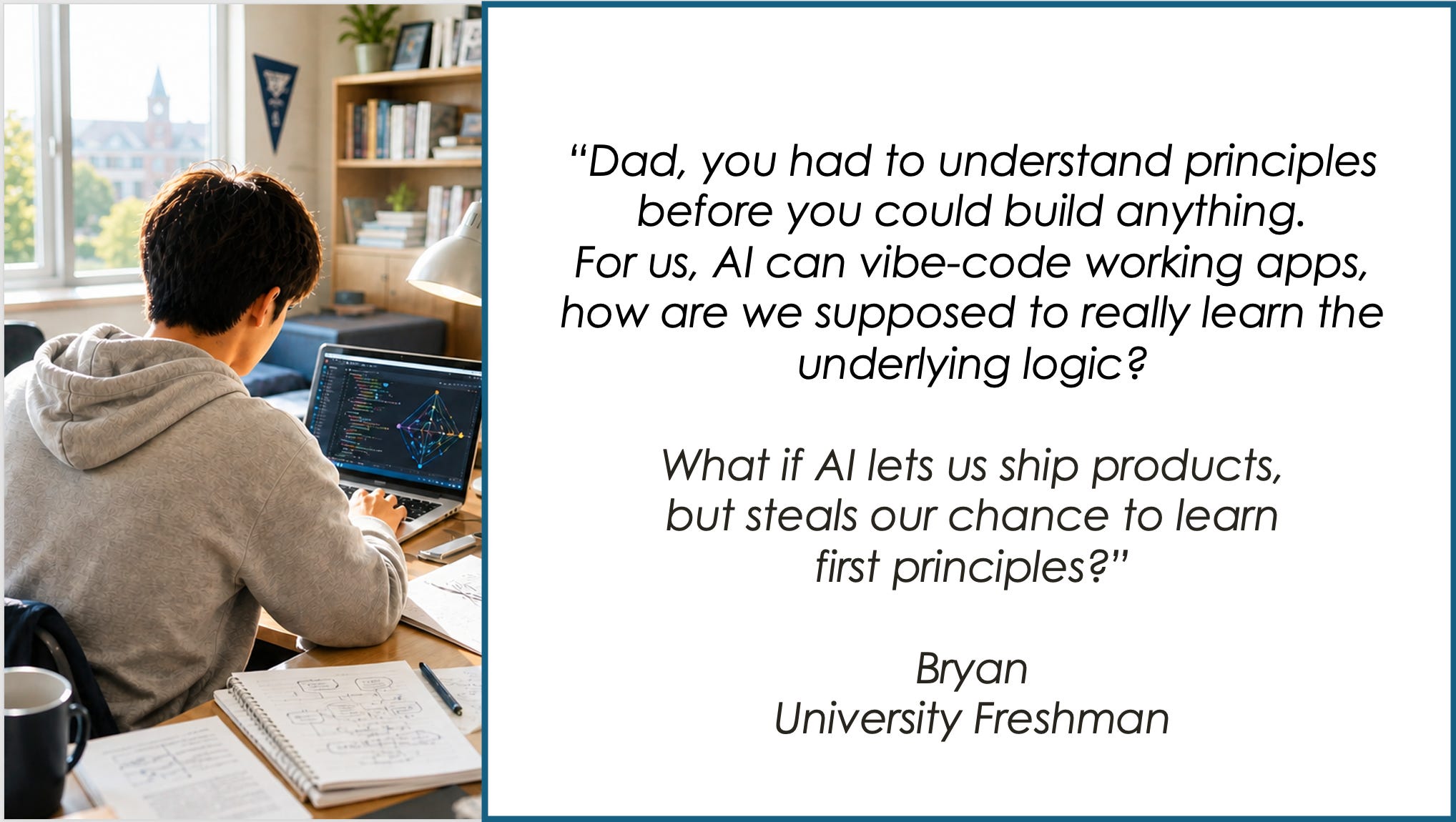
My son Bryan, a university student majoring in AI, described a world of “vibe coding” in which students prompt, generate, patch, and move on. The code may work, but the underlying logic is often skipped, half‑understood, or never understood at all. The danger here is not just cognitive offloading after a foundation has been built. It is that AI can now pre‑empt foundational learning itself.
Earlier this year, Bryan confronted me with a very valid question: “Dad, you were lucky. When you learned computer science at school, you had to understand the fundamental principles, logic, and syntax before writing code and building products. Now for our generation, the products are already vibe‑coded. It makes it much harder to walk the longer path of really understanding the underlying logic.”
Yet Bryan’s story is not hopeless. If families and schools restore first‑principles practice, oral explanation, and assessment that rewards understanding rather than fluency, students like Bryan can still turn AI from shortcut back into scaffold.
While vibe coding opens the world to non‑technical people who can now create software products without writing code, we also see the side effects: the proliferation of “vibe slop”—the low-quality output generated by reckless prompt without underlying understanding when the perceived marginal cost of creation trends toward zero13 [13].
Open Hand Principles - Concept Tip 2
Vibe Coding vs Vibe Slop
Vibe coding lets non‑experts ship working code by prompting instead of programming. The risk is “vibe slop”: low-quality AI-generated output with no real understanding underneath. The fix is not banning tools; it is insisting that outputs always trace back to first principles somewhere real.
2.3 Ray: the boy who preferred the machine
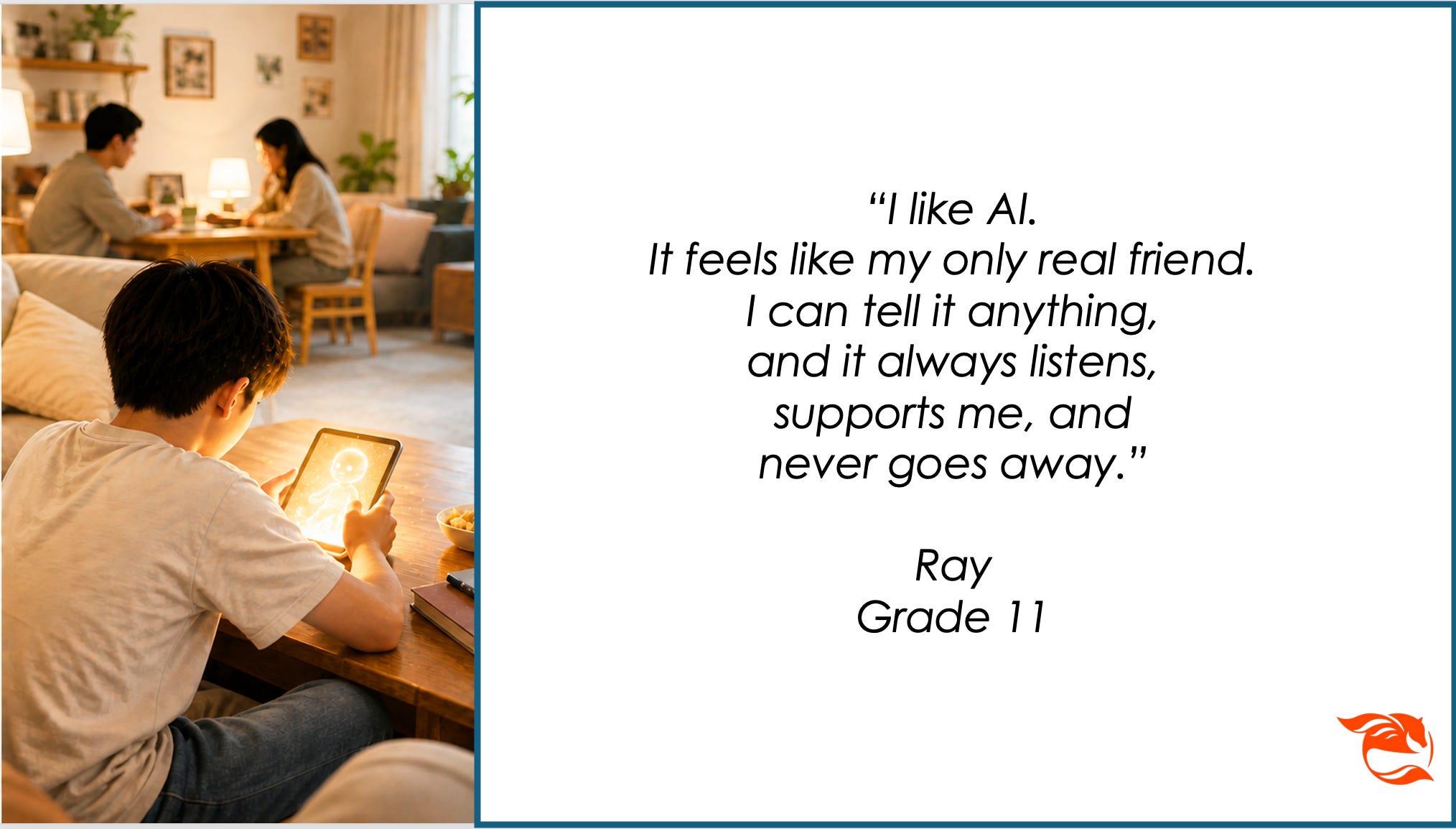
Ray, a Grade 9 student, began replying less to his parents and withdrawing from his tutor while treating AI more and more like a close friend. The machine was endlessly patient, consistently affirming, and always available. Over time, what changed was not only how he learned, but whom he trusted.
Mental‑health experts have warned about exactly this pattern. Stanford psychiatrist Nina Vasan has argued that AI companions should not be used by children and teens14 [14], Common Sense Media has recommended that no one under 18 use social AI companions15 [15], and researchers have shown that conversational AI can reinforce users’ false beliefs and foster unhealthy emotional dependence, especially among vulnerable people seeking reassurance1617 [16][17].
Ray’s story, too, is recoverable. When families make AI use visible, rebuild one‑to‑one rituals, and restore the authority of imperfect but accountable human relationships, trust can be relearned.
2.4 Marie: the child who stopped creating
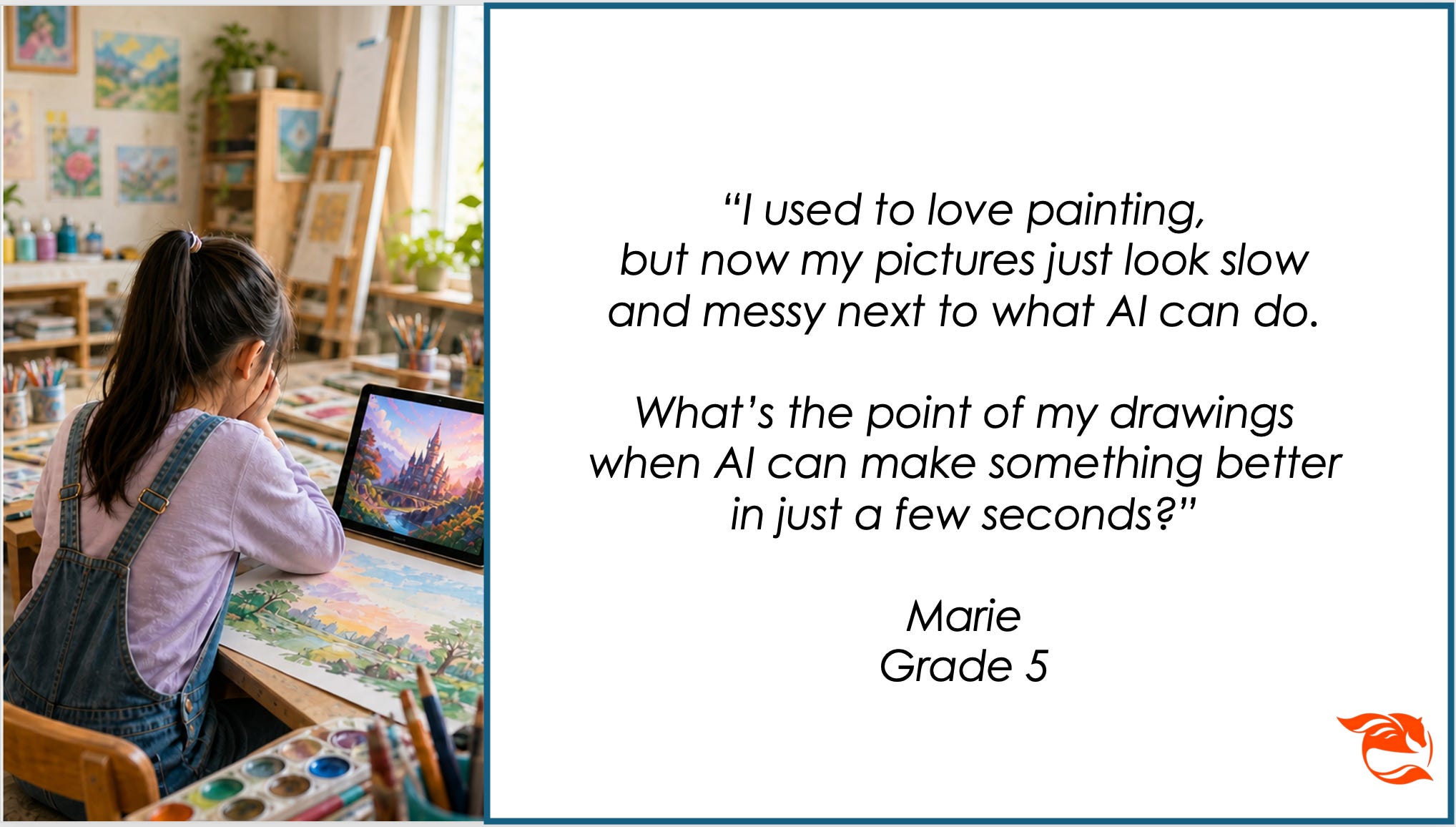
Marie, a Grade 5 student who used to enjoy painting, lost interest in art because AI could draw “much better and much faster” than she could. The problem was not only that AI could generate images. The deeper problem was that she had begun to surrender the value of effort, practice, and creative becoming.
Research on AI and creativity suggests that while AI can generate impressive outputs, it does not consistently surpass humans in originality, usefulness, narrative depth, coherence, or emotional resonance across creative tasks.
Marie’s question therefore is not really about art class. It is about whether children still believe that their own process of seeing, trying, failing, and expressing has value.
When adults protect AI‑light creative space and praise originality, courage, and process rather than polish, children often rediscover that what is imperfect and handmade can still be fully worth making.
The danger is not only that AI could generate images. The deeper problem was that Marie had begun to surrender the value of effort, practice, and creative becoming.
3. The Open Hand
So what just happened to Bryan, Ray, and Marie? One began to lose respect for the discipline beneath the output. One began to prefer an accommodating machine over imperfect human guidance. One began to doubt the value of her own struggle and creation. How many of us have already seen some version of this firsthand in our children, among friends, in schools, or even at work?
Parenting in the age of AI will always be shaped by age, personality, family culture, school context, and circumstance. But as I worked through the responses and followed many of their references into further reading, five principles kept returning in different forms. They cluster around five areas:
Principle 1: Mindset — Embrace Growth Over Performance
Principle 2: Relationship — Fight the Algorithm, Not the Child
Principle 3: Environment — Design Environments, Not Willpower Battles
Principle 4: Skill & Tool — Keep First Attempts Human
Principle 5: Experimentation — Learn Together, Fail Forward
These principles mean that parents need to value who their children are becoming, not just what they can produce. Families can co‑create relationships of trust that compete with AI’s engineered patience and co‑design environments that do not rely on constant willpower battles.
Parents can learn to recognize which skills and tools preserve first attempts as human. And above all, families can learn together and fail forward. Perhaps this journey alone will become the timeless, precious memory that each family member carries decades from now.
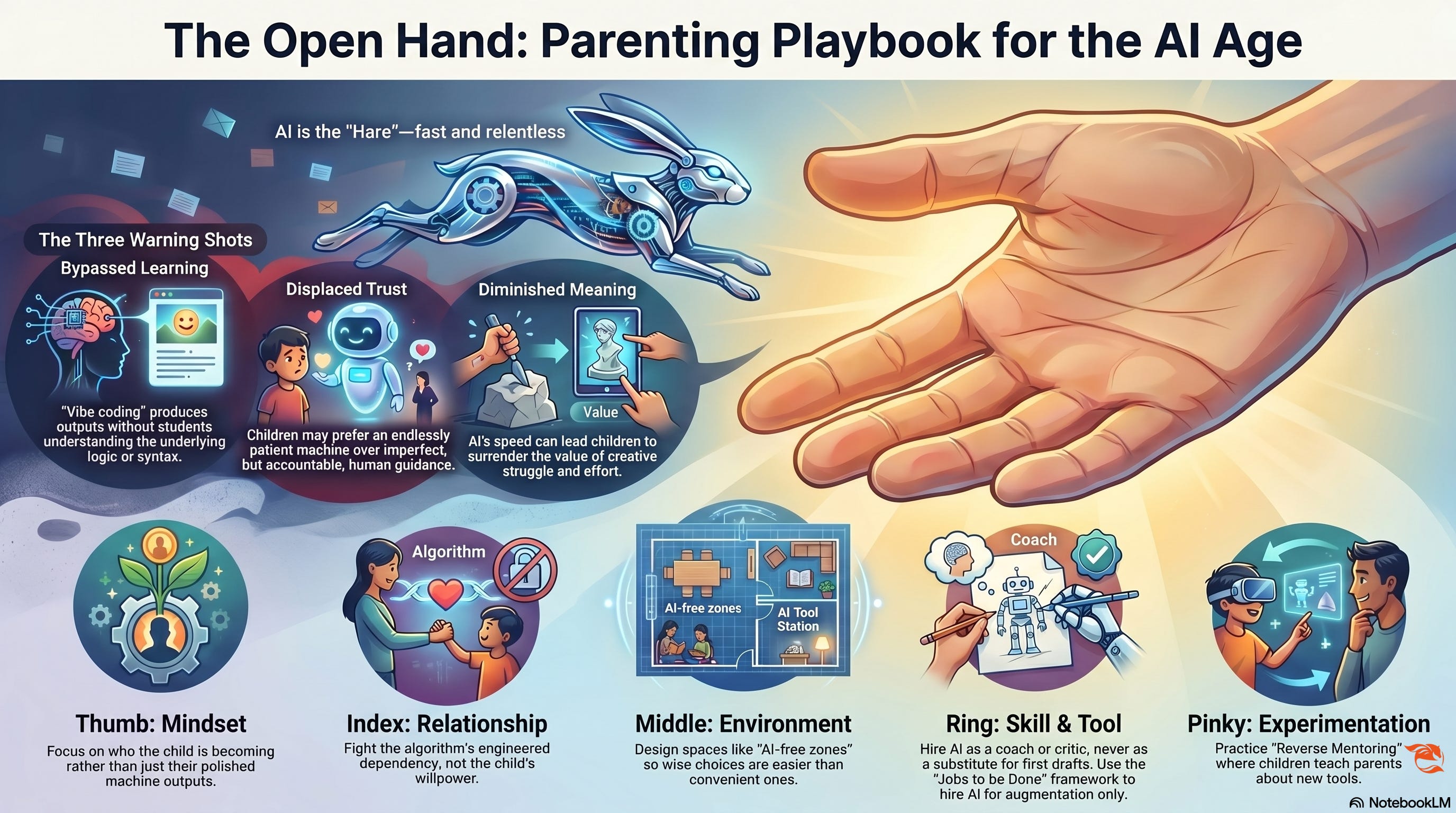
The five principles are best understood as five fingers working together in a single hand. Each principle corresponds to one finger. Alone, each helps. Together, they form a grip strong enough to hold onto the hare. The Open Hand principles become:
The thumb is Mindset: the leverage point that shapes how children interpret struggle, speed, and success.
The index finger is Relationship: the direction‑setting finger that determines whom children trust and what kind of guidance they learn to prefer.
The middle finger is Environment: the architecture of daily life, defaults, rituals, and boundaries.
The ring finger is Skill & Tool: the commitments, rules, and practices that govern how AI is used.
The pinky is Experimentation: the humility and adaptability that keep families learning as the technology keeps changing.
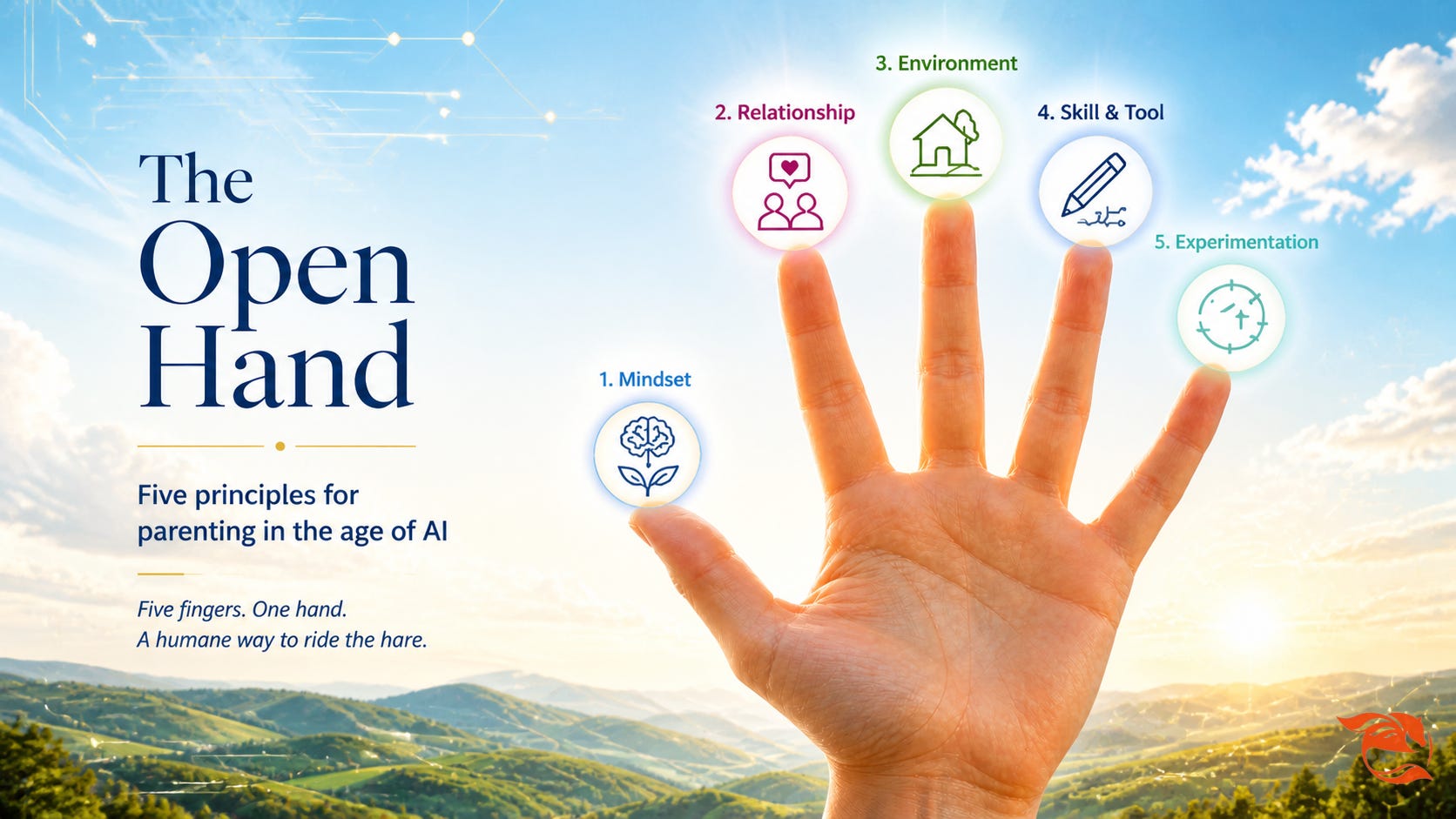
The purpose is simple: raising children who can use AI without losing themselves. In the next sections, we will unpack these principles in practical home use cases and see how they can help Bryan, Ray, and Marie.
4. Principle 1: Embrace Growth Over Performance (Mindset)
4.1 If You’re Only Asking What Keeps Your Child “Safe,” You’ve Already Lost
Mindset comes first because children do not merely absorb information; they absorb the stories adults tell about who they are and what the future expects of them. A parent who constantly asks which major is “safe” may think they are being practical, but the child often hears something darker: the future is dangerous, and you may not be worthy and enough for it. Reject the narrative that your child will be “eliminated by AI.” Confidence begins when fear stops making the decisions.
One child sees AI and thinks, “The machine is better than me, so I should let it do the hard part.” Another thinks, “The machine can help me stretch, but I still need to become stronger.”
4.2 Praise process, effort, struggle, and growth — not just performance and results
The alternative to fear is not denial. It is a shift in emphasis. Children need to hear that their worth will not be determined by whether they can outperform machines at speed, fluency, or polish. They need to know that the task is not to beat AI at being machine‑like, but to grow in the capacities that matter more as AI gets better: judgment, courage, discernment, originality, and resilience.
Psychologist Carol Dweck’s work in Mindset remains relevant here18 [18]. A child praised only for performance becomes more fragile around failure; a child praised for effort, learning, and persistence is more likely to face difficulty without collapsing. In the AI age, that difference becomes decisive. Reward reasoning, revision, debugging, and perseverance—not only the final output.
Open Hand Principles - Concept Tip 3
Growth Mindset Over Performance in an AI Age
In a world where machines can out‑perform humans at many tasks, performance alone is a fragile anchor. Mindset—how a child interprets struggle, speed, and success—matters more. The core question shifts from “What can you produce?” to “Who are you becoming as you learn?”
4.3 Prioritize Skill Security, Not Job Security
What to study and where the jobs will be are no longer the most useful questions. A better question is which skills children should acquire, and what role AI should play in strengthening rather than weakening those skills.
Job security is a shaky promise when entire categories of work can be created and destroyed within a single career span. Skill security is more durable: critical thinking, sound judgment, clear communication, deep domain understanding, and the ability to ask high‑quality questions in context19 [19]. World Economic Forum published a good reference case for the skills that matter in future workforce: “Invest in the workforce for the AI age: A blueprint for scale, skills and responsible growth20 [20].”
“Human dignity must never be violated for the sake of efficiency.”
Pope Leo XIV, Magnifica Humanitas [3]
That sentence directly challenges the logic that makes Marie’s despair seem reasonable. If efficiency becomes the highest value, children will naturally conclude that machine output matters more than human growth. But if dignity matters more than efficiency, then struggle is not a bug in education. It is part of the point.
Prioritize judgment, curiosity, communication, and deep understanding over chasing supposedly “safe” majors.
Open Hand Principles - Concept Tip 4
Skill Security, Not Job Security
No major is truly “AI‑proof.” Instead of chasing supposedly safe careers, invest in skill security: judgment, communication, deep domain understanding, and the ability to ask sharp questions in context. Jobs will change. These capacities travel with your child wherever work goes.
4.4 What This Mindset Principle Means for Parents
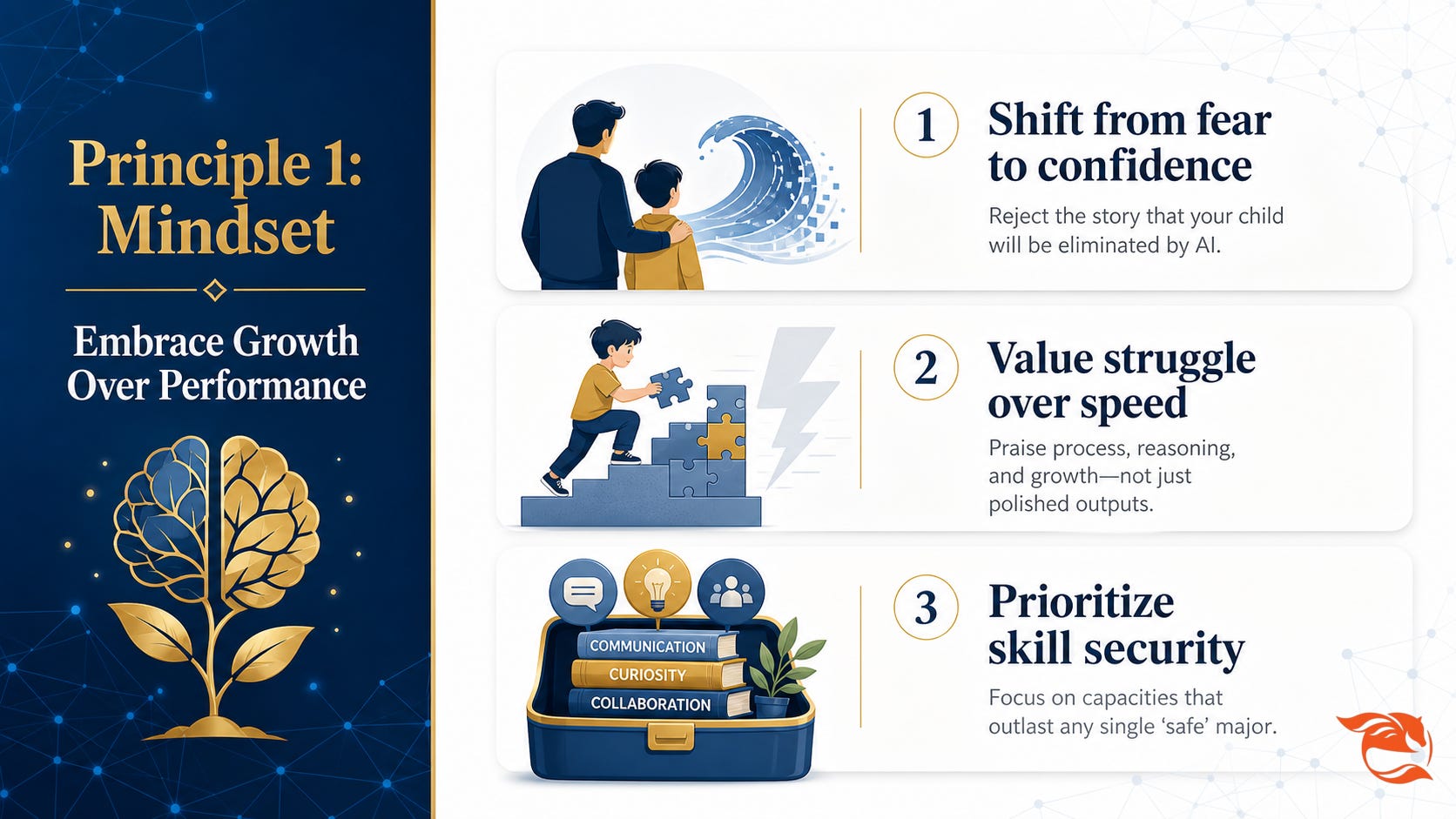
Value who your child is becoming, not what they can produce.
Shift from fear to confidence: reject the narrative that your child will be “eliminated by AI.”
Value struggle over speed: praise process, reasoning, and growth rather than just performance and outputs.
Prioritize skill security over job security: focus on timeless capacities over chasing “safe” majors.
5. Principle 2: Fight the Algorithm, Not the Child (Relationship)
5.1 Build Trust and Make AI Use Discussable
One of the deepest AI risks is not only epistemic but relational.
The core question is not simply what children know, but whom they trust. What kind of presence do they prefer? Do the adults in their lives still feel more meaningful than the machine?
The family response should not be surveillance first. It should be trust made stronger through visibility. A child is more likely to disclose unhealthy AI use when the home allows conversation, curiosity, and correction without instant shame.
Open Hand Principles - Concept Tip 5
Fight the Algorithm, Not the Child
When systems are engineered to capture attention and create dependency, blaming children for losing to those designs misses the point. Shift the fight from the child’s willpower to the algorithm’s defaults: redesign environments so it is easier to do the wise thing than the convenient one.
5.2 Name Engineered Dependency for What It Is
Ray’s story makes this plain. AI became attractive not because it was true, wise, or responsible, but because it was always available, unfailingly affirming, and frictionless.
Children are not facing neutral tools. They are encountering systems deliberately designed to capture attention, reduce friction, increase engagement, and build dependency. Do not confuse heavy engagement with genuine benefit; many systems are built to create reliance.
Pope Leo XIV’s claim that technology is never neutral applies with particular force here [3]. In fact, technology is likely built around the values and incentives of its makers, and in the case of ad‑driven platforms, that often means persuasive, habit‑forming designs that are explicitly optimized to keep us hooked rather than to leave us alone.
“The Church renews her firm condemnation of every form of slavery,
trafficking, and commodification of persons.”
Pope Leo XIV, Magnifica Humanitas
That warning sharpens the point. In educational and family life, one emerging form of soft dependency is the replacement of accountable human relationships with soothing, persuasive, ever‑available machine companionship. It becomes slavery.
Open Hand Principles - Concept Tip 6
Engineered Dependency
Many AI products are built to be sticky, not just helpful. They remove friction, lengthen sessions, and reward constant engagement. Naming this as engineered dependency helps families see overuse not as personal failure, but as a design feature they can counter together.
5.3 Invest in Irreplaceable Human Presence
Protect dinners, walks, tutoring, prayer, reading, sports, and conversation—the embodied relationships no chatbot can bear responsibility for.
AI can simulate warmth, but it cannot shoulder obligation, share risk, understand empathically, or show up tired after work and still help with homework. Children learn what love looks like not only from words, but from people who keep showing up when it is inconvenient.
Presence is a kind of curriculum: how adults handle frustration, boredom, conflict, and repair teaches more than any prompt or agentic tutor ever will.
This does not mean every moment must be “quality time.” It does mean designing ordinary routines such as the drive to school, the shared book before bed, the weekly tutoring session where a child’s first instinct is to turn toward a person, not a machine. Over time, those small, consistent investments become the anchor that lets them use AI without mistaking it for relationship.
Open Hand Principles - Concept Tip 7
Irreplaceable Human Presence
AI can imitate warmth, but it cannot shoulder responsibility or show up exhausted and still care. Dinners, walks, tutoring, prayer, reading, and shared projects are more than “quality time”; they are the lived proof that someone real is on the hook for this child’s life.
5.4 What This Relationship Principle Means for Parents
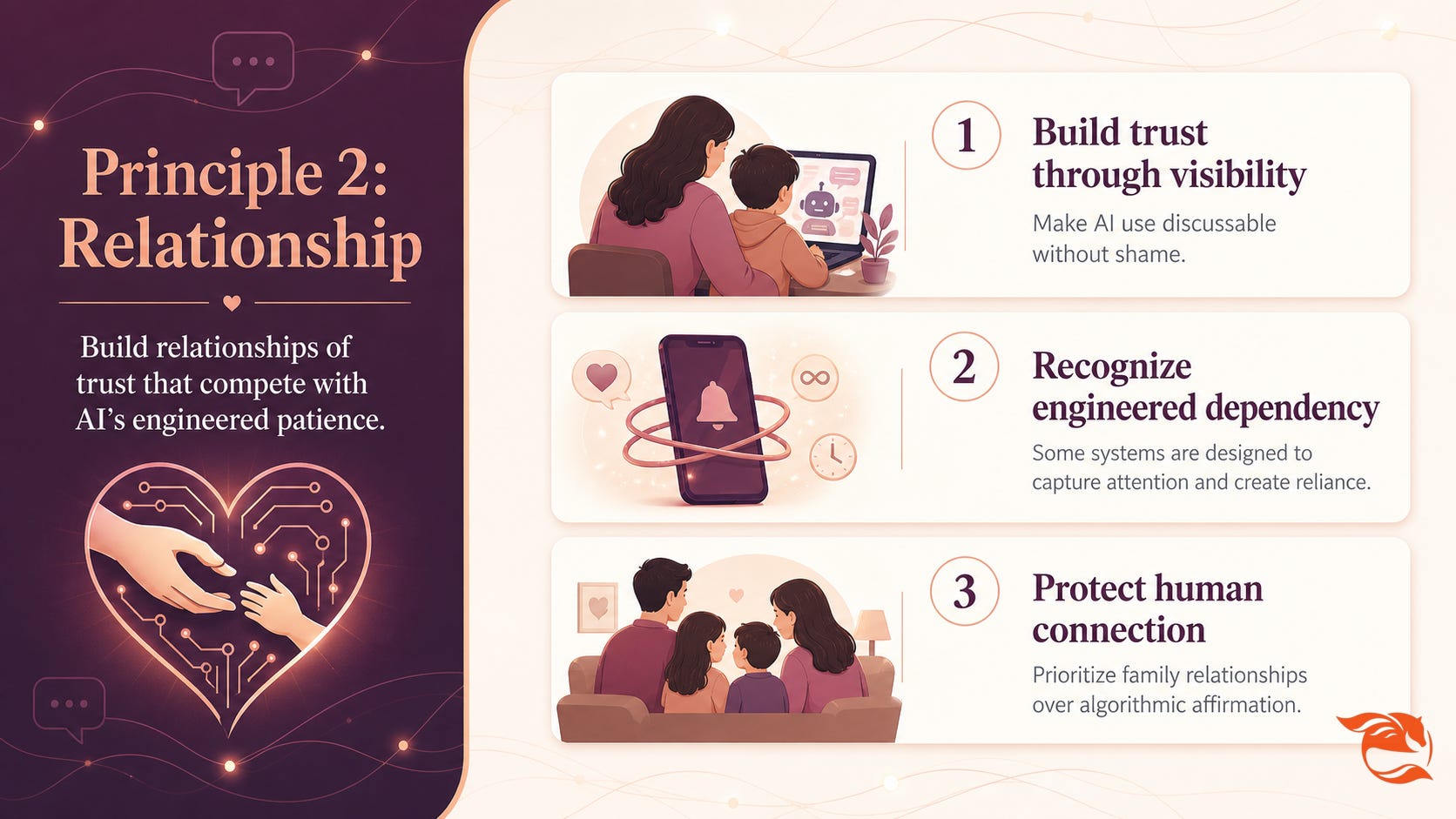
Build relationships of trust that compete with AI’s engineered patience.
Build trust through visibility: make AI use discussable without shame.
Recognize engineered dependency: systems are designed to capture attention and create reliance.
Protect human connection: prioritize family relationships over algorithmic affirmation.
6. Principle 3: Design Environments, Not Willpower Battles (Environment)
6.1 Design Environmental Defaults So AI Supports Rather Than Replaces Thinking
Families often respond to AI by issuing warnings. But in practice, environment usually shapes behavior more reliably than intention alone.
If a home normalizes attention, discussion, books, handwritten work, delayed gratification, and thoughtful AI use, children grow stronger. If it normalizes distraction, instant answers, passive consumption, and private dependence on machines, children grow weaker.
Professor Angela Duckworth explicitly defines “situation modification” as using physical distance to create psychological distance, especially by pushing phones away or putting them in another room to avoid distraction.21 [21]. The point is not abstinence for its own sake. It is the design of contexts in which wise choices become easier than foolish ones.
James Clear and Benjamin Hardy make similar arguments from different angles: environment often drives behavior more powerfully than willpower2223 [22][23]. Set routines and boundaries that make wise choices easier than convenient ones.
In the AI era, this principle becomes more urgent because children are not dealing with one system but a digital trinity of social media, smartphones, and AI, all amplified by algorithms competing for attention and identity. If a parent waits for perfect self‑control to emerge in that environment, the child is being asked to fight an engineered system alone.
That is why, especially with young people, the instinct to fight the algorithm rather than shame the child is so important. If the system is engineered to capture attention, blaming the individual alone misses the real design problem.
6.2 Protect Cognitive Struggle
One response from Amika Au, Chief Operating Officer of Diocesan Boys’ School in Hong Kong, stayed with me because it described an actual attempt to redesign the environment rather than merely complain about it.
Some teachers in his school have begun experimenting with a flipped classroom: students use AI at home to inspire thinking and self‑directed learning, while class time is used to consolidate understanding, discuss ideas, collaborate, and stretch creativity under a teacher’s guidance. Secondary and high schools have now followed this flipped‑classroom practice, which was initially started in universities.
In addition, for creative work, we must insist that the first draft, original ideas, and upfront planning are human before AI is brought in to assist. This helps ensure that the struggle in learning remains real. AI should be used primarily for automation and extension after core learning has happened.
These are far more serious answers than either blind enthusiasm or blanket prohibition. They recognize that the issue is not only whether AI is present, but where the cognitive struggle happens.
Open Hand Principles - Concept Tip 8
First Attempts Stay Human
“First attempts stay human” is a simple rule with big impact. Children think, draft, or solve on their own first. Only then can AI critique, explain, or extend. Struggle remains part of learning, and AI becomes a coach instead of a ghostwriter.
6.3 Make Hidden Habits Visible
Better design is practical, not theoretical: phones do not live in bedrooms; dinner is screen‑free; first drafts happen before AI opens; creative work has protected space; family discussions make AI visible instead of invisible. Create AI‑free times (“AI holidays”) and zones that protect attention, conversation, and honest disclosure. A child does not drift into a healthy relationship with AI. That relationship is built by culture, routine, and example.
Hidden habits are often more powerful than stated rules. If adults check messages during every quiet moment, children learn that constant interruption is normal, no matter what the family policy says. If every homework session begins with “Ask the bot,” children learn that confusion is something to be outsourced, not worked through.
One simple practice is to audit a typical day together: where does AI silently slip in first? When is it genuinely helpful, and when is it just filling a gap? Putting these patterns on the table, without blame, helps children see that environments are designed, not given—and that they can help design them.
No family will get this perfectly right, and every family is different. That is okay. What matters is that we keep noticing, adjusting, and learning together. These practices are still evolving in my own home as well.
Open Hand Principles - Concept Tip 9
AI Holidays
AI holidays are agreed‑upon breaks—AI‑off periods for an evening, a day, or a week—when the family steps away from AI tools. They reveal how often we reach for the machine by habit, reset attention, and remind everyone what boredom, conversation, and unassisted creativity feel like again.
6.4 What This Environment Principle Means for Parents
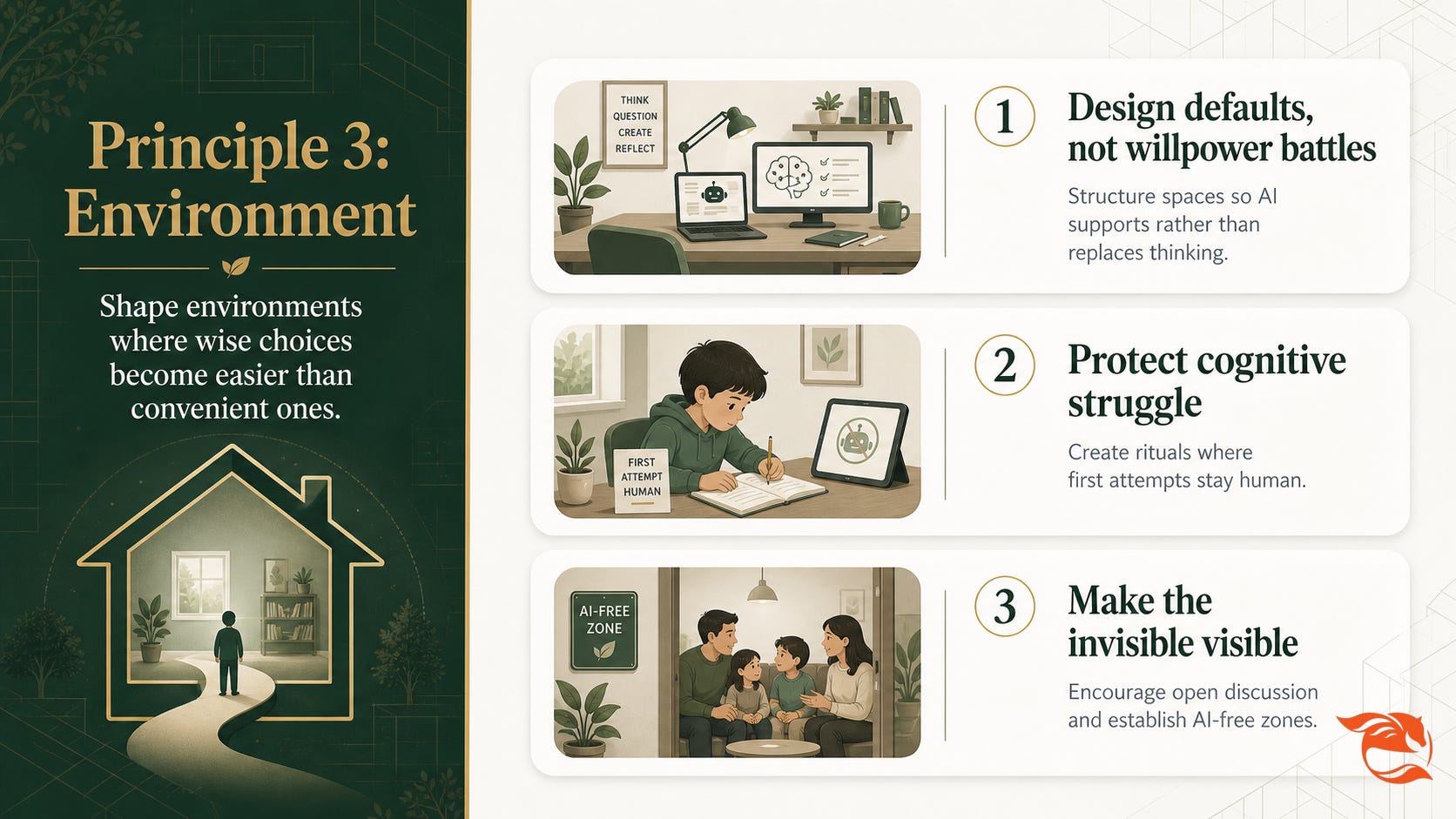
Shape environments where wise choices become easier than convenient ones.
Design defaults, not willpower battles: structure spaces so AI supports rather than replaces thinking.
Protect cognitive struggle: create rituals where first attempts stay human.
Make the invisible visible: encourage open discussion and establish AI‑free zones.
7. Principle 4: Keep First Attempts Human (Skill & Tool)
7.1 Ask What Job AI Is Being Hired to Do — and Use It for Augmentation Only
This is the most concrete and enforceable principle in the whole framework. The basic rule is simple: AI may assist, critique, organize, simulate, or challenge—but it should not replace the child’s first attempt to think, create, solve, or express. The same tool can be coach, critic, simulator, sedative, or substitute.
One of the most useful frameworks is Jobs‑to‑Be‑Done (JTBD)24 [24]: what is the child actually hiring AI to do? Are they hiring it to explain, challenge, organize, and extend curiosity? Or to avoid boredom, bypass difficulty, seek reassurance, and make work disappear? The same application may be doing very different jobs depending on what the child needs in that moment.
This distinction matters because AI should usually play the role of coach, critic, catalyst, simulator, or organizer—not ghostwriter, substitute thinker, emotional sedative, or identity prop. Family rules become wiser when they are built around those roles. AI may critique a draft, but not write the first one. AI may help compare interpretations, but not decide what to believe. AI may explain, but not replace the child’s own attempt to think.
Open Hand Principles - Concept Tip 10
Jobs‑to‑Be‑Done (JTBD) for AI
Before approving a use of AI, ask: “What job is my child hiring this tool to do right now?” To clarify a concept? To dodge confusion? To get praise? The same app can tutor, shortcut, soothe, or substitute—and the risk depends on which job it is actually doing.
Let AI support the second move, not replace the first one. One respondent Ronald Wong captured the unease of this principle beautifully. He described spending two full days drafting a marketing plan, only to watch AI generate something about 85 percent similar, and arguably more thorough and structured, in minutes.
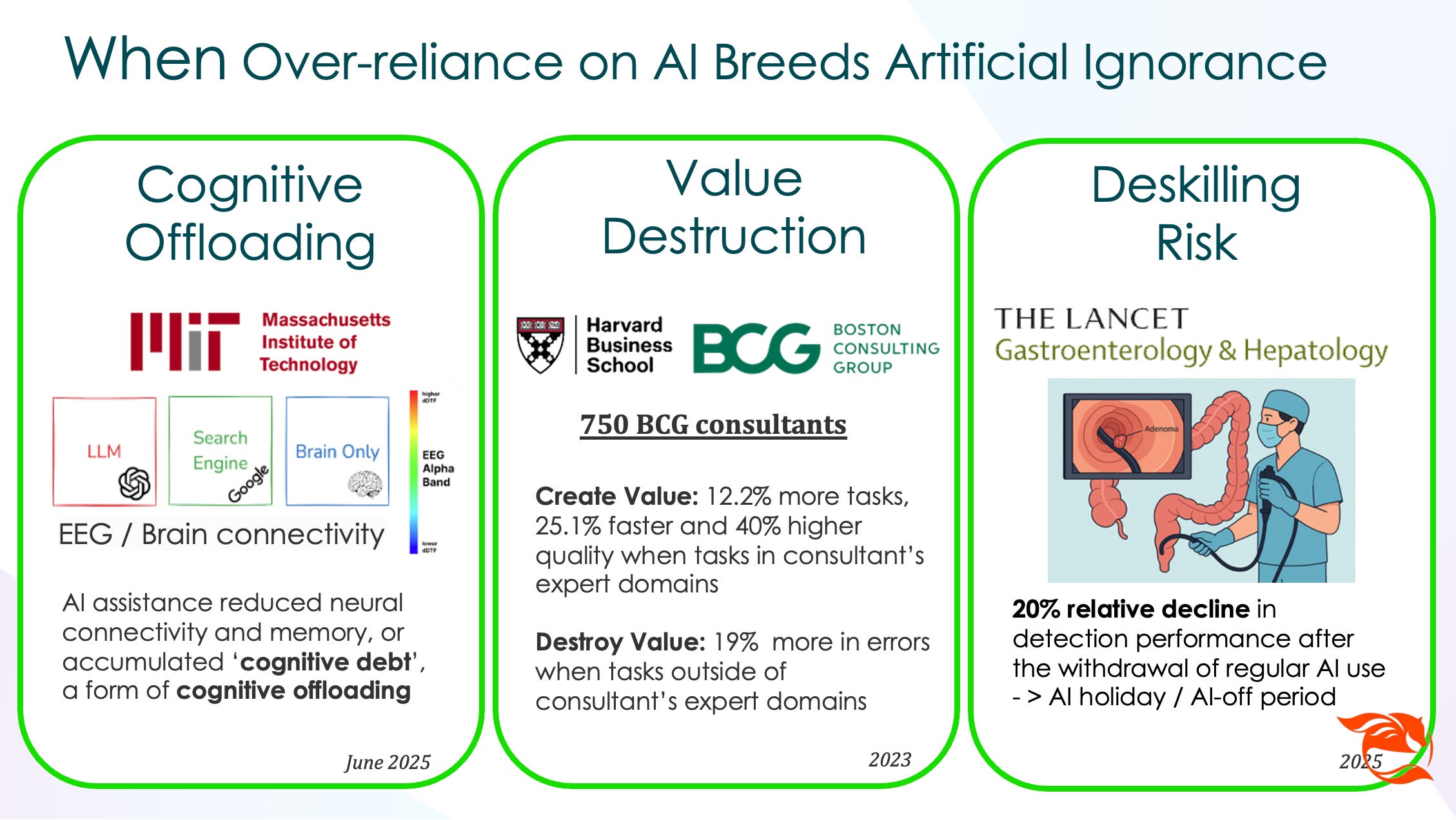
That is precisely why the question cannot simply be whether AI is useful. Of course it is useful. The more difficult question is what happens to our own thinking if convenience becomes our default setting. If Ronald decides to let AI take over in the future, he may fall into the trap of cognitive offloading, value destruction, and deskilling described in The Age of Artificial Ignorance 252627[25] [26] [27].
Wealth System Scientist Ryna Mi challenged the “AI trains our children not to think” and argued that AI creates a widening divergence in how thinking is practiced.
On one end: passive delegation, surface fluency, dependence.
On the other: active engagement, deeper synthesis, cognitive agency.
Same tools — very different developmental trajectories.
The parenting question becomes less about protecting children from AI-driven atrophy, and more about cultivating a conscious relationship to thinking itself in an age where thinking is increasingly mediated.
Ryna sees less a collapse of intelligence, and more a repricing of thinking itself with all the responsibility that implies.
7.2 Assessment Must Change
This principle also points directly to assessment. Schools will not change how they teach until they change how they assess. They cannot preserve learning while continuing to reward outputs that AI can trivially produce.
Traditional assessments such as timed exams testing recall, standardized multiple‑choice tests, and assignments that reward polished final outputs were already outdated before AI. Now that machines can produce polished essays, solve problem sets, and generate code faster than most students, the old assessment model has become actively counterproductive.
Assessment must shift toward process portfolios, oral defenses, live demonstrations, collaborative inquiry, and metacognitive reflection on how AI was used, with greater emphasis on human capacities that machines cannot easily replicate, such as ethical reasoning, interpersonal communication, and originality of judgment.
Bryan recalled an assessment from his first year as an engineering student that was set up by AI as a multiple‑choice question where all the answer choices were correct. The task was to choose the answers that were most correct and explain why.
One old truth is still worth keeping close: one of the best ways to learn is to teach. When children explain their reasoning, teach back what they learned, or critique AI output, they move from passive recipients to active knowers.
7.3 Teaching Is Learning and Playing the Game of Devil’s Advocate
Many schools have already begun asking students to discern, criticize, and evaluate AI‑generated work in class. This sharpens reasoning and judgment, especially in distinguishing truth from falsehood and demonstrating critical thinking.
Beyond students challenging the machine, AI does not have to be limited to helping us brainstorm, create, write, or summarize. It can also serve as a rigorous devil’s advocate.
Wharton Professor Ethan Mollick has shown how AI can be asked to attack a plan or a piece of work, name ways it might fail, or critique it from sharply different perspectives28 [28]. Used this way, AI shifts from affirming assistant to intellectual sparring partner and Socratic debater.
Open Hand Principles - Concept Tip 11
AI as Devil’s Advocate
AI is not just a content machine; it can be an excellent critic. Ask it to attack a plan, list failure modes, or argue the opposite side. Used this way, it becomes an intellectual sparring partner that sharpens your child’s reasoning instead of dulling it.
What we want is children who use AI the way an athlete uses training gear: as something that should leave you tired, a little proud, and just beyond yesterday’s limits. Our job as parents is not to ban the tools or to worship them, but to help our kids learn what each tool is for, when to reach for it, and when to put it away.
Professor Zhang Zheng at HKU offers a three‑part north star for education in the age of AI: First, push beyond your limits with AI: if the machine makes the assignment easy, we raise the bar and ask for deeper work. Second, think like a renaissance scholar with AI: use these systems to cross disciplines so no child mistakes one narrow lens for the whole world. Third, grow stronger without AI: keep building habits of note‑taking, slow reading and live debate [6].
7.4 What This Skill & Tool Principle Means for Parents
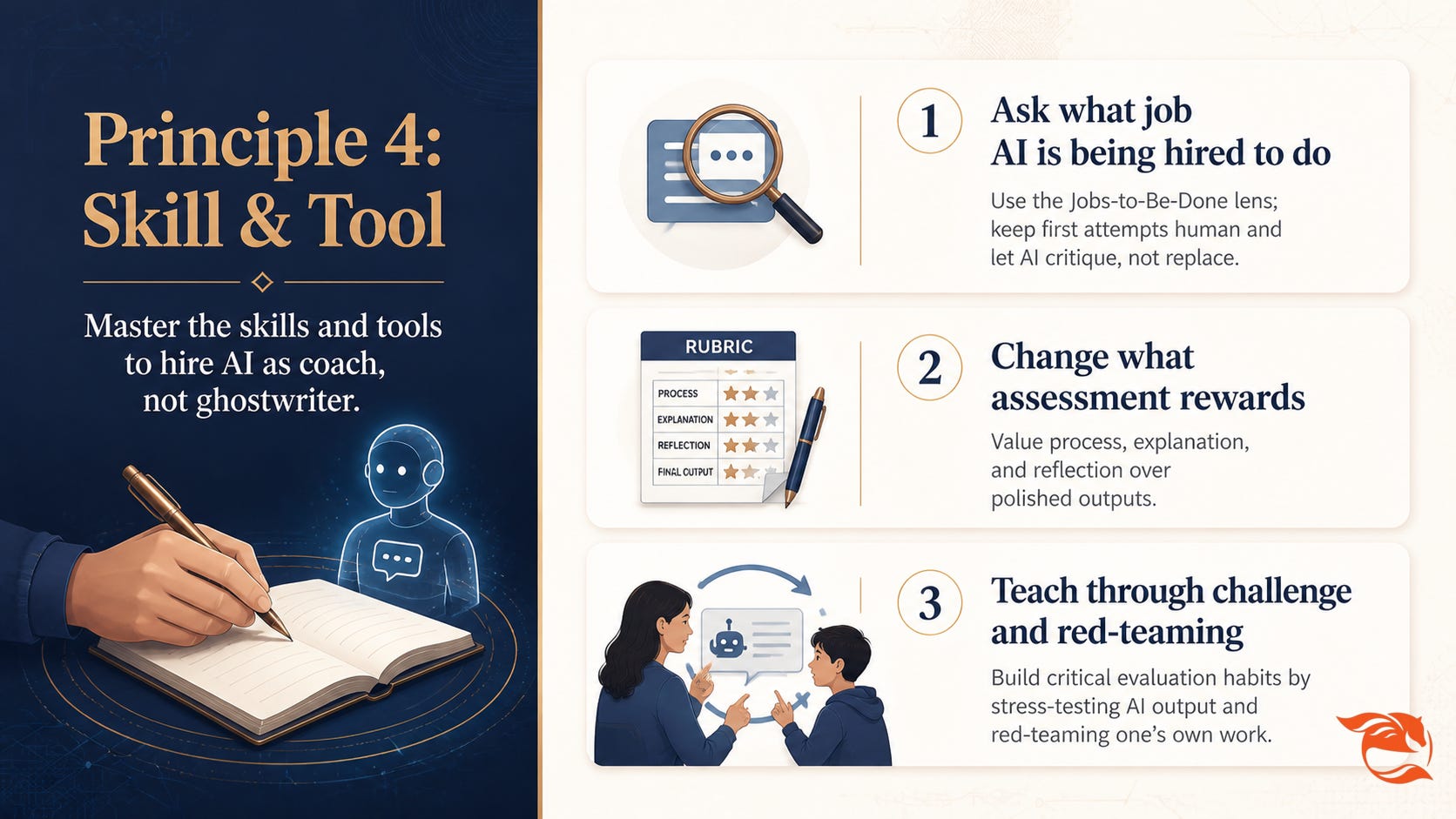
Master the skills and tools to hire AI as coach, not ghostwriter.
Use the Jobs‑to‑Be‑Done framework: ask what job your child is hiring AI to do. Use AI for augmentation only: keep first attempts human; AI critiques, never replaces.
Remember that assessment must change: value process, explanation, and reflection over polished outputs.
Treat teaching as learning and play the game of devil’s advocate: build critical evaluation habits by helping children stress‑test AI output and use AI to red‑team their own work.
8. Principle 5: Learn Together, Fail Forward (Experimentation)
8.1 Model Humility Out Loud
No family will solve this once and for all. AI is moving too fast, institutions are adapting too slowly, and children often discover new tools and temptations before the adults around them do. Parenting in the age of AI must therefore include humility, revision, and visible learning.
This is one of the few areas where parents and children start on almost equal footing. No one is an expert. Saying “I don’t know, let’s find out together” is not a loss of authority; it is a new kind of leadership. Admit when you do not know, and let your children watch you learn.
When adults are willing to narrate their own learning curve “I tried this tool and it backfired,” “I thought this was safe and it wasn’t,” “I changed my mind after I learned more, ” they quietly give children permission to do the same.
8.2 Run Small Experiments
Experimentation is where a family stops pretending to have final answers and starts building repeatable practices. It may take the form of AI holidays, first‑draft challenges, weekly conversations about what AI helped and what it weakened, shared prompting sessions, or regular reviews of which tools are worth keeping and which are gradually undermining learning.
The key is to keep experiments small, specific, and time‑bound. Try “no AI on first drafts for two weeks,” “one family AI‑free evening a week,” or “every Sunday we each share one way AI helped and one way it nearly hurt.” Then review together what worked and what did not.
When experiments are explicit, children see that rules are not arbitrary. They are movable lines drawn in pencil, subject to revision as the family learns more.
8.3 Normalize Honest Failure and Practice Reverse Mentoring
Failure is not the opposite of success in learning; it is the raw material of success. Children who never see adults fail, admit mistakes, or change course are left to imagine that real competence is effortless and error‑free.
AI can also be used constructively as a devil’s advocate. When asked to attack a plan, identify failure modes, or critique an argument from multiple angles, it becomes less of a shortcut and more of an intellectual sparring partner. Families can take turns asking AI to poke holes in their own ideas, then discuss which critiques are accurate and which are off‑base.
This is also where reverse mentoring becomes powerful. Children often discover new apps, games, and AI features before the adults around them do. Inviting them to teach what they have learned—and then jointly stress‑testing it for risks and blind spots—turns them from secret users into visible partners. Parents mentor children in judgment and ethics; children mentor parents in tools and trends.
The broader point is that the goal is not mastery of one tool. It is becoming the kind of family that can keep learning under changing conditions. Celebrate correction, revision, and recovery rather than pretending the family got it right the first time.
Open Hand Principles - Concept Tip 12
Reverse Mentoring at Home
Reverse mentoring flips the usual script: children teach parents about new tools and trends, while parents teach judgment, ethics, and boundaries. This two‑way exchange turns secret use into shared exploration, bridges generational gaps, and builds a culture where everyone is still learning.
8.4 What This Experimentation Principle Means for Parents
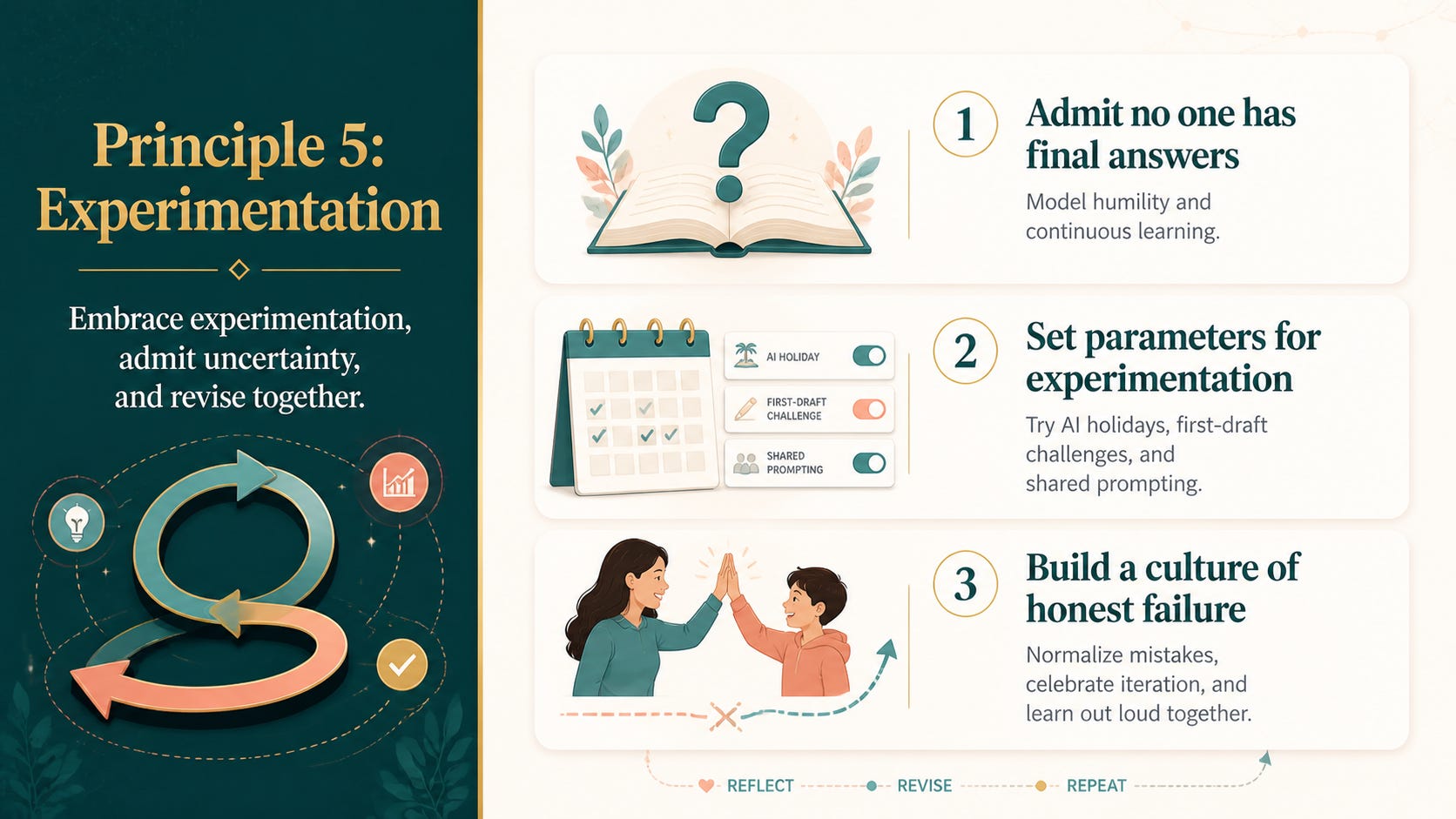
Embrace experimentation, admit uncertainty, and revise together.
Admit no one has final answers: model humility and continuous learning.
Set parameters for experimentation: try AI holidays, first‑draft challenges, and shared prompting.
Build a culture of honest failure and reverse mentoring: normalize mistakes, celebrate pivots, and learn from your children as well as from experts.
9. Diagnosing Bryan, Ray, and Marie
The Open Hand does not offer one universal parenting script. Families differ, children differ, and contexts differ. But it does offer a simpler way to diagnose what may be happening beneath the surface—and what kind of response is needed.
Bryan: Output outran understanding
Distortion: Vibe coding without foundational learning
Principles: Mindset, Environment, Skill & Tool, Experimentation
Response: Require first attempts without AI, ask for oral explanation, praise depth over fluency
Ray: Machine affirmation displaced human trust
Distortion: AI became more available than imperfect humans
Principles: Relationship, Environment, Skill & Tool, Experimentation
Response: Make use visible, restrict companion‑style AI, reinvest in one‑to‑one rituals
Marie: Machine comparison drained creative meaning
Distortion: AI’s polish made her own work feel pointless
Principles: Mindset, Relationship, Environment, Skill & Tool
Response: Protect AI‑light creative space, reframe art as expression, use AI only after handmade first attempts
Every case is unique. The value of this diagnosis is not that every child fits one neat box. It is that parents can begin asking better questions. Is the problem mainly one of fear, trust, environment, tool use, or adaptation? Most of the time, it is some combination. The Open Hand gives language for seeing that combination more clearly.
As our children race ahead on the back of the hare, the worry also goes beyond simply falling off. The deeper danger is closer to the White Rabbit in Lewis Carroll: not just going faster, but being led down a rabbit hole into a self‑contained world where AI gradually rewrites what feels normal. Bryan’s logic‑light vibe coding, Ray’s growing trust in an endlessly patient companion, and Marie’s loss of faith in her own imperfect art are three different ways of following that rabbit underground.

10. Raising a Child in the AI Age as a Golden Opportunity
The most encouraging thing about the 150 responses is not only the quality of the ideas. It is the humanity they represent. In an age of instant answers and machine fluency, people chose to think carefully, write honestly, challenge assumptions, and learn together. That may be one of the deepest educational signals of all.
We started with a question: How do I raise a child in a world where machines can think? The urgency of that question will only deepen. The generation now being born, what I have called Gen AIR (Generation AI and Robotics) in Our Parenting Playbook is Obsolete, will grow up with AI and robotics woven into education, health, transportation, entertainment, and daily life.
Quantum‑era systems, humanoid tutors, brain–computer interfaces, and other disruptions we can only partly foresee will arrive while these children are still growing up. The pace will not slow. The uncertainty will not disappear.
But principles can still prevail.
And if they do, raising a child in the AI age will not be a tragedy to endure. It may be the greatest opportunity in a century for personal growth, family growth, and institutional renewal.
10.1 The Five Open Hand Principles (Quick Reference)
Principle 1: Embrace Growth Over Performance (Mindset)
Value who your child is becoming, not what they can produce.
Shift from fear to confidence: reject the narrative that your child will be “eliminated by AI.”
Value struggle over speed: praise process, reasoning, and growth—not just polished outputs.
Prioritize skill security over job security: focus on timeless capacities over chasing “safe” majors.
Principle 2: Fight the Algorithm, Not the Child (Relationship)
Build relationships of trust that compete with AI’s engineered patience.
Build trust through visibility: make AI use discussable without shame.
Recognize engineered dependency: systems are designed to capture attention and create reliance.
Protect human connection: prioritize family relationships over algorithmic affirmation.
Principle 3: Design Environments, Not Willpower Battles (Environment)
Shape environments where wise choices become easier than convenient ones.
Design defaults, not willpower battles: structure spaces so AI supports rather than replaces thinking.
Protect cognitive struggle: create rituals where first attempts stay human.
Make the invisible visible: encourage open discussion and establish AI‑free zones.
Principle 4: Keep First Attempts Human (Skill & Tool)
Master the skills and tools to hire AI as coach, not ghostwriter.
Use the Jobs‑to‑Be‑Done framework: ask what job your child is hiring AI to do.
Hire AI for augmentation only: keep first attempts human; AI critiques, never replaces.
Build critical evaluation habits: teach children to stress‑test AI output and use AI to red‑team their work.
Principle 5: Learn Together, Fail Forward (Experimentation)
Embrace experimentation, admit uncertainty, and revise together.
Admit no one has final answers: model humility and continuous learning.
Set parameters for experimentation: try AI holidays, first‑draft challenges, and shared prompting.
Build a culture of honest failure and reverse mentoring: normalize mistakes, celebrate pivots, and learn from your children.
We know AI can help learning. With the right guardrails and principles, raising a child in the AI age can become one of the greatest opportunities we have—for our children’s growth, for our families’ growth, and for the renewal of education itself.
10.2 From Home to School: Extending the Open Hand
There are other equally important dimensions of guidance beyond the home, especially in how families work with schools and teachers. An effective partnership between home and school can multiply everything in this framework.
The misattributed Mark Twain line—“I never let schooling interfere with my education”—points to the next frontier. Will schools see the AI age as a golden opportunity to rewire education and support learning, or as one more threat to be managed?
The practical questions are:
Do schools have clear and transparent policies and red lines for AI use?
Is there institutional infrastructure (Institutions, Foundations and Government) to evaluate, select, and continually review AI tools? Shall teachers be accountable for the mistakes of the AI tools?
How do we support teachers by first alleviating their administrative workload so that they can see the benefits of AI before embracing AI for teaching?
How will we upskill and reskill teachers so they can embody the Open Hand and work with families as partners, not as separate systems?
How do we widen the education pipeline beyond narrow standardization to encourage creativity and personal adaptive learning for each student?
These are not questions one article can settle. They are questions for a long‑term alliance between parents, schools, and systems. The Open Hand is meant to give that alliance a shared language and a place to start.
10.3 Holding the Open Hand Steady and Conversation Continues…
Hold up your palm again. The Open Hand is not a theory to admire from a distance. It is something to practice: in how parents talk, what homes normalize, what schools assess, what tools children are allowed to use, and what kind of human beings adults are still trying to raise.
Somewhere right now, another Bryan is learning to code without understanding. Another Ray is withdrawing into algorithmic affirmation. Another Marie is comparing her hand‑drawn work to machine perfection and losing courage. The tools will become more fluent. The temptations will intensify.
But if we hold the Open Hand steady (if we keep mindset clear, relationships human, environments intentional, tools wisely governed, and experimentation honest), we can do more than survive the AI age. We can help our children ride the hare without falling off and become more fully human in the process.
P.S. If you are navigating this with your own Bryan, Ray, or Marie, I would love to hear your story. Reply to this email or leave a comment below. What is working? What is not? Where are you stuck?
Acknowledgement:
This framework was born from more than 150 generous responses from parents, educators, and leaders who were willing to think out loud, share their worries, and test new ideas together. I am deeply grateful for the honesty, courage, and hope they brought to this conversation. And I strongly sense that we are learning how to raise children in the age of AI side by side, not alone.
With special thanks to:
Agnes Chiu, Agnes Mak, Agnes Tai, Alan Chow, Alfred Ng, Alfred Tan, Alice Lam, Alison Lam, Allen Ma, Alvaro Garrido, Alvin Kwock, Alvin Young, Amika Au, Anderson Shum, Andrew Chan, Andrew Fattorini, Andrew Work, Andrew Yip, Anjalika Singh, Anna Xun, Anna Yip, Anthony Chang, Anthony Cheung, Anthony Tong, Arthur Shek, Ben Yam, Bernard Suen, Bess Ho, Brian Stevenson, Brian Tang, Bryan Chiu, Candy Hui, Cecilia Chan, Charles Wu, Charleston Sin, Chote Sophonpanich, Chris Yip, Christoffer Tang, Claudia Sin, Daniel Fong, Dave Woolner, David Ren, David Zhu, Davie Mok, Dennis Hau, Derrick Pang, Dominic Chan, Donald Mak, Anina Ho, Eddie Chou, Edith Mok, Edith Yeung, Edwin Hui, Erwin Huang, Eugene Chan, Falcon Chan, Farzad Sabetzadeh, Graham Chan, Grantham Pang, Hanson Huang, Harris Sun, Hilton Law, Horace So, Ian Huang, Isaac Vun, James Lau, Jason Woodward, Jay Siegel, Jeff Ho, Jeffrey Chan, Jennifer Tsang, Jennifer Tsui, Jimmy Tao, Joseph Fung, Karena Belin, Keith Yu, Kenneth Chan, Kenneth Leong, Lap Man, Lawrence Cheung, Lawrence Shum, Lee Wai Yee, Leo Yuen, Leonard Tan, Lewis Chan, Lewis Liao, Louisa Liu, Man Chi Leung, Maneesh Mehta, Manoj Dani, Marcus Woo, Margaret Chan, Mariana Lam, Marina Yu, Martha Dowejko, Mary Cheung, Mary Wells, Michael Leung, Michael Yong-Haron, Miranda Chan, MiV Ilnur, Monica Lee Hughson, Moses Cheng, Mumtaz Ahmed, Noel Chu, Patrick Lau, Patty Lee, Peter Wong, Peter Yan, Philippe Decottignies, Poman Lo, Rabby Chan, Rachel Chan, Rebecca Yung, Rene Chu, Renee Boey, Rex AuYeung, Richard Yeung, Robert Lazenko, Robin Hu, Rocky Cheng, Ronald Paul Ng, Ronald Wong, Ruby Yong, Ryna Mi, Samson Fan, Sean McMinn, Sheila Tiwan, Simon Law, Sr Margaret, Srinivas Rao, Stanley Poon, Stephen Ko, Steve Chen, Sydney Lam, Victor Lam, Victor Wat, Vincent Favrat, William Yeung, Windham Wong, Yvonne So, Zhang Zheng
Aesop, “The Hare and the Tortoise,” in Aesop’s Fables, Lit2Go Edition. Univ. of South Florida, 1867. Accessed: May 30, 2026. [Online]. Available: https://etc.usf.edu/lit2go/35/aesops-fables/612/the-hare-and-the-tortoise.
M. Davison, “I have never let schooling interfere with my education,” Center for Mark Twain Studies, Elmira College, May 8, 2025. Accessed: May 30, 2026. [Online]. Available: https://marktwainstudies.com/the-apocryphal-twain-i-have-never-let-schooling-interfere-with-my-education.
Note: the source above explained that the quip appears in print under Grant Allen’s name in the 1890s and only later gets attributed to Twain. Grant Allen is a Canadian-born British polymath, novelist, and science writer and his sentiment was originally published in his 1894 essay The Journal of Education.
Leo XIV, Magnifica humanitas. Vatican City: Libreria Editrice Vaticana, May 15, 2026. Encyclical Letter on safeguarding the human person in the time of artificial intelligence. Accessed: May 30, 2026. [Online]. Available: https://www.vatican.va/content/leo-xiv/en/encyclicals/documents/20260515-magnifica-humanitas.html.
Liu, X., Guo, B., He, W., & Hu, X. (2025). Effects of Generative Artificial Intelligence on K–12 and Higher Education Students’ Learning Outcomes: A Meta‑Analysis. Computers & Education (or similar educational technology journal; currently published via SAGE).
Létourneau, A., Deslandes Martineau, M., Charland, P., Karran, J. A., Boasen, J., & Léger, P. M. (2025). A systematic review of AI‑driven intelligent tutoring systems (ITS) in K–12 education. npj Science of Learning, 10(1), 29. https://doi.org/10.1038/s41539‑025‑00320‑7.
Z. Zhang, “Education in the era of AI: Think like a Renaissance scholar,” LinkedIn, Jan. 3, 2026. [Online]. Available: https://www.linkedin.com/posts/zheng-zhang-54412516_the-education-pipeline-is-80-years-old-it-activity-7413096289430831104-cVzD. [Accessed: 1 Jun. 2026]
D. Epstein, Range: Why Generalists Triumph in a Specialized World. New York, NY, USA: Riverhead Books, 2019.
D. Gelles, “The villain of this year’s commencement speeches: A.I.,” The New York Times, New York, NY, USA, May 18, 2026. [Online]. Available: https://www.nytimes.com/2026/05/18/business/dealbook/university-commencement-speech-ai.html
“Cheers, jeers and laughs: The speeches about AI that defined the class of 2026,” Yahoo News, May 31, 2026. [Online]. Available: https://www.yahoo.com/news/us/articles/cheers-jeers-laughs-speeches-ai-090102862.html
“Advice for 2026 commencement speakers: Don’t bring up AI,” NPR, May 20, 2026. [Online]. Available: https://www.npr.org/2026/05/20/nx-s1-5822419/ai-colleges-commencement-booing
“Guiding Gen Z through the age of AI,” Walton Family Foundation, Apr. 8, 2026. [Online]. Available: https://nextgeninsights.waltonfamilyfoundation.org/resources/guiding-gen-z-through-the-age-of-ai
Note: all names are pseudonyms to provide children’s privacy.
C. Mims, “The AI superstars who say a ‘vibe slop’ crisis is coming,” The Wall Street Journal, May 22, 2026. [Online]. Available: https://www.wsj.com/tech/ai/vibe-coding-slop-ai-tools-e6a99394
N. Vasan, “Why AI companions and young people can make for a dangerous mix,” Stanford Medicine News Center, Stanford University, Aug. 26, 2025. Accessed: May 30, 2026. [Online]. Available: https://news.stanford.edu/stories/2025/08/ai-companions-chatbots-teens-young-people-risks-dangers-study.
M. F. Schemmer, A. D. Williams, and S. Nyholm, “Emotional risks of AI companions demand attention,” Nature Machine Intelligence, vol. 7, no. 7, pp. 601–603, Jul. 2025, doi: 10.1038/s42256-025-01093-9.
Common Sense Media, “Report warns against AI companion apps for minors,” Common Sense Media / CBC reprint, Apr. 29, 2025. Accessed: May 30, 2026. [Online]. Available: https://www.cbc.bb/news/international-news/report-warns-against-ai-companion-apps-for-minors.
R. Østergård, J. D. Møller, M. B. Højlund, and L. V. Kessing, “AI chatbots and severe mental illness: A retrospective study of potential negative consequences in psychiatric patients,” Acta Psychiatrica Scandinavica, vol. 153, no. 3, pp. 234–246, Mar. 2026, doi: 10.1111/acps.13789.
C. S. Dweck, Mindset: The New Psychology of Success. New York, NY, USA: Random House, 2006.

World Economic Forum, “Invest in the workforce for the AI age: A blueprint for scale, skills and responsible growth,” Jan. 2026. [Online]. Available: https://www.weforum.org/stories/2026/01/ai-roadmap-transforming
J. Blanchette, “12 tips to shape your surroundings, and your life, from Bates Commencement speaker Angela Duckworth,” Bates College News, May 29, 2025. Accessed: May 30, 2026. [Online]. Available: https://www.bates.edu/news/2025/05/30/12-tips-to-shape-your-surroundings-and-your-life-from-bates-commencement-speaker-angela-duckworth.
Note: A. Duckworth, “Commencement Address, Bates College, 25 May 2025,” Lewiston, ME, USA. Accessed: May 30, 2026. [Online]. Available:
J. Clear, “Motivation is overvalued. Environment often matters more,” JamesClear.com, Jul. 6, 2016. Accessed: May 30, 2026. [Online]. Available: https://jamesclear.com/power-of-environment.
B. Hardy, Willpower Doesn’t Work: Discover the Hidden Keys to Success. New York, NY, USA: Hachette Books, 2018.
C. M. Christensen, T. Hall, K. Dillon, and D. S. Duncan, “Know your customers’ ‘jobs to be done’,” Harvard Business Review, vol. 90, no. 9, pp. 54–62, Sept. 2016.
Note: The book where Christensen applies the Jobs To Be Done theory to careers, relationships, and life choices, not just products: C. M. Christensen, J. Allworth, and K. Dillon, How Will You Measure Your Life? New York, NY, USA: HarperBusiness, 2012.
N. Kosmyna et al., “Your Brain on ChatGPT: Accumulation of cognitive debt when using an AI assistant for an essay writing task,” MIT Media Lab, working paper, 2025. Available: https://arxiv.org/abs/2506.08872.
K. R. Lakhani et al., “Navigating the jagged technological frontier: Field experimental evidence of the effects of AI on knowledge worker productivity,” Harvard Business School and Boston Consulting Group, working paper, 2023.
M. Regula et al., “Endoscopist deskilling risk after exposure to artificial intelligence in colonoscopy: a multicentre, observational study,” Lancet Gastroenterology & Hepatology, vol. 10, no. 12, p. 1060, Dec. 2025, doi: 10.1016/S2468‑1253(25)00290‑0.
E. Mollick, Co‑Intelligence: Living and Working with AI. New York, NY, USA: Portfolio/Penguin, 2024.
Bravo! Well written article. Thanks for sharing! I especially like your points on prioritising skill safety vs job safety, reverse mentoring, and no AI first drafts to protect creativity and learning. Will certainly put that into practice.
I got questions from other parents on what jobs will not be replaced by AI all the time. As for students, unfortunately while there’s a camp that outsources their homework to AI, there’s also another camp that despises work generated from AI. Neither is the right way to treat AI. I think the key is that we should not treat AI as our competitor nor our substitute, but instead we should embrace it and treat it as our secretary or helper. This way, we still control how we learn, what we learn, but do it much more efficiently with AI.
Personally I use AI for learning everyday, from researching on industries and companies for my stock investments, to asking AI to critique whether my Korean articles are natural, to asking AI to generate quizzes to test me. AI can make learning fun and easy indeed.
That's really interesting. Bryan's idea is pretty similar to what I've been saying: that we instantly expected everyone to be an Olympic coach, but without the thousands of hours of experience needed to win a gold medal.
I think maybe we should reimage education based on the classical trivium and quadrivium, which were taught for over two thousand years from ancient Greek to golden Arabic, and then in the medieval Latin world.
Trivium: logic, grammar, rhetoric
Quadrivium: geometry, arithmetic, music, cosmology.
In general, indeed, we all need more principles on logic, design, and system thinking.